
Our Location
304 North Cardinal St.
Dorchester Center, MA 02124

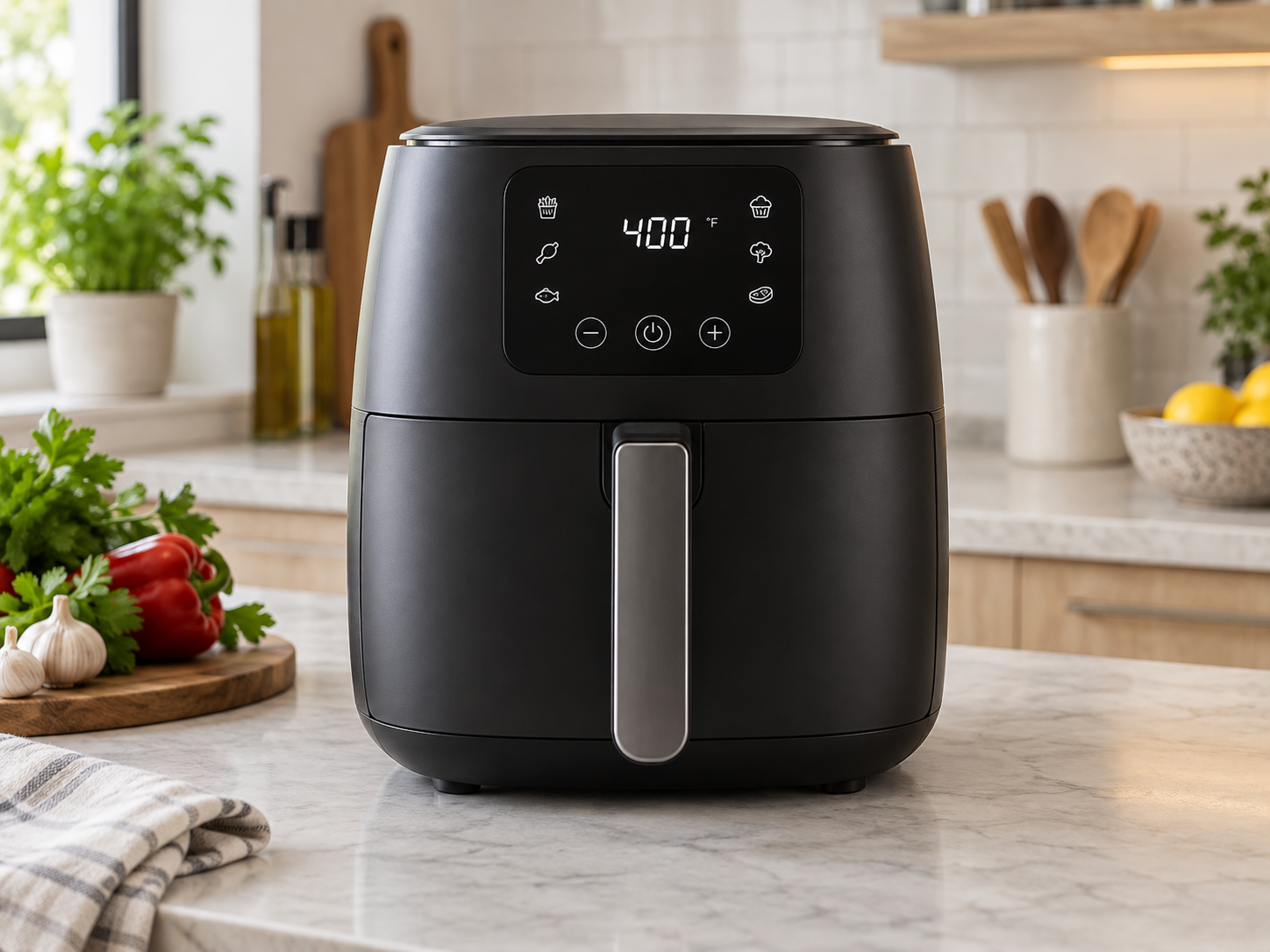
Defining what is an air fryer begins with the appliance category: a countertop convection oven that circulates heated air around food inside a compact cooking chamber. Air moving at high speed strips the insulating vapor layer off wet food surfaces, which lets the exterior brown and crisp without any submersion in hot oil.
A heating element mounted above the cooking chamber supplies the heat, and a fan directly beneath it pushes that heated air down across the food and back upward. Chamber volume typically runs from 2 to 26 quarts, and wattage runs from 800 to 1,800 watts on the countertop models a standard kitchen outlet supports.
Three chamber formats cover most of the category, and basket, oven-style, and dual-basket air fryers differ in loading direction, rack count, and usable floor area. Cooking temperatures reach 400 degrees Fahrenheit on most models, and typical cycles run 12 to 20 minutes against the 25 to 40 minutes a full-size oven needs.
This article defines the air fryer, explains how its heating element and fan work, compares it with convection ovens and deep fryers, then covers types, capacity, wattage, temperature, foods, oil use, placement, limitations, identification, and the selection rules a household applies.
An air fryer is a countertop convection appliance that circulates heated air around food at high speed, browning and crisping the exterior without a bath of hot oil. The appliance pairs a heating element with a high-speed fan inside a chamber small enough that the circulating air completes a full circuit in under one second.
Size places it between a toaster oven and a full-size oven, and most basket models occupy about 11 by 13 inches of counter space at 2 to 8 quarts. Recognizing the appliance as a compact convection oven instead of a deep fryer explains its practical limits, and air frying removes the oil bath deep frying always requires.
An air fryer browns and crisps food surfaces by forcing heated air across them fast enough to drive off surface moisture before the interior of the food overcooks. Moisture removal happens first, and the fan strips the thin vapor layer that forms above wet food, which lets surface temperature climb past the browning threshold.
Reheating forms the second common use, and dry circulating air restores crispness to leftover fried food, while a microwave leaves it soft and unevenly warmed throughout the portion. Treating the appliance as a browning and reheating tool rather than a general-purpose oven prevents disappointment with wet batters, loose doughs, and the dishes that hold standing liquid inside them.
An air fryer works by heating air with an exposed element and driving it through a perforated basket with a fan, forcing convection across every food surface. Three components carry the process, and the element supplies the heat, the fan supplies the velocity, and the chamber shape decides how that moving air reaches the food.
Cycle temperature typically holds between 350 and 400 degrees Fahrenheit, and the fan generally runs continuously from the first second of a cycle until the timer reaches zero. Understanding these three components explains why capacity and wattage vary so widely across the whole category, and the heating element sets the practical ceiling on both of those figures.
The heating element in an air fryer supplies all the thermal energy, and it sits directly above the basket as an exposed coil or a sheathed metal rod. It draws 800 to 1,800 watts on countertop models, which converts almost the entire electrical draw into radiant and conducted heat inside the small cooking chamber.
Element position explains the browning pattern, and top mounting sends radiant heat straight downward, so upward-facing surfaces brown well before the underside of the food begins to color. Loading food in a single layer exposes every piece to that radiant path, and the fan mounted directly beneath the element then distributes the heat the element produces across them.
The fan in an air fryer moves heated air past the food fast enough to strip the boundary layer of cooler vapor clinging to every wet food surface. It sits between the element and the basket, and it typically turns near 2,000 revolutions per minute, fast enough to make fan noise clearly audible in a quiet kitchen.
Air speed matters more than air temperature, and a slow fan at 400 degrees browns food less than a fast fan at 375 degrees over the same cooking time. Leaving the rear vent clear preserves that air speed, and the basket shape then decides where the moving air actually reaches the food that it surrounds inside the chamber.
Basket shape affects air fryer airflow by setting the distance between the element and the food and the area available for air to pass around each piece. A square basket presents roughly 8 by 8 inches of floor, which holds about 2 pounds of food in the single layer that even browning requires.
Round baskets lose their usable corners, and a round floor of the same nominal quart rating can hold a smaller single layer than a square floor of equal depth. Measuring the basket floor rather than reading the quart rating indicates real capacity, and that same distinction separates a full-size convection oven from a countertop air fryer.
An air fryer differs from a convection oven in chamber volume and fan speed, and both appliances cook by moving heated air across the exposed surfaces of food. Chamber volume separates them most clearly, and a 6-quart air fryer encloses roughly 1.5 gallons against the 150 quarts a standard 30-inch oven cavity holds inside it.
Smaller volume produces faster recovery, so an air fryer returns to temperature within seconds of the drawer closing, while a full oven cavity takes several more minutes. Using the air fryer for one tray and the full-size oven for batch cooking covers both cases, though deep frying differs from both of them along a separate axis.
An air fryer differs from a deep fryer in the heat transfer medium, and hot air replaces the oil bath that submerges food in a conventional deep fryer. Oil volume marks the practical gap, and a deep fryer holds 2 to 4 quarts of oil, while an air fryer needs only 1 to 2 teaspoons on the food.
Texture differs as a result, and oil conducts heat into every surface at once, which produces the uniform crust no circulating air can fully reproduce on its own. Choosing air frying accepts a slightly drier crust instead of an oil-saturated one, and the chamber formats available divide this category into four recognizable types.
Types of air fryers divide into four chamber formats, and basket, oven-style, dual-basket, and multi-cooker designs differ in loading direction, rack count, and heated zone count. Capacity separates them predictably, and basket models hold 2 to 8 quarts, while oven-style cavities reach 26 quarts and dual-basket models sit between those two capacity bands.
Zone count splits the group again, because dual-basket models carry two independent elements and fans, while the other three formats heat one chamber at a single setting. Matching format to the food a household cooks most prevents unused capacity, and the basket air fryer anchors this group as the format most kitchens buy first of all.
A basket air fryer holds food in one pull-out drawer beneath a top-mounted element and fan, forming the most compact format in the category by a wide margin. It typically holds 2 to 8 quarts, and its footprint stays near 11 by 13 inches on most single-drawer models built for a household kitchen counter.
Heat concentrates on upward-facing surfaces, so single-layer loading and one shake at the midpoint of a cycle together produce the most even browning this format can reach. Confirming the drawer clears the upper cabinet prevents the conflict an oven-style air fryer avoids by swinging its own door forward on a side-mounted hinge instead.
An oven-style air fryer cooks on two or three wire racks inside a cavity closed by a hinged glass door, occupying the counter space a microwave claims. It typically holds 10 to 26 quarts, three to five times a basket model, which lets a whole chicken or a full tray of vegetables lie completely flat.
Rack position changes results within one cycle, and trays nearest the element brown faster, so rotating them partway through a long cycle becomes a part of normal use. Planning rack rotation into the cooking time prevents the uneven browning this format produces, and a dual-basket air fryer solves the problem one cavity cannot, using two separate chambers.
A dual-basket air fryer contains two drawers, and each drawer carries its own element, fan, and control, so two foods cook at different temperatures at the same time. Combined capacity typically reaches 8 to 11 quarts, split into two drawers of 4 to 5.5 quarts, a division that standardized across the dual-zone category.
Synchronized finishing separates the format from two separate appliances, since the control staggers both start times and lets a longer food and a shorter food complete together. Confirming counter width reaches 18 inches before purchase prevents a fit problem, and a multi-cooker air fryer trades that same width for a second cooking method instead.
A multi-cooker air fryer combines air frying with pressure cooking in one housing, and most models pair a sealed pressure base with a separate crisping lid above it. It typically holds 6 to 8 quarts and draws about 1,500 watts on the crisping element against roughly 1,000 watts on the pressure element beneath the pot.
Lid swapping defines the workflow, and the pressure lid and the crisping lid cannot operate at the same time, which adds a handling step between the two stages. Counting the cooking methods a household actually uses prevents paying for idle capability, and capacity across all four of these formats deserves closer examination than quart ratings suggest.
Air fryer capacity runs from 2 quarts on the smallest basket models to 26 quarts inside the largest oven-style cavity sold for a household kitchen counter. Usable volume falls well below every stated figure, and single-layer loading fills roughly the lower third of a chamber, so a 6-quart rating can hold only about 2 quarts of food in one layer.
Serving counts follow from that usable third, and a 4-quart chamber feeds two people, while 6 quarts feeds three or four and 8 quarts feeds about five. Comparing basket floor dimensions rather than quart ratings prevents the most common capacity mismatch, and household size then decides which of those bands a kitchen actually needs.
A four-person household needs 5 to 6 quarts in a basket air fryer, which holds roughly 2 pounds of food in the single layer even browning requires. Portion math drives that figure, and four servings of fries or four chicken thighs occupy about 2 pounds, which fills a standard square basket floor completely.
Batch cooking changes the answer, and households cooking for five or more generally move to 8 quarts or to a dual-basket model splitting the same load in two. Buying one size above the current household size prevents repeat batches, and available counter space limits how far this reasoning can extend inside a working kitchen.
An air fryer needs its own footprint plus clearance on every side, and a 6-quart basket model occupies roughly 11 by 13 inches of open counter surface. Clearance adds to that footprint, and manufacturers typically specify about 5 inches of open space behind and above the appliance for the heated exhaust it expels.
Cabinet height limits the choice further, so 18 inches of space between counter and cabinet rules out most oven-style cavities before capacity enters the comparison at all. Measuring the height and depth available before purchase prevents venting heat into cabinet undersides, and wattage then decides whether the chosen kitchen outlet can carry the appliance safely.
An air fryer uses 800 to 1,800 watts on countertop models, and most mid-size basket units draw between 1,500 and 1,700 watts during a normal cooking cycle. Current follows directly from that draw, and 1,700 watts at 120 volts equals about 14.2 amps against the 15-amp rating most kitchen appliance circuits carry.
Consumption stays modest despite the draw, since a 20-minute cycle at 1,500 watts consumes 0.5 kilowatt-hours against the 2 kilowatt-hours a full-size oven uses every hour. Plugging the appliance into an outlet shared with a toaster trips the breaker, and the temperature setting then determines how long that draw continues on each cooking cycle.
Air fryer temperature ranges from 175 to 400 degrees Fahrenheit on most models, and cooking times run 12 to 20 minutes for the common single-layer foods. Conversion from oven recipes follows a fixed rule, and reducing the oven temperature by 25 degrees and the time by 20 percent typically produces equivalent results.
Preheating shortens the first cycle, and 3 minutes at the target temperature brings the chamber and the basket to full heat before any food enters the drawer. Checking food at 70 percent of the converted time prevents overcooking, and small chambers recover heat far faster than the full-size ovens those recipes quietly assume.
An air fryer can cook any food that browns on a dry surface, and frozen fries, wings, breaded cutlets, and cubed vegetables suit the chamber best. Reheating extends that list, and leftover pizza, fried chicken, and pastries regain crispness within 3 to 5 minutes at 350 degrees Fahrenheit in a basket chamber.
Wet batters and loose doughs fail in the chamber, because the airflow strips the liquid coating off the surface before heat can set it into a continuous crust. Confirming a food holds a dry surface before cooking prevents most of these failures, and oil use follows directly from that same surface-moisture principle in every case.
An air fryer needs 1 to 2 teaspoons of oil for most foods, and the oil promotes browning rather than carrying heat into the food itself. Oil raises surface temperature by improving contact between the hot air and the food, which produces the color and crust that dry air alone reaches more slowly.
Frozen foods generally need no added oil, since manufacturers apply oil before freezing and that coating melts onto the surface during the first few minutes of the cycle. Spraying oil directly onto the basket rather than the food strips the nonstick coating over time, and placement inside the kitchen affects the appliance in several similar ways.
An air fryer should sit on an open counter with 5 inches of clearance behind and above it, well away from cabinet undersides and wall-mounted upper shelves. Exhaust temperature drives that requirement, and the rear vent expels air near 200 degrees Fahrenheit, hot enough to discolor a painted cabinet finish over repeated cycles.
Outlet position matters as much as clearance, since a 1,700-watt appliance requires a circuit that carries no toaster, kettle, or microwave running on the same run. Placing the appliance beside the range hood uses existing ventilation, though placement alone cannot remove the limitations every air fryer format carries into a kitchen.
Air fryer limitations concentrate in three areas: capacity restricting batch size, moisture loss affecting lean foods, and the fan noise continuing through every minute of a cycle. Capacity limits results most often, and a 6-quart chamber holds one layer of about 2 pounds, which forces repeat batch cooking for any household above four people.
Noise measures 60 to 65 decibels on most models, comparable to a running dishwasher, and it continues without any pause at all because the fan never cycles off. Accepting batch cooking and constant fan noise prevents disappointment after purchase, and moisture loss in lean foods deserves separate treatment from those other two limits entirely.
An air fryer dries out lean foods, and continuous airflow removes surface moisture faster than fat can migrate outward to replace it during a standard cooking cycle. Fat content predicts the outcome, and chicken breast, white fish, and lean pork lose moisture visibly, while thighs, wings, and salmon retain it under the same settings.
Cycle length compounds the effect, while every additional minute past the internal target temperature removes more water from the outer layers of any lean cut. Shortening the cycle and adding a thin oil coating prevent most of that loss, and smoke from rendered fat produces the opposite complaint in much fattier foods.
An air fryer smokes when rendered fat collects in the drawer beneath the basket and reaches its smoke point under direct radiant heat from the element above. Most cooking fats begin smoking between 350 and 450 degrees Fahrenheit, a band that overlaps the 400-degree maximum basket units reach during high-temperature cycles.
Residue from earlier cycles usually produces the same result, because carbonized deposits left on the element burn off before fresh fat reaches its own smoke point. Adding 2 tablespoons of water to the drip drawer keeps collected fat below its smoke point, and identifying the format a kitchen already owns starts with three simple checks.
Three checks identify an air fryer type without documentation: the opening mechanism, the rating label on the base, and the measured volume of the cooking basket. Opening mechanism separates the basket, oven-style, and multi-cooker formats, while the rating label supplies wattage and model number, and direct measurement confirms the true capacity.
Manuals disappear more often than appliances fail, which makes these three checks the practical substitute for units bought secondhand or received without their original packaging. Running all three checks takes under 5 minutes and starts with the opening mechanism, the only attribute a household can read without moving the appliance at all.
To check the opening mechanism, pull the front of the appliance and note whether the cooking space slides out as a drawer or swings open on a hinged door. A single drawer indicates a basket format, two drawers indicate a dual-basket format, and a hinged glass door above wire racks indicates the larger oven-style cavity.
A locking lid rather than a drawer or door indicates a multi-cooker, and the pressure seal around its rim distinguishes that format from every other one on the counter. Recording the opening style narrows the appliance to one of four formats, and the rating label on the base can then supply wattage and the exact model number.
To read the rating label, tilt the appliance forward and locate the printed or etched plate on the base listing voltage, wattage, model number, and production date. Wattage on the plate indicates capacity indirectly, and a figure near 1,000 watts points to a small chamber, while 1,700 watts points to a 6-quart basket.
Model numbers differ from the marketing names printed on the box, which makes the plate number the only string matching replacement baskets, racks, and crisper plates. Photographing the plate before the print wears off preserves that reference, and measuring the basket then confirms the capacity a wattage figure can only imply.
To measure basket capacity, fill the removed basket with water one quart at a time and count the quarts required to reach the top of the usable space. Stated ratings describe total enclosed volume, and the figure a measurement returns typically falls 10 to 20 percent below the number printed on the original packaging box.
Usable capacity sits lower still, and single-layer loading fills only the bottom third, so a measured 6-quart basket holds about 2 quarts of food in practice. Recording the measured figure rather than the printed rating gives an accurate baseline, and these three results together support a clear and specific selection decision between formats.
Choosing an air fryer starts with counter space, then capacity, then wattage, in that order, since a chamber that cannot fit the counter fails regardless of capacity. Counter depth eliminates formats first, while a depth under 14 inches rules out oven-style cavities and most dual-basket models before capacity enters the comparison at all.
Capacity follows from household size, and 4 quarts suits two people, while 6 quarts covers four and 8 quarts or a dual-basket model covers much larger households. Confirming basket floor dimensions against the largest item a household cooks regularly prevents the most common mismatch, which quart ratings alone consistently fail to expose anywhere.
