
Our Location
304 North Cardinal St.
Dorchester Center, MA 02124

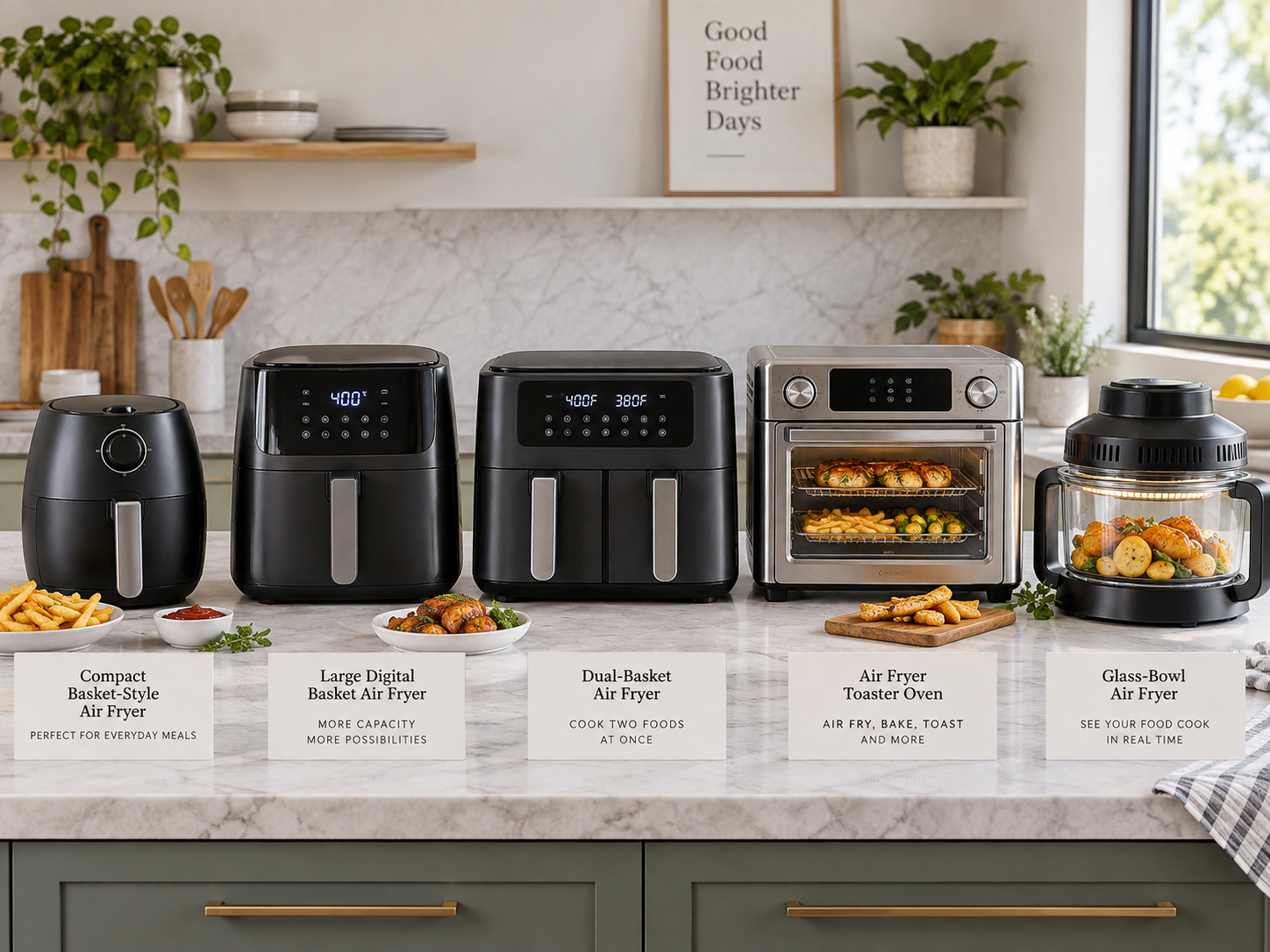
Every type of air fryers sold for household kitchens falls into ten designs, separated by the chamber that holds the food and the cooking function added to that chamber. Chamber and function together decide capacity, footprint, and food movement, which makes these two attributes the practical basis for sorting the category into groups.
Chamber-based designs cover the basket, oven-style, dual-basket, stacked dual-basket, and glass-container air fryers, and each one presents a different floor area to the air the fan circulates. Function-based designs cover the paddle, combo, lid, microwave, and built-in air fryers, where a stirring arm, a pressure base, or an oven cavity replaces the countertop chamber.
Capacity across the ten designs runs from 2 quarts in the smallest basket model to 26 quarts in the largest oven-style cavity a household counter holds. Wattage tracks that spread, since it moves from 800 watts on compact models to 2,000 watts on the largest chambers a standard kitchen outlet supports.
This article groups the types of air fryers by chamber and by added function, then covers capacity, wattage, kitchen placement, food suitability, type limitations, identification of an existing model, and the selection rules that separate one purchase from another.
Types of air fryers divide into ten recognized designs, grouped by the chamber that encloses the food in one set and by the cooking function added in another. Chamber-based types include the basket, oven-style, dual-basket, stacked dual-basket, and glass-container designs, and each one covers a distinct band of capacity, footprint, and loading height.
Function-based types include the paddle, combo, lid, microwave, and built-in designs, which attach air frying to a mechanism the chamber-based group leaves out of its housing. Identifying the type before comparing models narrows the field faster than comparing brands, since type decides how food cooks more than any single specification printed on its box can.
Air fryer type changes how food cooks, and chamber geometry, food movement, and rack count together decide how much surface each piece presents to the circulating air. A basket concentrates a short vertical airflow path onto one layer, while an oven cavity spreads a longer path across three separate racks, and those racks brown at unequal rates.
Stirring changes the pattern again, and a paddle turns loose pieces continuously, which removes the mid-cycle shake that every basket type requires for even browning. Matching the type to the food a household cooks most prevents buying capacity that stays unused, and the same reasoning can separate air fryer types from the toaster ovens beside them.
Air fryer types differ from toaster ovens in fan speed and chamber depth, and every air fryer drives air fast enough to strip the insulating vapor layer off food surfaces. A toaster oven relies mostly on radiant heat from its exposed elements, while an air fryer pairs a shallower chamber with a high-speed fan that forces air downward onto the food.
Overlap appears in the oven-style group, where one appliance carries both a toaster setting and an air fry setting inside the same cavity at different fan speeds. Checking the stated fan speed and chamber depth before purchase separates these two categories, and chamber shape then divides the air fryer group into its five main chamber designs.
Chamber-based types of air fryers hold food inside a purpose-built cooking chamber, and the five designs differ in floor area, loading direction, and the number of heated zones. Capacity across this group runs from 2 quarts to 26 quarts, a spread wide enough to separate a single-portion drawer from a cavity large enough to hold a whole chicken inside it.
Zone count splits the group further, and dual-basket and stacked designs carry two independent elements and fans, while the remaining three heat one chamber at one setting. Counting zones and measuring chamber floor area before comparing quart ratings prevents mismatched purchases, and the basket air fryer anchors this group as the most common design.
A basket air fryer holds food in one pull-out drawer beneath a top-mounted heating element and fan, forming the most compact design in the chamber-based group. It typically holds 2 to 8 quarts, and its footprint stays near 11 by 13 inches on most single-drawer models built for a household kitchen counter.
Heat concentrates on upward-facing surfaces, because the element sits directly above the basket, so single-layer loading and one mid-cycle shake together produce the most even browning. Confirming the drawer opens fully beneath an upper cabinet prevents the clearance conflict an oven-style air fryer avoids by swinging its door forward on a side hinge.
An oven-style air fryer cooks on two or three wire racks inside a cavity closed by a hinged glass door, occupying roughly the counter space a microwave claims. It typically holds 10 to 26 quarts, three to five times a basket model, which allows a whole chicken or a full tray of vegetables to lie flat.
Rack position changes results within one cycle, because trays nearest the element brown faster, so rotating them partway through a long cycle becomes a part of normal operation. Planning rack rotation into the cooking time prevents the uneven browning this design produces, and a dual-basket air fryer removes the problem with two separate chambers.
A dual-basket air fryer contains two side-by-side drawers, and each drawer carries its own heating element, fan, and control, so two foods cook at different temperatures at once. Combined capacity typically reaches 8 to 11 quarts, split into drawers of 4 to 5.5 quarts, a division Ninja established as the standard across the dual-zone category.
Synchronized finishing separates this design from two separate appliances, since the control staggers both start times and a longer food and a shorter food complete together. Confirming that counter width reaches 18 inches before purchase prevents a fit problem, and stacking those same two chambers vertically produces a narrower variant of this same design.
A stacked dual-basket air fryer places two drawers one above the other rather than side by side, reducing counter depth while preserving two independent cooking zones. Its footprint drops to roughly 11 inches deep against the 18 inches a side-by-side 10-quart model occupies, while overall height rises to about 15 inches.
Vertical stacking places the upper drawer above the lower element housing, which warms that chamber slightly and shortens the time it needs to reach the same browning. Swapping drawer contents halfway through a long cycle prevents most of that difference, and moving the chamber from coated metal to glass produces the last chamber-based design in this group.
A glass-container air fryer seats a removable heating pod on top of a borosilicate glass container, which serves as the cooking chamber and then as the storage vessel. It typically holds 4 or 6 quarts at about 1,500 watts, matching the power a basket model of the same capacity draws from a standard wall outlet.
Glass replaces the coated metal basket every other chamber-based type uses, and these containers carry no nonstick coating at all, though they add noticeable weight to every load a household lifts. Confirming the pod seats on every container in a set prevents mismatched purchases, and types adding a second cooking function follow a different set of rules.
Function-based types of air fryers attach air frying to a mechanism the chamber-based group omits, and five designs cover stirring, pressure cooking, lids, microwaves, and full-size ovens. Two of these designs move food during the cycle or replace the lid on an existing pot, while the other three place air frying inside a larger appliance.
Capability rises with each addition, and a combo type can pressure cook, slow cook, steam, and roast, which a single-purpose chamber cannot do at any setting it offers. Counting the cooking methods a household actually uses prevents paying for an interface that stays idle, and the paddle air fryer alters the cooking process most directly.
A paddle air fryer carries a motor-driven stirring arm inside the cooking chamber, and the arm turns food continuously through the cycle rather than holding it in one fixed position. It typically holds 2 to 8 quarts at 1,300 to 1,500 watts, placing this design inside the same power band as a comparable single-drawer basket model.
Continuous motion removes the manual shake, and the arm keeps every piece moving through the airflow, so loose foods such as fries and cubed vegetables brown very evenly on every side. The arm lifts out for foods that break apart, and removing it before cooking delicate items prevents the damage no other chamber-based design can produce.
A combo air fryer houses air frying and a second cooking method in one appliance, and most models pair a pressure-cooking base with a separate crisping lid above it. It typically holds 6 to 8 quarts and draws about 1,500 watts on the crisping element against roughly 1,000 watts on the pressure element beneath the pot.
Lid swapping defines the workflow, and the pressure lid and the crisping lid cannot operate at the same time, which adds a handling step between the two cooking stages. Measuring cabinet space for the second lid before purchase prevents a storage problem, and buying that lid on its own converts the pressure cooker a kitchen already holds into one.
An air fryer lid is a standalone crisping lid replacing the pressure lid on an existing multi-cooker pot, adding air frying without adding a second appliance to the counter. Lids typically draw about 1,500 watts and fit 6-quart and 8-quart pots, matching the capacity of the base rather than contributing chamber volume of their own.
Pot geometry limits the result, and a deep narrow pot places food farther from the element than a shallow basket does, so browning takes longer at the same temperature setting. Verifying pot diameter against the lid specification before purchase prevents a seal that cannot seat, and combining air frying with a microwave cavity follows comparable logic.
A microwave air fryer combo houses a magnetron, a convection element, and a fan inside one cavity, so microwave heating and air frying run from a single appliance. It typically encloses 1 to 2 cubic feet, several times the volume a countertop basket provides, while claiming only the footprint a microwave already occupies.
Crisping reaches a lower ceiling than a dedicated chamber, and a large cavity recovers temperature slowly while it spreads airflow across a volume built mainly for microwave heating. Replacing an existing microwave with this design saves the counter space a second appliance needs, and full-size ovens apply the same principle at a larger scale.
A built-in air fry oven is a wall oven or range carrying an air fry setting, which drives the existing convection fan faster above a perforated rack. Cavity volume typically reaches 5 cubic feet, roughly thirty times a 5-quart basket, spreading identical airflow across a chamber built for full-size baking and roasting.
Temperature recovery slows at that volume, since a full-size cavity reheats far more air after the door opens than a countertop chamber reheats in a few seconds. Using the built-in setting for sheet-pan loads and a countertop type for single portions covers both cases, and a household can then compare the basket and oven designs directly.
Basket air fryers cook in one pull-out drawer beneath a top-mounted element, while oven air fryers cook on two or three racks behind a hinged glass door. Capacity separates the two most clearly, and basket models hold 2 to 8 quarts against the 10 to 26 quarts an oven-style cavity encloses at a similar height.
Airflow reaches food differently, and a basket concentrates a short vertical path onto one layer, which an oven cavity cannot match across three separated rack positions. Choosing the basket design for single-layer batches and the oven design for multi-rack loads resolves most kitchens, though a combo air fryer can change this comparison again.
Combo air fryers pair air frying with a second cooking method inside one housing, while standalone air fryers perform air frying alone inside a purpose-built chamber. A combo model carries two lids or two heating systems, since pressure cooking requires a sealed lid and a heating base that crisping alone never needs.
Footprint and weight rise accordingly, and a 6-quart combo occupies more counter depth and weighs noticeably more than a 6-quart basket model built for one function alone. Counting the methods a household uses weekly before purchase prevents paying for idle capability, and capacity separates these ten types more sharply than any other figure.
Air fryer capacity runs from 2 quarts in the smallest basket type to 26 quarts in an oven-style cavity, with most household models sitting near the middle. Usable volume falls below every stated figure, and single-layer loading occupies roughly the lower third of a chamber, so a 6-quart rating can hold only about 2 quarts of food.
Split types divide the volume further, and a 10-quart dual-basket model presents two 5-quart chambers rather than one continuous floor wide enough for a whole chicken. Comparing chamber floor dimensions rather than quart ratings alone indicates which type suits a household, and wattage separates these ten types along a second and independent axis.
| Air fryer type | Typical capacity | Typical wattage |
|---|---|---|
| Basket | 2 to 8 quarts | 800 to 1,800 watts |
| Oven-style | 10 to 26 quarts | 1,500 to 1,800 watts |
| Dual-basket | 8 to 11 quarts | 1,600 to 1,800 watts |
| Stacked dual-basket | 10 quarts | 1,600 to 1,800 watts |
| Glass-container | 4 to 6 quarts | 1,500 watts |
| Paddle | 2 to 8 quarts | 1,300 to 1,500 watts |
| Combo | 6 to 8 quarts | 1,000 to 1,500 watts |
| Air fryer lid | Matches host pot | 1,500 watts |
| Microwave combo | 1 to 2 cubic feet | 1,000 to 1,700 watts |
| Built-in | 5 cubic feet | 2,400 to 5,000 watts |
Air fryer wattage typically runs from 800 watts on the smallest basket models to 2,000 watts on the largest countertop types, with most household models near 1,500 watts. Current follows directly from the draw, and 1,700 watts at 120 volts equals about 14.2 amps, close to the 15-amp rating most kitchen appliance circuits carry.
Built-in types sit outside that range, and a wall oven running an air fry setting draws 2,400 to 5,000 watts from its own dedicated 240-volt circuit instead. Plugging a countertop type into an outlet shared with a toaster trips the breaker, which makes outlet position part of deciding where each type fits a kitchen.
Air fryer types fit different kitchen positions, and footprint typically runs from the narrow strip a basket model claims to the full counter depth an oven-style cavity demands. Clearance adds to every footprint, and manufacturers generally specify about 5 inches of open space behind and above the appliance for the heated exhaust the vent expels.
Stacked and glass-container types suit narrow counters, where a depth near 11 inches leaves the working space that a side-by-side dual-basket model at 18 inches deep removes from it. Measuring counter depth and cabinet height before purchase prevents venting heat into cabinet undersides, and the food a household cooks decides which type earns that position.
Air fryer types suit different foods, and chamber floor area, food movement, and rack count decide whether a batch cooks in one layer or across several levels. Basket and glass-container types suit single-layer foods such as fries, wings, and breaded cutlets, which generally crisp within 12 to 20 minutes at 375 to 400 degrees Fahrenheit.
Paddle types suit loose pieces that tumble freely, while oven-style and built-in types handle sheet-pan loads, whole poultry, and the large pizza rounds no drawer chamber can accept flat. Listing the three foods a household cooks most often before choosing prevents buying a type that handles none of them, and capacity limits raise a broader question.
No countertop air fryer type can replace a full-size oven, and the largest oven-style cavity holds 26 quarts against roughly 150 quarts in a standard 30-inch oven. Rack count sets the second limit, and a countertop cavity accepts two racks against the five rack positions and full sheet pans a standard oven cavity holds.
Oven-style and built-in types can replace an oven for small batches, where reheating, roasting one tray of vegetables, or baking four portions fits the countertop cavity. Keeping the full-size oven for batch cooking and an air fryer for single trays covers both cases, though every type carries limitations that reach well beyond its stated capacity.
Air fryer type limitations concentrate in three areas: cleaning surfaces varying by chamber, fan noise continuing through every cycle, and the storage that multi-part designs demand. Cleaning load generally scales with part count, and a dual-basket type adds two crisper plates and two drawers against the single plate and drawer a basket type carries.
Storage separates the combo and lid types from the rest, and a second lid occupies cabinet space that a sealed countertop chamber never requires between cycles. Counting removable parts before purchase indicates the cleaning time each type adds every week, and the paddle design introduces one limitation that no other air fryer type shares.
A paddle air fryer cannot cook battered food well, and the rotating arm drags across a wet coating well before that coating sets against the surface of the food. Coating loss usually follows a fixed order, where batter smears onto the arm first, transfers to the chamber floor second, and leaves the food bare by mid-cycle.
Dry breading behaves differently, and crumbs bond to the surface within the first minutes of a cycle, so a rotating arm turns breaded pieces without stripping them. Removing the arm for wet-battered items returns the appliance to a plain basket, and separate chambers can create a different browning problem inside two dual-basket drawers.
Two drawers brown at different rates because each chamber holds a separate element and fan, and differences in load weight change how fast air recovers its set temperature. Load imbalance drives most of the gap, and a full drawer absorbs heat faster than a half-full drawer running at the same temperature for the same total cycle length.
Stacked types add a second cause, where heat rising from the lower element housing warms the upper drawer and shortens the cycle time that chamber needs. Matching load weight between drawers prevents most of the difference, and identifying which air fryer type a kitchen already holds starts with three checks on the appliance.
Three checks identify an air fryer type without documentation: the chamber and its opening, the presence of a stirring paddle, and the rating label fixed to the base. Chamber and opening separate the basket, oven-style, dual-basket, and glass designs, while the paddle check resolves stirring models and the label supplies wattage and model number.
Manuals disappear more often than appliances fail, which makes these three checks the practical substitute for models bought secondhand or received without any packaging. Running all three checks takes under 5 minutes and starts with the chamber, the only attribute a household can read without moving or tilting the appliance at all.
To check the chamber, open the appliance and note whether the cooking space pulls out as a drawer, swings open on a door, or lifts free as a container. A single drawer indicates a basket type, two drawers indicate a dual-zone type, and a hinged glass door above wire racks indicates the oven-style design.
Orientation separates the two dual-zone designs, and side-by-side drawers sit level with each other, while stacked drawers occupy one position directly above the other. Recording the opening style narrows the type to one of five chamber designs, and the next check resolves whether that chamber also stirs its food during the cycle.
To check for a stirring paddle, remove the basket and look for a central spindle, a drive coupling in the chamber floor, or a removable arm across the base. A drive coupling confirms a paddle type even when the arm is missing, since the motor shaft passes through the chamber floor on every stirring design sold.
Basket types without stirring carry a flat crisper plate on short legs instead, and it raises food above the drawer floor without any moving part beneath the food load. Ordering a replacement arm requires the model number rather than a chamber measurement, and the rating label on the appliance base supplies that number directly.
To read the rating label, tilt the appliance forward and locate the printed or etched plate on the base, listing voltage, wattage, model number, and production date. Wattage on the plate indicates the type indirectly, and a figure near 1,000 watts points to a small basket model, while 1,700 watts points to a split chamber.
Model numbers differ from the marketing names printed on the box, which makes the plate number the string matching replacement baskets, racks, and crisper plates. Photographing the plate before the print wears off preserves that reference, and these three checks together supply everything a selection decision between the ten types requires.
Choosing between air fryer types starts with counter space, then capacity, then the cooking methods a household uses weekly, in that order of practical importance. Counter depth eliminates designs first, because a depth under 14 inches rules out side-by-side dual-basket models and most oven-style cavities before capacity enters the comparison.
Capacity follows from household size, and a 3 to 4 quart chamber suits two people, while 6 to 8 quarts covers four, and 10 quarts covers larger households. Confirming chamber floor area against the largest item a household cooks regularly prevents the most common mismatch, which quart ratings alone consistently fail to expose.
