
Our Location
304 North Cardinal St.
Dorchester Center, MA 02124

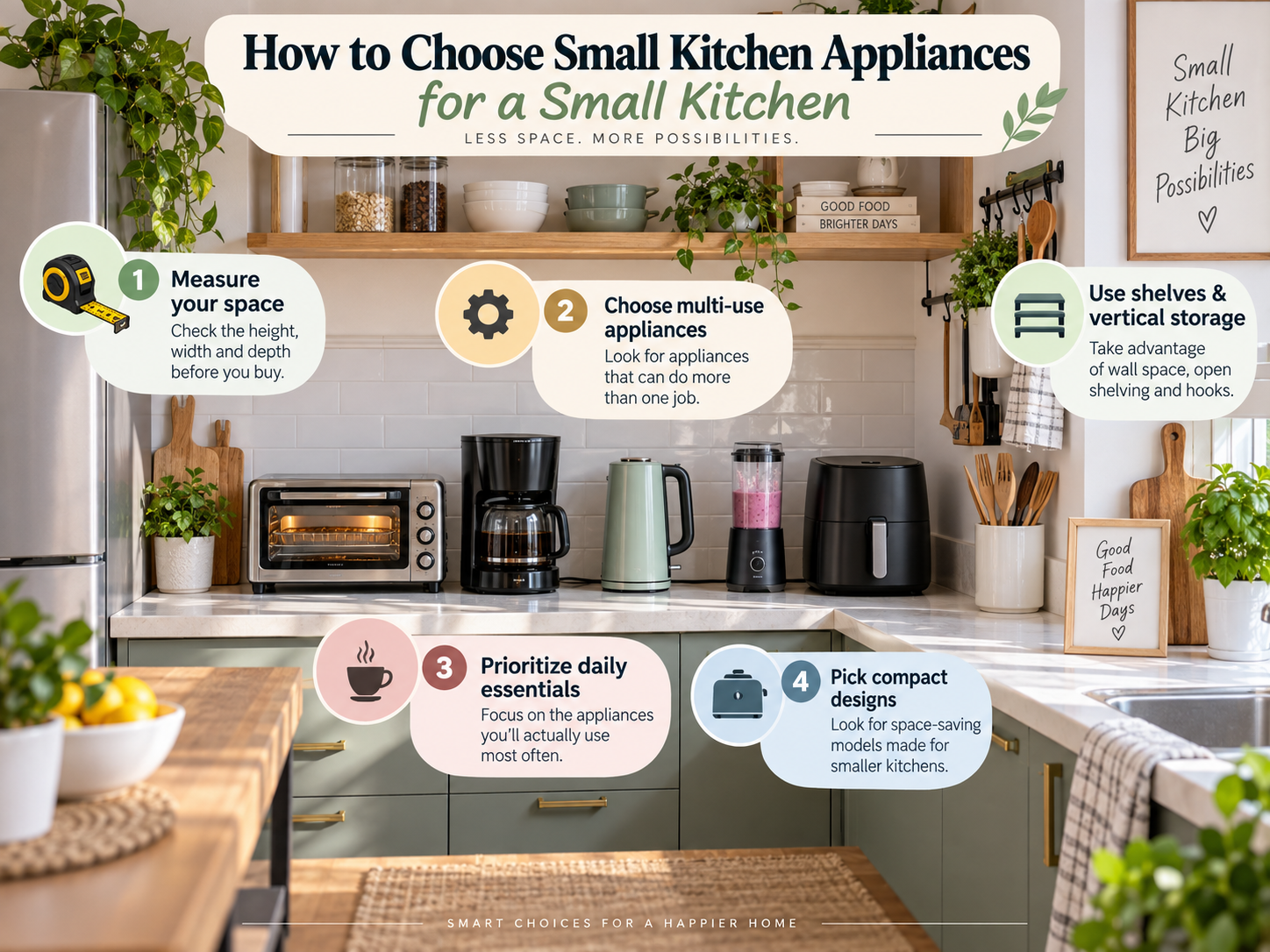
Choosing small kitchen appliances for a small kitchen means selecting countertop appliances that fit the available counter area, the space under the wall cabinets, the storage that exists, and the circuits already wired into the room. The purpose is not to own fewer appliances. The purpose is to own appliances that can be placed, operated safely, stored, and powered in a kitchen where each of those four resources is limited. For a general overview of the appliance category itself, see our article on what small kitchen appliances include.
Four measurable factors control the outcome. The first is footprint: the width and depth the appliance occupies on the counter. The second is clearance: the free air space the manufacturer requires around and above the appliance while it runs. The third is storage volume: whether the appliance can be put away in a 12-inch-deep wall cabinet or a base cabinet when it is not in use. The fourth is electrical load: the wattage the appliance draws and the capacity of the kitchen circuit it shares with everything else on the counter.
Small kitchen appliances can be grouped by how they occupy space rather than by what they cook. Some sit out permanently, some are stored between uses, some mount under a cabinet, some combine several functions in one housing, and some are compact versions of a standard appliance. These five groups behave differently in a small kitchen even when their cooking functions overlap, which is why a small kitchen often needs a different selection than a large kitchen with the same cooking habits.
This article defines the selection problem, explains how to identify a genuinely space-limited kitchen, compares small-kitchen selection with full-size-kitchen selection, classifies the five placement groups and describes each one, gives verified dimensions and manufacturer clearance requirements, explains how placement affects operation, covers the counter and cabinet measurements and circuit limits that decide what fits, states the limitations of a small-kitchen appliance set, covers rentals and other special cases, and ends with the factors that determine the correct choice.
It means matching each appliance’s footprint, required clearance, storage size, and wattage to the counter space, cabinet gap, storage, and circuits you already have.
In a large kitchen, appliance selection is mostly a question of function: what the appliance does and how well it does it. In a small kitchen, function is only the second question. An appliance that cannot be placed with its required clearance, or cannot be stored, or cannot run alongside the other appliances on the same circuit, does not become useful because it cooks well.
The four limits are independent of one another. A compact appliance can still fail the clearance test if the manufacturer requires free space above it and the wall cabinet is only 18 inches above the counter. A low-wattage appliance can still fail the footprint test if it is deep. A small appliance that is used daily can fail the storage test, because daily appliances are rarely put away.
This is also why counting appliances is the wrong method. Two appliances that each need 4 inches of clearance on every side consume far more counter than their footprints suggest, while one multi-function appliance with the same footprint as a single cooker can replace two separate housings.
Measure usable counter run, the vertical gap under the wall cabinets, free cabinet volume, and the number of kitchen circuits. Those four numbers define the constraint.
Usable counter run is the length of counter that is clear, not the total length. Counter behind a sink or a cooktop, and counter occupied by a dish rack or a knife block, is not available for an appliance. The vertical gap matters because many countertop appliances are used in place, under the cabinets. KraftMaid states that wall cabinets are typically installed 54 inches above the floor, or 18 inches above the countertop, and that the standard wall cabinet depth is 12 inches. That 18-inch gap is the ceiling most countertop appliances have to fit under while running.
Free cabinet volume determines which appliances can be stored instead of displayed. A 12-inch-deep wall cabinet cannot hold an appliance more than about 12 inches deep, so deep appliances end up in base cabinets or stay on the counter permanently.
Circuit count is the fourth number and the one homeowners check last. The National Electrical Code requires two or more 20-ampere small-appliance branch circuits to serve the receptacles in a dwelling kitchen, in NEC 210.11(C)(1) and 210.52(B)(1). That requirement applies to new work under whichever code edition and local amendments a jurisdiction has adopted. An existing kitchen may have been wired under an earlier edition and may have fewer circuits, so the panel and the receptacles, not the code text, tell you what the room supports.
Small kitchens are limited by placement, clearance, storage, and shared circuits. Full-size kitchens are limited mainly by function, capacity, and budget.
The practical differences are specific rather than general. In a full-size kitchen, a 1,750-watt air fryer and a 700-watt microwave can usually be plugged into different circuits and left in separate zones. In a small kitchen, both may sit on the same 4 feet of counter and share one 20-ampere circuit, where their combined 2,450 watts exceeds what that circuit can carry.
Capacity choices also move in the opposite direction. A larger multicooker costs little extra counter depth but changes the wattage: Instant Pot lists the Duo at 700 watts in the 3-quart size, 1,000 watts at 6 quarts, and 1,200 watts at 8 quarts. In a full-size kitchen, the larger size is usually the safer default. In a small kitchen, the larger size can push a shared circuit past its limit and take storage space the kitchen does not have.
The third difference is function overlap. A full-size kitchen can absorb two appliances that do similar jobs. A small kitchen pays counter or cabinet space for each housing, so overlapping functions are a direct cost rather than a convenience.
For practical comparison, small kitchen appliances can be grouped into always-out countertop, stored, under-cabinet mounted, multi-function, and compact-version appliances.
This is a placement grouping used in this article to compare space demands. It is not an official industry classification, and manufacturers do not label products this way. The same appliance can move between groups depending on how often the household uses it.
The five groups are covered in order below, each using the same six fields: definition, distinguishing feature, operating method, common application, relevant measurement, and main limitation.
These are appliances used often enough that they stay on the counter permanently, so they consume both footprint and running clearance at all times.
Definition: A countertop appliance that remains in its operating position between uses.
Distinguishing feature: It occupies counter space 24 hours a day, not only while running.
Operating method: It is plugged in, used in place, and left in place, which means its clearance requirement is permanent in practice even though the manufacturer states it for operation.
Common application: Daily-use appliances such as a coffee maker, a microwave, or a toaster.
Relevant measurement: Footprint plus required clearance. A 0.7-cubic-foot Sharp SMC0760KB countertop microwave measures 17.3 inches wide, 12.6 inches deep, and 10.2 inches high, and GE Appliances recommends 3 inches of clearance on both sides and the top and 1 inch at the rear for countertop microwaves.
Main limitation: Every always-out appliance permanently reduces usable counter run, so a small kitchen can support only a few of them.
These appliances are used occasionally, brought out for the task, and returned to a cabinet, so they consume storage volume instead of counter space.
Definition: A countertop appliance that is stored between uses and placed on the counter only while working.
Distinguishing feature: Its space cost is cabinet volume, not permanent counter area.
Operating method: It is carried to a clear section of counter, plugged into an available receptacle, used, cooled, and put away, which means clearance only has to exist at the temporary location.
Common application: Weekly or occasional appliances such as a hand mixer, an immersion blender, or a waffle maker.
Relevant measurement: Stored dimensions against cabinet depth. A 12-inch-deep wall cabinet, the standard depth KraftMaid lists, limits stored appliances to roughly 12 inches of depth.
Main limitation: An appliance that is awkward to lift or store is used less, so heavy or bulky appliances rarely stay in this group in practice.
These appliances mount to the underside of a wall cabinet or to a wall, moving the footprint off the counter and into the vertical gap.
Definition: A small appliance installed on a cabinet bottom or wall bracket rather than set on the counter.
Distinguishing feature: It uses the vertical gap between counter and cabinet instead of the counter surface.
Operating method: It is fastened in position and powered from a nearby receptacle, so its clearance is fixed at installation and cannot be adjusted later by sliding the appliance forward.
Common application: Under-cabinet coffee makers, can openers, and radios in kitchens with no spare counter run.
Relevant measurement: The 18-inch counter-to-cabinet gap KraftMaid cites, minus the mounted appliance’s height and any clearance below it.
Main limitation: Mounting requires drilling into cabinetry and a fixed location, which rules it out in most rentals and makes later changes expensive.
These appliances combine several cooking functions in one housing, reducing the number of separate units competing for counter and cabinet space.
Definition: A single appliance that performs functions normally split across two or more separate appliances.
Distinguishing feature: One footprint, one plug, and one clearance requirement serve multiple cooking methods.
Operating method: Program selection changes the heating or pressure behavior inside the same housing. The Instant Pot Duo Crisp + Air Fryer, for example, uses two interchangeable lids so one 6-quart pot handles pressure cooking and air frying.
Common application: Kitchens that need pressure cooking, slow cooking, steaming, or air frying but cannot hold a separate appliance for each.
Relevant measurement: Wattage, which rises with added functions. Instant Pot lists the 6-quart Duo at 1,000 watts and the 6-quart Duo Crisp at 1,500 watts.
Main limitation: The whole appliance is unavailable when one function is in use, and the higher wattage takes a larger share of a shared circuit.
These are smaller-capacity versions of common appliances, chosen when a full-size version does not fit the counter, the cabinet gap, or the circuit.
Definition: A reduced-capacity model of a standard small appliance, such as a 0.7-cubic-foot microwave or a 4-quart air fryer.
Distinguishing feature: Function is unchanged while capacity, footprint, and often wattage are reduced.
Operating method: The mechanism matches the full-size version, so the smaller chamber holds less food per batch and larger jobs are split into batches.
Common application: One- and two-person households, apartments, and kitchens with counter runs shorter than about 4 feet.
Relevant measurement: Capacity against footprint. SharkNinja lists the 5-quart Ninja Air Fryer Pro AF141 at 14.84 by 11.34 by 10.55 inches and 1,750 watts, while the 4-quart Ninja AF101 is listed at 11 inches wide, 13.6 inches deep, and 13.3 inches high with 1,550 watts.
Main limitation: Batch cooking takes longer, and a compact model is not automatically lower-wattage, as the 1,550-watt 4-quart air fryer shows.
The table below lists verified dimensions and wattages for common compact appliances, with dimensions and wattages taken from the manufacturer or, for the Ninja AF101 and the Instant Pot Duo, from the current retail listing for that exact model.
| Appliance | Model | Width | Depth | Height | Wattage |
|---|---|---|---|---|---|
| Countertop microwave, 0.7 cu ft | Sharp SMC0760KB | 17.3 in | 12.6 in | 10.2 in | 700 W |
| Air fryer, 4 qt | Ninja AF101 | 11.0 in | 13.6 in | 13.3 in | 1,550 W |
| Air fryer, 5 qt | Ninja AF141 Air Fryer Pro | 11.34 in | 14.84 in | 10.55 in | 1,750 W |
| Multicooker, 6 qt | Instant Pot Duo 6QT | 13.38 in | 12.2 in | 12.48 in | 1,000 W |
The pattern the table shows is that height and wattage do not track capacity: the 4-quart air fryer is both taller and shorter on capacity than the 5-quart model, and the 700-watt microwave draws less than half the power of either air fryer.
Heat-producing appliances vent hot air through side, rear, or top openings, so blocked clearance changes operating temperature and can damage cabinets above.
Clearance is an operating requirement, not a styling preference. GE Appliances explains that countertop microwaves need air clearance on each side, the rear, and the top so the intake and discharge vents can circulate air, and states that the appliance feet should not be removed because they affect air circulation and stability. The same company instructs that a toaster oven be placed where steam can escape without damaging counters, cabinets, and walls.
Manufacturer requirements differ by model, and the difference is large enough to change placement. The Gourmia GAF680 air fryer manual requires at least 4 inches of free space at the back and sides and 4 inches above the appliance. The Midea Dual 8-in-1 air fryer manual requires at least 5 inches at the back, front, sides, and above. Both manuals also state that nothing be placed on top of the appliance.
The practical consequence in a small kitchen is that the appliance’s operating position may not be its storage position. An appliance that needs 5 inches above it cannot run under an 18-inch cabinet gap if it is 13.3 inches tall, because 13.3 plus 5 is 18.3 inches. Pulling that appliance forward to the open counter while it runs is the standard fix, and it is only possible if a clear section of counter exists.
The table below collects published clearance requirements for common heat-producing countertop appliances, stated by the source named in each row.
| Appliance | Source | Sides | Top | Rear | Front |
|---|---|---|---|---|---|
| Countertop microwave | GE Appliances | 3 in each side | 3 in | 1 in | Front edge set back at least 3 in from the counter edge |
| 2- and 4-slice toaster oven | GE Appliances | 4 in | 4 in | 4 in | 4 in |
| Air fryer, GAF680 | Gourmia manual | 4 in | 4 in | 4 in | Not specified |
| Air fryer, MAD113MCAF | Midea manual | 5 in | 5 in | 5 in | 5 in |
The requirements are not interchangeable between appliances or even between two air fryers, so the manual for the specific model you own sets the placement, and the largest stated dimension controls where the appliance can run.
Measure clear counter run, counter depth, the vertical gap under the wall cabinets, and the depth of the cabinet you intend to store the appliance in.
Depth is the measurement that most often fails. KraftMaid lists 12 inches as the standard wall cabinet depth, and countertops in most kitchens are about 24 inches deep. A 12.6-inch-deep microwave with the 1 inch of rear clearance GE Appliances specifies occupies 13.6 inches of that depth, so it extends past the face of a 12-inch wall cabinet and leaves roughly 10 inches of counter in front of it.
Height is the second check, and it is pass or fail rather than adjustable. Under the 18-inch counter-to-cabinet gap KraftMaid cites, the 10.2-inch-tall Sharp microwave plus 3 inches of top clearance needs 13.2 inches and fits with room to spare. The 13.3-inch-tall Ninja AF101 plus a 4-inch top requirement needs 17.3 inches and clears an 18-inch gap by 0.7 inch, which leaves no margin for an uneven installation.
Receptacle position is the third check. The National Electrical Code, in 210.52(C)(1), requires a receptacle outlet at each wall countertop and work surface 12 inches or wider, installed so that no point along the wall line is more than 24 inches horizontally from a receptacle. Where that provision applies, any point on a qualifying counter is within reach of a standard appliance cord, but cord lengths still vary by model, and SharkNinja lists a 31.2-inch cord on the AF141.
Choose appliances for the tasks the household repeats weekly. Occasional tasks belong to stored or multi-function appliances, not to always-out ones.
Frequency decides group placement, and group placement decides space cost. An appliance used daily will stay on the counter regardless of intent, so its footprint and clearance should be treated as permanent before buying. An appliance used once a month should be chosen for how easily it stores, which means depth under about 12 inches and a weight that can be lifted from a cabinet comfortably. SharkNinja lists the AF141 at 10.67 pounds, which is light enough to move between counter and cabinet.
Energy use gives a second, measurable reason to prefer small appliances for small jobs. The U.S. Department of Energy states that a toaster oven or convection oven uses one-third to one-half the energy of a full-size oven for small portions. Silicon Valley Power’s appliance energy chart lists about 0.04 kilowatt-hour for a toaster cycle, about 0.12 kilowatt-hour for a five-minute microwave run, about 0.75 kilowatt-hour per hour for a toaster oven, and about 2.3 kilowatt-hours per hour for an electric oven. At the U.S. residential average retail price of 18.34 cents per kilowatt-hour reported by the Energy Information Administration for June 2026, an hour of toaster-oven use costs about 14 cents and an hour of electric oven use costs about 42 cents.
For which appliances a basic kitchen needs before any of this optimization begins, see the essential appliances for a first kitchen.
Small kitchens concentrate high-wattage appliances on few circuits, so total simultaneous wattage matters more than any single appliance rating.
The arithmetic is fixed by voltage and breaker size. On a 120-volt circuit, a 15-ampere breaker corresponds to 1,800 watts and a 20-ampere breaker to 2,400 watts. NEC 210.20(A) requires the branch-circuit rating to be not less than the non-continuous load plus 125 percent of the continuous load, where a continuous load is one expected to run for three hours or more, which works out to 1,440 watts on a 15-ampere circuit and 1,920 watts on a 20-ampere circuit for loads of that duration.
Applied to real appliances, the 1,750-watt AF141 air fryer and the 700-watt Sharp microwave draw 2,450 watts together, which is above the 2,400-watt capacity of a 20-ampere circuit and well above a 15-ampere circuit’s 1,800 watts. Two appliances that each run safely alone can trip a breaker when used at the same time, and in a small kitchen they are more likely to be on the same circuit because there are fewer receptacles spread over less wall.
Ground-fault protection is a separate requirement. NEC 210.8(A)(6) requires GFCI protection for receptacles in dwelling kitchens, and 210.8(A)(7) covers receptacles within 6 feet of the top inside edge of a sink bowl. These provisions govern the wiring rather than the appliance, they apply as adopted and amended by the local jurisdiction, and existing installations may predate the current edition. For how wattage ratings translate into heat and running cost inside the appliance, see how small kitchen appliances work.
Wattage on a label is a rating, not a constant draw, and appliances with thermostats cycle their heating elements. Where a specification is unclear or a circuit is already loaded, the appliance manual and the panel directory are the sources to check, and an electrician is the correct source for any change to the wiring.
Compact appliances cook smaller batches, multi-function appliances serve one function at a time, and clearance rules limit how many appliances can run at once.
Batch size is the first limitation and it cannot be designed away. A 4-quart air fryer basket and a 0.7-cubic-foot microwave cavity hold less food than larger models, so cooking for more people means sequential batches and longer total time.
Simultaneous use is the second limitation, and it has two independent causes. A multi-function appliance is occupied by whichever function is running. Separately, two appliances that each require several inches of clearance often cannot be operated side by side on a short counter run, even when the circuit could carry both.
The third limitation is that these constraints are specific to the home, not to the appliance. Counter depth, cabinet height, cabinet depth, circuit count, and receptacle placement all vary, and results depend on the exact model and the installation. Published dimensions and clearances also change between model revisions, so the current manual for the model being bought is the only reliable specification.
Rentals and dorms restrict mounting and circuit changes, and kitchens without upper cabinets remove both the cabinet gap limit and the storage option.
In a rental, the under-cabinet group is usually unavailable because mounting requires drilling into cabinetry, and adding a circuit is not a tenant decision. Selection therefore shifts toward compact and multi-function appliances that work with the existing receptacles. Dorms add a further restriction: many institutions limit which heat-producing appliances are permitted, and those rules are set by the institution rather than by any code or manufacturer, so the housing policy has to be checked directly.
A kitchen without wall cabinets above the counter removes the 18-inch vertical limit, so tall appliances and appliances needing top clearance become easier to place. The same kitchen loses cabinet storage, which pushes appliances into the always-out group and makes footprint the binding constraint instead of height.
Older kitchens are the third case. A kitchen wired before the current requirements were adopted may have fewer small-appliance circuits than a new kitchen, so the practical capacity is whatever the panel and receptacles provide rather than what current code specifies for new work.
Choose by measured fit, manufacturer clearance, use frequency, function overlap, and circuit capacity. Those five factors decide what works in a small kitchen.
Measured fit. Footprint and height decide whether the appliance can be placed at all, and they are the only factors that cannot be worked around. Take counter depth, clear counter run, the vertical gap under the wall cabinets, and the depth of the intended storage cabinet before shopping, then compare them against the manufacturer’s published dimensions for the exact model. The 18-inch gap KraftMaid cites as typical, and the 12-inch standard wall cabinet depth, are the two numbers most likely to disqualify an appliance. Both vary by kitchen, so measure rather than assume.
Required clearance. Clearance turns a footprint into the space an appliance actually needs while running, and it varies by model. GE Appliances specifies 3 inches at the sides and top and 1 inch at the rear for countertop microwaves and recommends 4 inches on all sides for its 2- and 4-slice toaster ovens, while the Gourmia GAF680 manual requires 4 inches and the Midea MAD113MCAF manual requires 5 inches. Add the largest stated clearance to the appliance height and depth before deciding where it will live. If the total exceeds the cabinet gap, the appliance must be pulled onto open counter to run, which requires counter you may not have.
Use frequency. How often an appliance is used determines whether it costs counter space or cabinet space, and that cost is usually larger than the price difference between models. Daily appliances stay out, so they should be chosen for compact footprint and modest clearance. Occasional appliances should be chosen for storage: depth near or under the 12-inch standard cabinet depth, and a weight that can be lifted easily, such as the 10.67 pounds SharkNinja lists for the AF141. Frequency is a household judgment, not a specification, and it is the factor most often misjudged before purchase.
Function overlap. Each separate housing costs space, so overlapping functions are more expensive in a small kitchen than in a large one. A multi-function appliance such as the Duo Crisp, which pressure cooks and air fries in one 6-quart pot, removes a housing but raises the load to 1,500 watts against 1,000 watts for the 6-quart Duo, and it can only perform one function at a time. Choose combination appliances where the functions are used at different times, and separate appliances where two jobs regularly run together.
Circuit capacity. Wattage decides what can be operated simultaneously, which is the constraint a small kitchen hits most often. A 120-volt, 20-ampere circuit corresponds to 2,400 watts, and a 15-ampere circuit to 1,800 watts, so a 1,750-watt air fryer leaves little room for anything else on the same circuit. Total the wattages of the appliances likely to run at the same time, compare that total against the circuit serving those receptacles, and check the panel rather than assuming the kitchen has the two 20-ampere small-appliance circuits that NEC 210.11(C)(1) requires for new work. Where the total is close to the limit, either stagger use or have an electrician evaluate the circuits.
