
Our Location
304 North Cardinal St.
Dorchester Center, MA 02124

 ByAlan
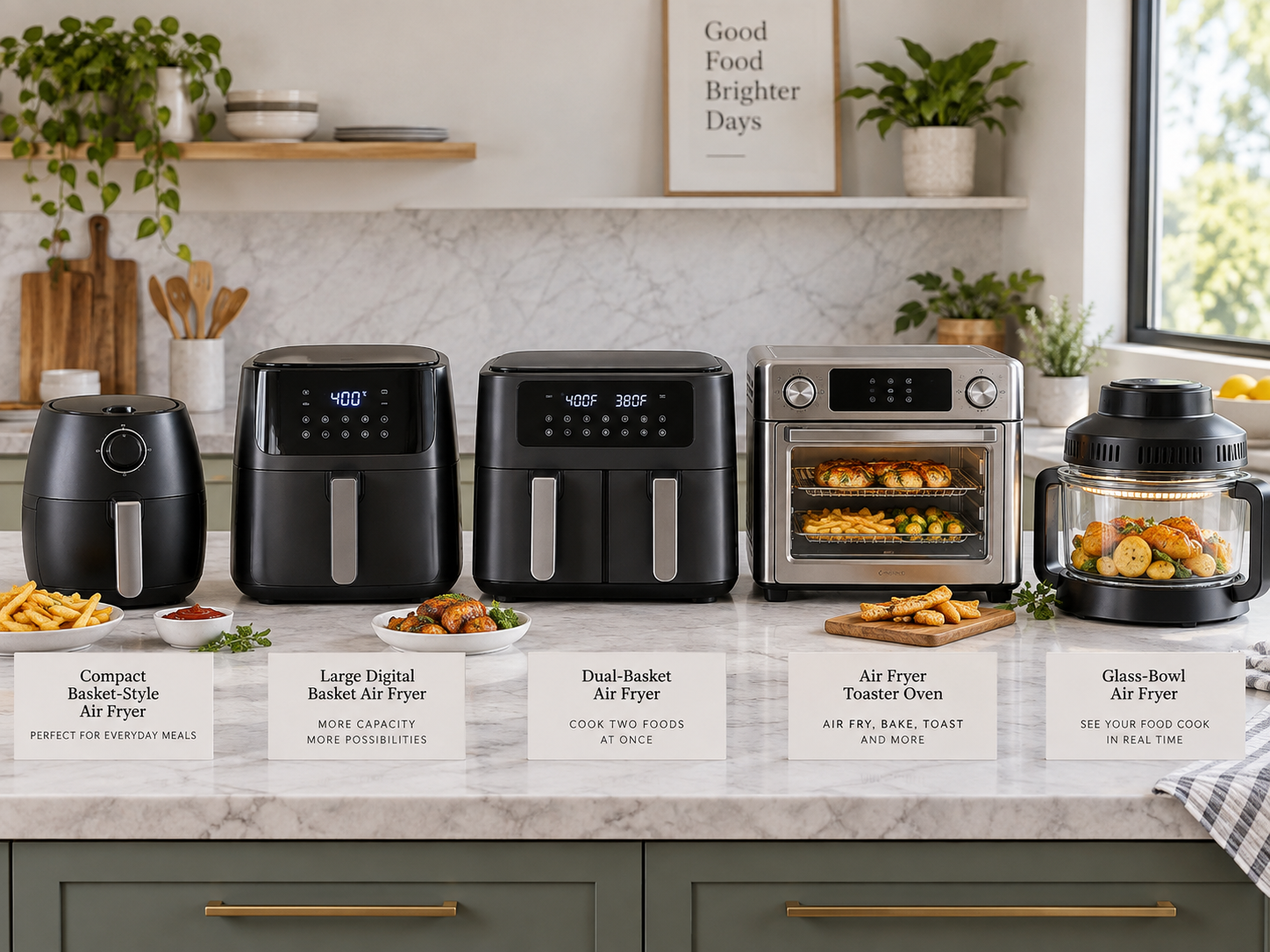
Air fryer types fall into a handful of main styles: single-basket models, dual-drawer or two-basket units, oven-style and toaster oven designs, French door ovens, and multi-cooker or pressure cooker combos. Smaller variations such as window, dome, combi and mini models sit around the edges. All of them cook by moving hot air around food, but the shape of the appliance changes capacity, cleanup, counter footprint and how evenly food crisps.
This guide is for anyone asking what type of air fryer is best, which type to buy, or how many types of air fryers there are. There is no single count, because brands blend features and the categories overlap. Instead of declaring one winner, the sections below describe each style, its tradeoffs and the kind of cook it suits.
Start with a quick overview of how the technology works, then use the comparison table to narrow your options. Later sections cover each style in detail, compare air fryers with convection and conventional ovens, and finish with a buying checklist, food-by-food pairings and short answers to common questions. The guide mentions brands only as examples of a style, not as endorsements.
Specifications such as capacity, wattage and presets differ between models and change over time, so treat any size ranges here as general guidance. Check the manufacturer’s current product details before you buy.
An air fryer is essentially a compact convection appliance. A heating element warms the air inside the cooking chamber, and a fan circulates that hot air rapidly around the food. Moving air carries heat to the surface of food quickly, which helps the outside dry and brown. Many baskets and trays include a perforated base or a crisper plate so air can reach the underside as well as the top. Compared with deep frying, the approach typically uses little or no added oil, which is why oil consumption is a common reason people buy one. Specific health or calorie claims depend on the food and method, so check reliable sources before relying on them.
Design matters because airflow, distance from the heat source and food layout all affect results. In a basket model, the fan and element sit close to a small chamber, so air moves fast across a compact space. Food piled deeply in a basket can block airflow, which is why shaking or turning it is often recommended. In an oven-style unit, air travels across wider racks, so capacity is larger but results can vary between rack positions. Food on a flat tray may crisp differently from food in a perforated basket.
Design also shapes everyday convenience. Capacity determines whether you cook a single portion or a family meal in one go. Removable baskets and trays are easy to wash but may be small, while oven interiors are roomier but harder to clean. Footprint, preheating habits and noise vary with the style too. The sections below look at each type with those practical differences in mind.
The table below summarizes the main kinds of air fryers. Capacities and sizes are broad generalizations, since they vary widely by brand and model. Use it as a starting point, then read the matching section for the detail behind each row.
| Type | Shape | Typical capacity | Best for | Main tradeoff | Counter space |
|---|---|---|---|---|---|
| Basket | Compact pod or tub with a pull-out basket | Small to medium | Fries, wings, vegetables, snacks | Limited batch size; food may need shaking | Small to moderate |
| Dual drawer / two-basket | Wide unit with two pull-out drawers | Medium to large, split into two zones | Families, two-item meals | Bigger footprint and higher price | Moderate to large |
| Oven-style / toaster oven | Rectangular box with a door and racks | Large, multiple racks | Batches, baking, toasting, roasting | Bulky; interior is harder to clean | Large |
| French door oven | Large oven with two doors opening outward | Large | Big meals, frequent oven-style use | Size and cost; door clearance | Large |
| Multi-cooker combo | Pot with an air fryer lid | Varies with pot size | Cooks wanting one appliance for many tasks | Air frying may be a compromise | Moderate |
Categories overlap and vary by brand, so a given model may blend traits from more than one row. The most useful way to count air fryer types is by how you load, access and clean the appliance, rather than by a fixed number.
A basket air fryer is the style most people picture first. It has a compact body, a heating element and fan at the top, and a removable basket that slides out like a drawer. Food sits in the basket, often on a crisper plate or perforated base that lifts it slightly so air can circulate beneath. Sizes range from small countertop models suited to one or two people up to larger baskets meant for family portions. Several major brands, including Ninja, offer basket models alongside other styles, so brand names alone do not tell you the type.
The main practical habit with a basket model is managing how food is arranged. A single layer cooks most evenly, and overloading can leave some pieces softer than others. Shaking the basket or turning food partway through helps expose all sides to the moving air. Cleaning is usually simple, because the basket and plate lift out and many are dishwasher safe, though you should confirm this for your model and check how the nonstick coating should be treated. Wiping the interior and heating element area occasionally helps prevent grease buildup.
Basket models fit singles, couples and small kitchens, and anyone who mainly wants a fast way to cook frozen fries, wings, vegetables, nuggets and reheated leftovers. They also suit people trying an air fryer for the first time who prefer not to commit to a large appliance. If you often cook for four or more, or need two different foods ready together, a larger style may be more practical.
Dual-drawer air fryers, also called two-basket models, contain two separate cooking compartments in one body. Each drawer has its own basket and can be set independently, so you might cook chicken in one and vegetables in the other at different temperatures. Examples include Ninja’s DoubleStack-style and dual-zone designs, though several brands make similar units. The idea is to avoid cooking one dish, holding it, and then starting the next.
Many models offer a sync or match-finish feature. When you set different times for each drawer, the appliance delays the shorter one so both finish together. This is convenient for a meal with a protein and a side that need different cooking durations. Some designs stack drawers vertically to save width, while others place them side by side, so footprint differs. Check the dimensions of the specific model against your counter and cabinet clearance.
These units suit families and anyone who regularly cooks two components of a meal. The tradeoffs are practical: they usually cost more than a single basket, take more space, and mean two baskets to wash. Each drawer is often smaller than a large single basket, so cooking one large item, such as a whole chicken, may not fit. Think about whether you will really use both zones before paying for the extra capability.
Oven-style air fryers look like toaster ovens, with a rectangular cavity, a front door and removable racks. Many are toaster oven air fryers that add a fan and an air fry setting to a traditional toaster oven. Because the cavity is wider and racks hold food in flatter layers, they generally offer more capacity than basket designs. Depending on the model, they may also toast, bake, roast, broil, dehydrate or reheat, which makes them a flexible electric oven air fryer for small kitchens.
The broader range of functions comes with tradeoffs. These units take more counter space and can be heavy to move or store. Airflow across multiple racks may be less even than in a compact basket, so you may need to rotate trays or swap rack positions. Cleaning involves wiping the interior, door glass and crumb tray, plus washing racks and pans, which can take longer than rinsing a basket. Some people also notice that the unit heats the kitchen more than a small basket model, though this depends on the design.
Look at the number of racks and whether they can be repositioned, as this affects how many trays you can cook on at once. Check interior dimensions against the pans you own and the foods you want to cook, such as a pizza or a sheet pan. Review the controls, whether dials, buttons or a touchscreen, and how clear the presets are. Finally, consider cleaning: a nonstick interior, removable crumb tray and dishwasher-safe accessories make daily use easier. The best oven type air fryer is the one that fits your space and the way you cook, not the one with the longest feature list.
French door air fryer ovens are a large oven-style variation in which the front opens with two doors that swing outward from the center, instead of one door that drops down. Pulling either handle often opens both doors together, though behavior depends on the model. This arrangement gives wide access to the racks and can make it easier to load trays, because there is no flat door resting open below the cavity.
The design is convenient on a crowded counter edge, where a drop-down door might collide with items placed in front, although the swinging doors need side clearance instead. These ovens tend to be big, so they appeal to people who want a countertop oven to handle full meals, larger trays or frequent baking and roasting. The tradeoffs are size, weight and price, which are typically higher than for a basic toaster oven air fryer. Features such as rack count, accessories, presets and capacity vary significantly by model, so verify the details of any unit you are considering instead of assuming they come with the door style.
Multi-cooker air fryer combos fold several appliances into one. A common version is a pressure cooker or multi-cooker base, such as an Instant Pot-style pot, that comes with a separate air fryer lid. You use the standard lid for pressure cooking, slow cooking or steaming, then swap in the air fryer lid for crisping and browning. Others are dedicated appliances sold as, for example, a 6-in-1 unit that combines air frying with functions like roasting, baking, dehydrating or sautéing. The exact list of functions depends on the model.
These combos can reduce clutter for people who want one appliance to do many jobs. They can be especially useful for finishing a pressure-cooked dish with a crisp surface, such as browning meat after cooking it tender. The compromises are worth understanding, though. The air fryer lid usually works over an inner pot rather than a dedicated perforated basket, so airflow and capacity can differ from a standalone air fryer. The extra lid also needs somewhere to be stored, and the whole unit can be heavy and bulky.
Multi-cookers benefit households that already want a pressure cooker or slow cooker and see air frying as a useful extra. They are less ideal if crisp results from large batches are your main priority, since a dedicated basket or oven-style model is built around that task. Compare the cooking functions you will actually use with the price, and check how easy the lid and inner pot are to clean.
Beyond the core styles, several niche variations appear across the market. They often add convenience features rather than creating a distinct category, and they can be combined with any of the types above.
Smart air fryers add app or voice control, remote monitoring and guided recipes, while presets provide one-touch settings for common foods. These can be helpful for beginners, but check whether the presets match the foods you cook and whether the app adds real value. Features like these should be a tiebreaker after you have chosen the right basic style.
An air fryer, a convection oven and a conventional oven all heat food with hot air, but they differ in how that air moves and how much space it fills. A conventional oven relies mainly on heat radiating from its elements and natural air movement. A convection oven adds a fan to circulate air, which helps heat spread more evenly. An air fryer is a small, fan-driven chamber that moves air quickly over food in a tight space, which is why oven-style air fryers are often described as compact convection ovens with a stronger fan. The line between a convection oven and an oven-style air fryer can be blurry, and marketing terms differ by brand.
| Factor | Air fryer | Convection oven | Conventional oven |
|---|---|---|---|
| Heating method | Fast fan and element in a small chamber | Heating plus a circulating fan | Radiant heat with little forced airflow |
| Preheating | Usually short, and some recipes skip it | Moderate | Typically longest |
| Capacity | Small to medium; larger for oven styles | Large | Largest |
| Best uses | Crisping small batches, reheating | Roasting, baking, multiple trays | Large meals, delicate baking, big roasts |
Time and energy comparisons depend on the appliance, food and quantity, so avoid assuming fixed savings. In general, small appliances warm up quickly and suit small portions, while full-size ovens handle volume. Many households keep both: the air fryer for fast everyday jobs and the oven for large roasts, multiple trays and baking that needs gentle, even heat.
An air fryer can replace some oven tasks but not all. Large casseroles, big cuts of meat and baking for a crowd still fit better in a full-size oven. If you are weighing an air fryer oven against a standalone basket model, consider whether you want an extra appliance for small jobs or a larger one that can partly take over from your main oven.
The best type of air fryer depends on who you cook for, how much space you have and what you cook most often. Rather than looking for one winner, match your situation to a style. Start with household size, since capacity is the first constraint, then consider kitchen space, budget and how much cleanup you will tolerate. Think about your habits too: if you mainly reheat leftovers and cook frozen snacks, a small appliance is enough, whereas if you want to cook whole meals, you need more room.
Budget and cleanup often decide close calls. Basket models usually cost less and are easiest to wash, while large ovens and dual drawers cost more and add parts or interior surfaces to clean. If you are unsure, consider how you will actually use the appliance in a typical week, and choose the simplest style that meets that need. Buying more capacity than you can store or clean is a common reason air fryers end up unused.
Once you have chosen a style, compare models on a few practical features. Capacity is the first: check the stated size against the number of servings you cook, remembering that the usable space is smaller than the headline number for foods that need airflow. Wattage indicates heating power, but it does not guarantee better results, so read it alongside reviews and the design of the airflow system. Controls matter for daily use, from simple dials to touchscreens with presets and manual settings.
The priority shifts by type. For baskets, focus on basket size, plate design and ease of cleaning. For dual drawers, look at sync features and the size of each drawer. For oven styles and French door models, rack count, interior dimensions and interior cleaning matter most. For multi-cookers, check how well the air fryer lid performs and how many functions you will really use.
Most air fryer types can cook common favorites, so the question is mainly about batch size and layout. Foods that benefit from a single layer and fast airflow, such as fries, tater tots, wings and Brussels sprouts, work well in baskets and on oven racks, as long as they are not crowded. Larger batches suit bigger baskets, dual drawers or oven-style units. The table suggests general pairings; timing and temperature depend on the model, so follow the manufacturer’s guidance and recipe instructions.
| Food | Well-suited styles | Practical note |
|---|---|---|
| Fries and tater tots | Basket, oven-style | Spread in a single layer for the most even crisping. |
| Chicken breasts and wings | Basket, dual drawer, oven-style | Dual drawers allow a side dish to cook alongside. |
| Brussels sprouts and vegetables | Basket, oven-style | Shake or turn so surfaces brown evenly. |
| Sweet potato | Basket, oven-style, dual drawer | Cut size affects how evenly it cooks. |
| Veggie burger and burger patties | Basket, oven-style | Leave space so air reaches each patty. |
| Pizza, baked goods, larger trays | Oven-style, French door | Needs a flat tray and wider interior. |
Multi-cooker combos can handle many of these foods, especially smaller portions, but may be less suited to big batches. If you often cook for a crowd, prioritize the style that holds your usual portion without stacking food, because crowding is the most common reason food comes out unevenly.
How many types of air fryers are there?
There is no official number. The main styles are basket, dual drawer, oven-style or toaster oven, French door oven and multi-cooker combos, with variations such as window, mini and smart models. Because brands mix features, counts differ depending on how you group them.
Is an oven-style air fryer better than a basket model?
Neither is better for everyone. Oven styles offer more capacity and functions but need more space and take longer to clean. Basket models are compact, simpler and usually cheaper, but hold less food.
What size air fryer should I choose?
Match the capacity to the number of people you cook for and your typical portion. Smaller baskets suit one or two people, larger baskets, dual drawers or ovens suit families. Remember that food should not be packed tightly, so leave some room beyond the minimum.
Can air fryers bake or roast, and do they replace an oven?
Many can, especially oven-style models with bake and roast settings, and basket units can handle small portions. They can replace an oven for everyday small jobs, but a full-size oven remains better for big roasts, multiple trays and large baking projects.
