
Our Location
304 North Cardinal St.
Dorchester Center, MA 02124

 ByAlan
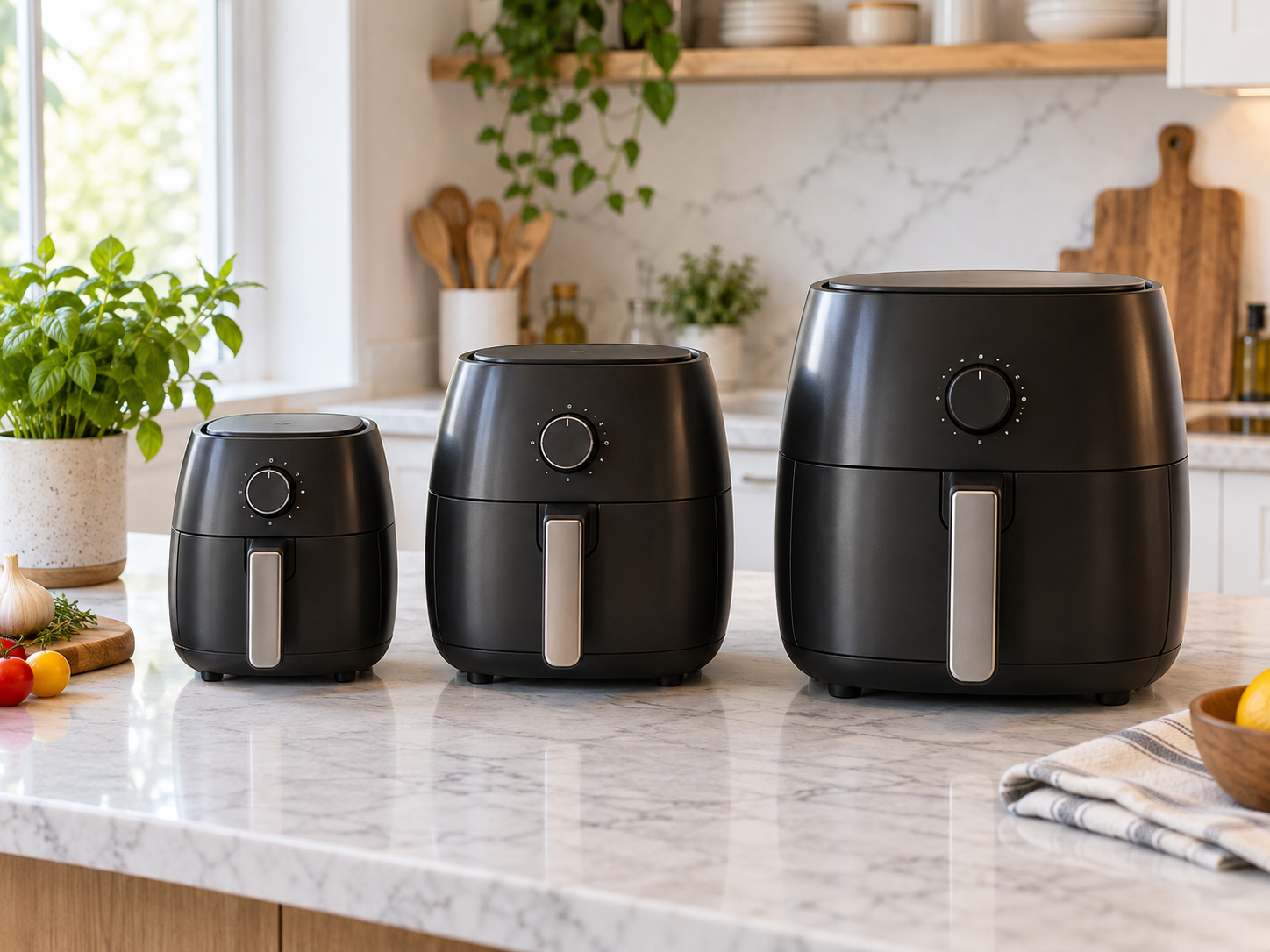
Air fryer size is the internal capacity of the basket, usually given in quarts or liters, and the most common choice is 5 to 6 quarts (4.7 to 5.7 L). That medium capacity suits households of two to four people because it can hold a main protein and a side dish in a single layer, which lets hot air circulate around the food and crisp it properly. A bigger number on the box does not automatically mean more food cooked well, so the label is only the starting point for choosing a model that matches your cooking habits.
Size is really two separate questions: how much food the basket holds, and how much room the appliance takes up on your counter. A fryer that fits your family’s meals can still be a poor fit if it is too deep for the space under your cabinets. Dimensions and ventilation clearance matter as much as capacity, particularly in smaller kitchens where the appliance has to share limited worktop space with other equipment. Looking at both measures together is the surest way to pick a size you will be happy with.
Air fryer size measures basket volume, shown in US quarts or liters, rather than the amount of food you can cook at once. Because crisping depends on air reaching every surface, food needs to sit in a single layer, which makes the floor area of the basket the more useful number than total volume. Stacking food deeply may fill the space, but the pieces on the bottom and in the middle will steam instead of browning, so a large nominal capacity can be misleading if the basket is tall and narrow.
Usable space is generally about 60 to 70 percent of the stated capacity, because food has to stay clear of the heating element and leave gaps for airflow. Basket shape also changes real capacity: a wide, shallow basket gives more single-layer room than a deep, narrow one with the same rating, and a square basket holds more in one layer than a round basket of the same rating. When comparing models, think about the surface your food will actually occupy, not only the quart figure printed on the packaging or listed beside the price.
A 6-quart basket effectively holds about 4 quarts of food, since the remainder must stay open so air can move freely around everything inside. Overfilled baskets lose their crisping ability because food packed tightly blocks airflow, leaving pieces pale, soft or unevenly cooked on the surfaces that touch. Treating the stated capacity as a ceiling you should not approach is the simplest way to avoid disappointing results and to judge whether a model is truly large enough for the portions you cook every day.
In a small basket, such as a compact model of about 1.6 to 3 quarts, usable capacity is modest, and a model holding 2 quarts at most is really suited to one person. That might mean a single serving of fries, a couple of fillets or a handful of wings, with extra portions needing a second batch. Food that is reheated or cooked in thin pieces fares best in these smaller baskets, because there is little room to spread out thicker items without crowding them against each other.
A medium basket in the 5 to 6 quart range gives around 3 to 4 quarts of working space under the 60 to 70 percent guideline. That is enough for a main protein plus a side dish in one layer, which is why this size is so popular with households of two to four people. Cooking a full dinner for several people in one go is realistic here, provided you resist the urge to pile everything in and instead spread it out so the hot air can reach each piece.
Large baskets of 6 to 10 quarts give the most usable floor area, which helps with party finger foods, whole pizzas and bigger cuts. Even so, the same rule applies: a 10-quart label does not mean 10 quarts of food, and the effective amount is lower. When you compare models, subtract roughly a third to forty percent from the headline figure to picture what will actually fit, then check that number against the biggest batch you realistically cook for your household on a typical busy evening.
Quarts and liters both describe basket volume, and one quart is a little under one liter, so a 5-quart basket is roughly 4.7 liters. In the United States, listings usually state capacity in US quarts, while retailers in the UK, Australia and many other markets prefer litres, often spelled that way on local sites. The two numbers describe the same kind of measurement, so a model labeled in liters can be compared with one labeled in quarts once you convert between them, rather than treating them as different kinds of size.
A handy reference point is the standard medium size, 5 to 6 quarts, which corresponds to 4.7 to 5.7 liters. If you shop on a site that uses litres, a model in that range is the equivalent of the most common medium capacity, and the same household guidance applies to it. Small compact units in the 1.6 to 3 quart range will appear with proportionally smaller litre figures, so it helps to keep these anchor values in mind while you browse listings from different regions.
Whichever unit appears on the box, remember that the figure is the nominal basket volume and not the amount of food you can cook. The usable space is still about 60 to 70 percent of the stated capacity, whether it is printed in quarts or liters, and the basket shape still determines how much single-layer area you get. Capacity labels are most helpful when you compare them within the same style of appliance, and when you pair them with dimensions and interior measurements from the specification sheet.
Most households need one quart of capacity per person, though buying one size up is often recommended so you can avoid cooking in batches. By that rule, a family of four is pointed toward 4 to 5 quart models, and many people choose a 5 to 6 quart basket for comfort. The right answer depends on more than headcount, so it helps to compare household size, how you usually cook and how often you prepare food in batches, because a busy family cooking full dinners needs more room than two people reheating leftovers.
The quick overview below shows how those household ranges map to capacities before the detailed chart in the next section. Use it as a starting point, then adjust up if the air fryer will be your main cooking appliance, or down if you only use it for occasional snacks. Cooking pattern matters because a household that makes several dishes at once benefits from more floor area, while a household that cooks one simple item at a time will rarely use the extra space of a larger unit.
| Household | Typical capacity |
|---|---|
| 1-2 people | 2-4 qt |
| 3-4 people | 5-6 qt |
| 5+ people | 8-10+ qt |
One to two people fit a 2 to 4 quart model, three to four people fit a 5 to 6 quart single basket, and larger groups need more. For five or more people, or for cooking two different meals at once, an 8 to 10 quart dual-basket or a 10+ quart oven-style model is the better fit. The table lays out each band with the basket type and the kind of cooking it handles best, so you can match your household to a capacity at a glance before looking at individual models.
The one-quart-per-person rule needs adjusting for cooking pattern, because it assumes a typical mix of meals and an average appetite. If you batch cook, meal prep or entertain, move up a size, since extra capacity saves repeated rounds of cooking. If you cook mostly snacks, reheat leftovers or prepare single portions, the lower end of your band will serve you well, and a smaller footprint may be worth more to you than spare capacity you rarely use on ordinary days.
| Household | Capacity | Basket type | Best-fit use |
|---|---|---|---|
| 1-2 people | 2-4 qt | Single basket | Snacks, small meals |
| 3-4 people | 5-6 qt | Single basket | Protein plus side |
| 5+ or dual-meal | 8-10 qt / 10+ qt | Dual-basket / oven-style | Large batches |
Size up when you cook in batches or rely on the air fryer, and size down when use is occasional or counter space is limited. A larger unit rewards frequent, bigger cooking jobs, but it is inefficient for small portions, since you heat a big cavity for a little food. The right call depends on how central the appliance is in your kitchen and how much room you can spare for it, so think about your weekly routine before deciding whether to buy extra capacity or save space with a compact model.
Size up for batch cooking, meal prep, entertaining, future household growth, or when the air fryer is your main cooking appliance. Size down for occasional use, snacks, single servings, small kitchens or when it supplements an oven or stovetop. If you are unsure, buying one size above your calculated need is a reasonable compromise that leaves room for growth, without committing to the counter space, price and running costs of the largest models on the market.
The right air fryer size matches the number of people you cook for and the way you cook, not just the household headcount. Medium or large models suit full meals and daily batch cooking, while compact models handle snacks and single servings, so intended use decides the question as much as the number of people at the table. Thinking about a typical weeknight dinner, and the biggest meal you cook regularly, makes it easier to pick a capacity you will use well.
Basket layout also affects fit: a single basket suits batch meals where one food cooks at one setting, while a dual basket lets you cook two foods at different settings and finish them together. A dual-basket design is helpful when you want a protein and a side that need different times or temperatures, though each basket is smaller than a single basket of the same overall size. The household breakdowns below apply these principles to the common groups of one to two, three to four and five or more people.
One or two people are well served by a compact 2 to 4 quart air fryer, and one person living alone can manage with about 2 quarts. Compact models of roughly 1.6 to 3 quarts suit individual use, and they take up little counter space, which makes them a good match for small kitchens. They cook fries, wings, fillets and reheated leftovers quickly and with little wasted energy, making them practical for everyday single or couple cooking where portions are modest.
The limits of a small basket are worth knowing before you buy. A whole chicken will not fit, bigger cuts may need cutting up, and cooking for two can mean working in multiple batches if the basket is at the smaller end of the range. If you often cook for two at the same time, or like to prepare a main and a side together, the top of the range, around 4 quarts, gives more breathing room while staying compact enough for a modest worktop.
Families of three or four are best served by a single 5 to 6 quart basket, which is the most common size for this household. A 6-quart basket suits a family of three and also a family of four, giving enough single-layer space for a main protein and a side dish, which covers typical weeknight dinners. Families cooking for four will usually be comfortable here, though anyone with large appetites or who wants leftovers might lean toward the top of the range rather than the bottom.
There are edge cases between three and four people. A family of three can often manage with the lower end of the 5 to 6 quart range, while a family of four may want to size up when cooking for more people or when the air fryer handles most meals. A 4 to 6 quart model is described as ideal for families of up to six, though larger groups will find that batches become more frequent, and a bigger basket or a dual-basket design starts to look more attractive.
Five or more people, or anyone cooking two dishes at once, should look at 8 to 10 quart dual-basket models or 10+ quart oven-style units. Baskets in the 6 to 10 quart range suit whole chickens, whole pizzas and party finger foods, so they handle entertaining and large family dinners, where a medium basket would require repeated rounds. Larger units reduce the number of batches, which matters when you want everything hot and ready at the same time for a group of hungry guests.
The choice between dual-basket and oven-style comes down to how you want to finish a meal. A dual-basket lets two different foods cook at once and finish together, while an oven-style unit offers one larger cooking space with racks for a bigger batch. Each approach has its own strengths, so think about whether you more often cook two separate dishes or one large quantity of the same food when deciding which style will serve your gatherings best.
Larger units come with trade-offs. They need more counter space, since some 8 to 10 quart dual-basket designs are 14 inches wide or more, and they generally cost more to buy and to run. If the extra capacity is something you will use only a few times a year, you might find a medium model plus a second batch is a more economical choice, while regular entertainers will likely appreciate the time saved by a bigger cooking area.
A whole chicken needs a large basket or an oven-style air fryer, and the interior dimensions matter as much as the quart rating. The bird has to clear the heating element and still leave room for air to move around it, so depth and height of the cooking space decide whether it fits. Capacity labels alone can mislead, because two models with the same quart figure may have very different interior shapes, one tall enough for a roast and another too shallow for anything but flat foods.
Dual-basket models are a particular trap. Each basket is smaller than a 6 quart basket, so a whole chicken may not fit in either one, even when the combined capacity looks generous. One dual-drawer model lists a chicken of 1.8 kg or 4 lb as its limit, which shows how the weight a model can handle is tied to its drawer size, not its total quarts. Look for a stated maximum weight on the specification sheet where one is given.
If your fryer is too small for a whole bird, cooking chicken in parts is a practical alternative. Thighs, breasts and wings fit easily in a single layer, cook more evenly and often take less time than a full roast. Smaller households that rarely cook a whole chicken can therefore stay with a compact model, while those who enjoy a roast dinner regularly should choose a 6 to 10 quart basket or an oven-style unit and confirm the interior measurements before buying.
Whether pans, trays and pizza fit depends on the interior width and depth of the cooking space, not on the quart rating alone. Round and rectangular baskets give different single-layer areas, and a square basket holds more in one layer than a round basket of the same rating, so the shape can matter more than the number. Muffin tins, baking dishes and parchment liners all need to sit flat without touching the walls or blocking airflow, which makes a quick measurement of your accessories worthwhile before you buy.
For reference, a half sheet pan is 18 × 13 in, a quarter sheet is 13 × 9 in and a full sheet is 26 × 18 in, so most basket-style air fryers can take only small pans at best, and a full-size sheet needs a very large oven-style unit. Larger models are marketed for a 12 in pizza, but the interior width is the figure to check on the specification sheet, since a pizza that touches the walls will cook unevenly and may be hard to remove.
Dimensions and counter space are critical kitchen-planning checks, because an air fryer needs room around it as well as a spot to sit. Hot, moist air exhausts from a rear or top vent, so the area behind and above the appliance must stay open, and a fryer pushed against a wall or tucked under a cabinet can send steam where it will cause damage over time. Measuring your intended spot before buying prevents the common surprise of a unit that fits the shelf but not the ventilation needs.
The footprint of a fryer is shaped by its format. Dual-basket and oven-style models are significantly wider and deeper than a single-basket model, and they also need space to open doors or pull drawers out. Planning for that movement matters in tight kitchens, where a drawer that cannot fully extend limits what you can cook and a door that bumps a wall is frustrating to use every day.
Storage is another consideration, especially if you plan to keep the appliance in a cupboard between uses. A taller or wider unit may not fit, and lifting a heavy fryer in and out becomes a chore that discourages regular use. If counter space is scarce, a compact model or a spot that can hold the fryer permanently is more realistic than a large unit that has to be moved, so factor in where it will live as well as how it cooks.
A typical 5 to 6 quart (4.7 to 5.7 L) air fryer measures roughly 11 to 13 inches wide, 14 to 16 inches deep and 12 to 14 inches tall. Dual-basket and oven-style models run wider and deeper, with dual-basket units about 15 to 17 inches wide, so they need more counter space than a single basket. The table summarizes the figures for each class, though brands differ, so always confirm the exact dimensions for the model you are considering.
The 5 to 6 quart class is the benchmark because it is the most common size. Its footprint is manageable on most counters, yet it is large enough to cook for two to four people. A fryer in this range stands roughly a foot tall, which is worth remembering if you plan to use it under wall cabinets, where height and ventilation clearance together limit where the appliance can go.
Dual-basket models are about 15 to 17 inches wide and have a deeper footprint, because two baskets sit side by side. Some 8 to 10 quart designs, including dual-basket types, may be 14 inches wide or more, so a single-basket unit of similar capacity can take up noticeably less space across the counter. If width is your tightest limit, compare the exact measurements rather than assuming a capacity class guarantees a footprint.
Oven-style air fryers hold 10 to 26 quarts, which makes them the largest option and the most demanding on space. They also need clear room in front for the door to swing and open space behind and above for heat exhaust. The figures here are typical ranges rather than guarantees, so measure the counter, the height under cabinets and the gap at the sides, and compare them with the specification sheet of the model you plan to buy.
| Class | Width | Depth | Height |
|---|---|---|---|
| 5-6 qt single basket | 11-13 in | 14-16 in | 12-14 in |
| Dual-basket | 15-17 in | Deeper | Varies |
An air fryer needs at least 5 inches of open space on both sides and behind it, so hot moist air can escape safely. That clearance prevents steam and heat from building up against walls or cabinets, which can damage finishes over time, and it keeps airflow steady so the fryer cooks consistently. About 5 inches on all sides and at the back is a sensible planning figure unless the manufacturer states something different for your model.
Check the gap above the appliance too. A 13 inch tall fryer under an 18 inch cabinet gap leaves only 5 inches overhead, which is tight when hot air exhausts from the top or rear vent. Allow room for a drawer to pull out or a door to swing open, and if space is limited, consider storing the fryer in a cupboard between uses and moving it to an open spot when you cook.
Single-basket fryers suit compact kitchens, dual-basket models suit two-food meals, and oven-style units suit trays and the biggest batches. Oven-style models use racks instead of a drawer and a removable basket, and multiple racks make the most of vertical space, so they behave more like a toaster oven or small convection oven. Basket styles layer food in a deeper drawer, which works well for fries and wings but offers less flat surface for trays or large items.
Capacity compares within one style but not across styles, so a 10 quart oven-style unit and a 10 quart basket are not equivalent. Oven-style models also need room for the door to open and for heat to exhaust, which adds to their footprint. Use the table as a quick guide, and match the format to what you cook most often rather than choosing purely on the number of quarts, since layout and footprint shape daily convenience as much as capacity does.
| Format | Capacity | Footprint | Best use |
|---|---|---|---|
| Single basket | 2-6 qt typical | Compact | Everyday meals |
| Dual-basket | 8-10 qt | 15-17 in wide | Two foods |
| Oven-style | 10-26 qt | Largest | Trays, batches |
Yes, an air fryer can be too big, because an oversized unit takes up unnecessary counter space and wastes capacity on small portions. Heating a large cavity for a single serving is inefficient, and the initial price and running costs increase with size, so you pay more for room you rarely use. Smaller units suit limited counter space and single servings, and they are easier to store, clean and move around the kitchen.
Power draw is worth checking on the specification sheet. Most air fryers use about 1,200 to 1,800 watts, and that range is not tied to capacity, so a larger unit does not necessarily draw more power. Running costs still tend to rise with size overall, which is one more reason to match capacity to your real needs rather than buying the largest model available. The wattage printed on the model is the best figure to rely on.
The sweet spot is usually one size above your calculated need. That extra room avoids batch cooking and leaves space for growth, without the footprint and cost of the biggest models. Bigger is genuinely better for entertaining and whole chickens, where capacity and interior depth are essential, but for most small households a medium unit is the more sensible, economical and practical choice.
