
Our Location
304 North Cardinal St.
Dorchester Center, MA 02124

 ByAlan
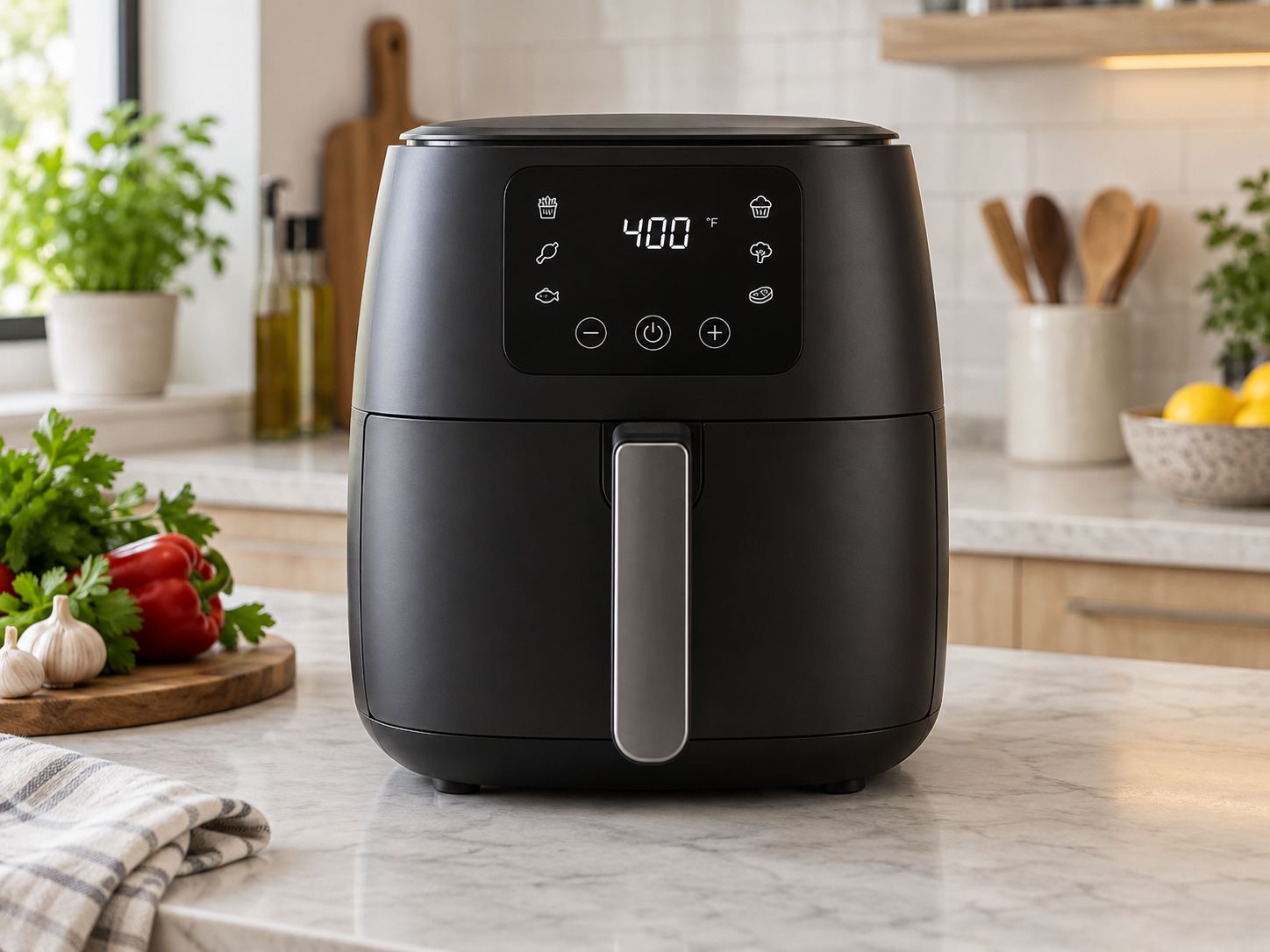
An air fryer is a compact countertop appliance that works as a high-powered convection oven. A heating element warms the air, and a fan pushes it through a chamber holding a perforated basket. The fan can blow hot air at 200°C or more over and around the food. That concentrated design cooks small portions quickly and gives them a browned, crisp surface. The name is a misnomer, because nothing is fried in oil. Rapid surface dehydration triggers Maillard browning, which produces the golden color and savory flavor people associate with deep-fried food, usually with only a light oil spray. Because it needs little or no oil, the result carries less fat and fewer calories than deep frying. It suits small portions, speed and easy cleanup, but it struggles with wet batters and large batches.
The appliance earns its place through speed and convenience. Its small chamber heats quickly, so meals often start cooking within minutes instead of waiting on a full-sized oven to come up to temperature. That makes it a handy tool for roasting vegetables, reheating leftovers and cooking proteins such as chicken wings or salmon, especially when you are cooking for one or two people. Reheating shows the difference clearly. Moving air restores crispness to foods that a microwave would leave soft, because it dries the surface while warming the interior. Many households therefore treat it as an everyday companion to the oven rather than a replacement for it.
Understanding its limits matters just as much as knowing its strengths. Wet batters need hot oil to set, so they simply drip and run in a stream of moving air. Capacity is the other constraint. Household baskets hold modest amounts, and a crowded basket blocks airflow, which undermines the very crisping the appliance is built to deliver. Delicate baking and large roasts also fall outside its comfort zone, since the chamber is small and the heat is intense. The sections that follow look at how the machine works, what it is made of, what to cook and how it compares with other appliances.
An air fryer works by using a heating element and a powerful fan to drive superheated air at high speed around the food in its basket. Heat transfers quickly from that moving air into the food. The fan directs hot air toward the food container, and the small chamber keeps that heat concentrated rather than letting it spread through a large cavity. Most models operate from 180°F to 400°F. Fast-moving air also strips away the thin, insulating boundary layer of cooler air that clings to the surface of food. Without that barrier, heat reaches the food more directly, so it cooks faster and more evenly. In a still oven, that layer lingers and slows the transfer of heat, which is one reason conventional cooking takes longer.
Speed is the most noticeable result. Foods that take 30-40 minutes in a standard oven can often be ready in 15-20 minutes in an air fryer, though exact timing depends on the model and the food. The shorter time comes from the combination of intense airflow, a compact chamber and very little preheating, since there is far less air and metal to warm than in a full-sized oven. Because cooking runs faster, it is easy to overshoot. Checking food a few minutes before a recipe’s expected finish helps you avoid dry or burnt results. Basket-style units also let you pull the basket out mid-cook to check progress without losing much heat.
Browning is the second major effect. As hot air sweeps across the food, moisture leaves the surface rapidly, and the drying surface begins to brown through the Maillard reaction. This is what creates a crisp crust on potatoes, chicken skin and vegetables, even though the interior stays tender because the food is cooked quickly. A dry surface browns far better than a wet one, which is why patting food dry before cooking makes a noticeable difference. The small chamber helps here too, because it keeps temperature and airflow high enough around the food to dehydrate its exterior efficiently.
It is called an air fryer because it imitates the crisp texture of fried food, even though it does not fry. No food is submerged in oil; hot moving air does the cooking. In effect, the machine is a compact, high-powered convection oven moving hot air around food. The label is a marketing shorthand for the results rather than a description of the technique. True frying surrounds food with hot oil, which cooks and browns it at once. An air fryer instead dries the surface and browns it through the Maillard reaction. That difference is why the appliance is better described as an oven that happens to produce fried-style crispness.
Oil still has a modest role. Only a tiny amount is needed, if any, depending on the food, and a light spray helps surfaces brown and carry seasoning. Foods with natural fat, such as chicken wings or salmon, can render enough of their own fat to crisp without added oil, while lean vegetables and potatoes benefit from a light coating. A small oil spray bottle adds flavor without leaving food greasy, which gives you control that a deep fryer cannot offer. The outcome is a golden exterior achieved with far less oil than the fully immersed method requires.
Expect a similar texture, but not an identical one. A deep fryer produces the rich, evenly blistered finish that comes from oil surrounding every surface of the food. Air frying gives a drier, lighter crispness that many people find satisfying, particularly for fries, wings and breaded items, but it will not fully duplicate a pub-style deep-fried result. This is also why wet batter fails. Without oil to set it quickly, the batter drips off or turns gummy instead of forming a shell. Knowing the difference helps you set realistic expectations and choose recipes the appliance handles well.
Yes, an air fryer uses the same principle as a convection oven, circulating hot air with a fan, but it does so with more intensity in a much smaller space. The compact chamber and high-speed fan create a more intense cooking environment than a standard oven. A basket with perforations replaces wide racks, letting air reach food from all sides. Size also affects heating. A larger oven volume takes longer to heat even at the same power as an air fryer, so the smaller unit preheats and cooks faster. The trade-off is capacity, since a full oven can handle much bigger loads and more varied cooking jobs.
The line between the two categories is blurry because many products combine them. Air fryer toaster ovens add a fan and air fry mode to a small oven with racks. Multi-cooker lids add air frying to a pressure cooker or similar pot, and some convection microwaves offer comparable hot-air cooking. These hybrids trade some of the standalone air fryer’s concentrated airflow for flexibility, giving you more functions in one appliance. Whatever the form, they all rely on fan-driven hot air, so the cooking principles remain the same.
The main parts of an air fryer are a heating element, a fan, a cooking chamber, a perforated basket and a crisper plate or tray. Together they heat air and move it around food. The element sits above or near the food and produces the heat, while the fan circulates that heat through the chamber. The basket or tray holds food while letting air pass through. Accessories vary by model and include racks, liners, baking pans, trivets and paddles. These extras expand what you can cook, though materials differ, so check what the manufacturer recommends. Wattage works as a general indicator of power, since higher-wattage units have more capacity to generate heat.
Air fryers come in two main design categories: basket-style and oven-style. Basket-style units hold food in a pull-out drawer or basket, while oven-style units use a door and removable trays or racks. Despite the different layouts, both share the same core parts, so the cooking principle does not change between them. Basket-style models tend to be compact and straightforward, and shaking the basket mid-cook is easy. Oven-style models spread food across trays, which can make it simpler to cook larger or more varied loads. The better choice depends on how much you cook and how much counter space you can spare.
Each component affects results in practical ways. The perforations in the basket and the crisper plate let air flow beneath the food, which helps the underside crisp rather than steam. The fan and vent require clear space, so avoid stuffing the chamber or covering openings. Removable baskets, trays and plates are usually the pieces you wash after cooking, so how easily they detach influences how simple cleanup feels day to day. Knowing these parts also makes troubleshooting easier when food cooks unevenly or fails to brown.
An air fryer is used for fast, crisp cooking of small portions, including roasted vegetables, reheated leftovers, fries, wings, salmon and other proteins. Frozen snacks such as fries, mozzarella sticks and fish sticks cook faster than they do in an oven, which makes the appliance popular for quick sides and snacks. Vegetables roast well too. Brussels sprouts, zucchini, bell peppers and sweet potatoes pick up browned edges and tender centers within a short cooking time. Chicken wings, steak, fish and pork chops cook evenly and finish with a crisp exterior, provided they fit in a single layer.
Some models stretch beyond basic crisping. Small-batch baking is possible in air-fryer-safe dishes, and certain units include a dehydrating setting for drying foods at low temperatures. These uses depend on the model and its capacity, so they work best for small recipes rather than full-size cakes or large trays of baked goods. Reheating is another strong use, since moving air revives crispness in foods like pizza slices and fries instead of leaving them soft. Fitting the food to the basket matters more than the recipe, because overcrowding is the most common obstacle to good results.
A few categories show what the appliance does best. Think of it as a tool for foods that benefit from dry, intense heat and a short cooking window, where a crisp outside and tender inside are the goal. It is less suited to foods that need liquid, gentle heat or bulk, which the next sections address. Matching the food to these strengths makes the machine feel useful rather than disappointing.
You should not cook wet batters in an air fryer, nor very large items or big batches. Wet batter needs hot oil to set, so in an air fryer it drips off or stays soft. Dry breadcrumbs or panko coatings work well instead, because they crisp in moving air. Delicate baking is another weak spot, since strong airflow and intense heat can disturb batters and doughs. Size is the other limit. Household models offer usable space of about 2-5 litres, so larger groups need to cook in multiple batches. A whole chicken, rack of ribs or full roasting joint will not fit a standard basket, and those foods suit a regular oven.
Overcrowding deserves special attention because it undermines the main strength of the appliance. Packing the basket blocks airflow, so food steams and turns soft rather than crisping. Cooking in smaller loads takes a little longer overall but gives far better texture than one overfilled basket. Spreading food in a single layer and leaving gaps between pieces lets hot air reach every surface. When a recipe calls for more food than fits comfortably, split it into rounds instead of forcing it in.
Oven-safe metal, ceramic and glass dishes are generally safe to use in an air fryer, as long as they fit the chamber and leave room for air to move. The fit matters as much as the material. A dish that fills the basket blocks circulation, so food cooks unevenly and browns poorly. Measure the interior before buying pans, and leave clearance around the sides and top of the dish. Always check manufacturer guidance for the materials your particular model permits.
Liners and trivets can help with cleanup and elevation, but they must be used carefully. Keep them from blocking the fan or touching the heating element. A liner placed under food and weighed down by it is safer than a loose sheet that can lift. Perforated liners preserve airflow, while solid sheets can block the openings that let air pass beneath the food. Use them only where the manufacturer allows, and never cover the full base of the basket.
Light foods need attention too. Light leafy foods can be lifted by the fan into the heating element, where they may scorch or become a hazard. Weigh down very light items or avoid cooking them in loose form, and secure any lightweight accessories so they cannot shift when the fan runs. This is also why unsecured paper or foil can be risky when no food holds it down. If something could blow around, it is better to leave it out.
Ventilation is the final safety point. The vent on the back of the unit must not be blocked, because it lets hot air and steam escape during cooking. Position the appliance with open space behind it, away from walls and cabinets, so heat does not build up. Blocked airflow can cause poor cooking results and may strain the appliance. Check the manual for clearance recommendations and follow them whenever you place the unit.
To use an air fryer, preheat it briefly, dry the food, add a light coat of oil, arrange it in a single layer, then set the temperature and time. Leave room for air to move, and avoid overcrowding the basket, since crowded food steams instead of crisping. An oil spray bottle adds flavor without making food greasy, and a thin coating is enough for most vegetables and potatoes. Pat wet or marinated items dry first, because surface moisture slows browning.
Timing needs close attention. An air fryer cooks more quickly than a traditional oven, so watch the clock to avoid overcooking. When converting an oven recipe, start by shortening the time and check early, since many foods finish well ahead of the oven schedule. Shake the basket or flip the food halfway through so every side is exposed to the airflow, then confirm doneness by sight, texture or a thermometer for meats. Over time, you will learn how your model behaves and can adjust accordingly.
Common mistakes are easy to avoid. Overcrowding, wet food and excess oil are the usual causes of soggy or smoky results. Keep portions modest, dry the surface and use only a light spray. After cooking, let the unit cool, then wash the basket and tray according to the manufacturer’s instructions, since removable parts are typically the ones that collect grease. Wiping the interior regularly prevents buildup that can smoke on later uses.
Air fryer food can be a lighter choice than deep-fried food, because it uses minimal oil and so lowers fat and calories. Less oil or none lowers the calorie and fat content of the prepared food. The benefit comes mostly from skipping the oil in which deep-fried foods are immersed and which then absorbs into them. Still, the appliance only changes the cooking method, not the ingredients. Health depends on what you cook and how long you cook it.
The food choice matters most. Roasted vegetables and lean proteins in an air fryer are a different proposition from heavily processed frozen snacks, even if both come out crisp. Seasoning and sauces also shape the result, so a light hand with salt and sugary coatings helps keep meals balanced. This is general information rather than personal dietary advice, and anyone with specific health needs should consult a qualified professional. The appliance is a tool; it does not make a food healthy by itself.
Browning starchy foods raises another question: acrylamide, a compound that can form when starchy foods are cooked at high heat. Studies show air frying can reduce acrylamide formation in starchy foods compared with some other methods. However, long or high-heat cooking of starchy food increases acrylamide, whether in an air fryer or an oven. Aiming for a golden color rather than a dark brown or burnt finish is a sensible approach. Watching time and temperature keeps both flavor and cooking quality in check.
An air fryer differs from a deep fryer, oven and toaster oven mainly in how it heats food, how much it holds and how much oil it needs. Air fryers need practically zero preheat, while a deep fryer can take upwards of 10 minutes to heat its oil. Air fryers also need little to no oil, whereas deep fryers require a lot, and that oil absorbs into the food. Ovens offer more space and baking versatility, and toaster ovens sit in between.
Chamber size explains much of the speed difference. An oven has a larger volume and takes longer to heat than an air fryer at the same power. The air fryer’s compact space and strong fan concentrate heat and airflow, so food cooks faster. A toaster oven can offer more versatility, and models with air fry modes combine small-oven flexibility with convection airflow. The table below compares general characteristics across the shared criteria.
Choosing among them depends on what you cook. Deep fryers suit wet batters and the classic fried texture, ovens handle large batches and baking, and toaster ovens cover small versatile jobs. Air fryers are strongest for quick, crisp portions with less oil and simple cleanup. Many kitchens keep an oven alongside an air fryer, using each where it performs best. Weighing capacity, speed and the foods you cook most will point you to the right match.
| Appliance | Heat transfer | Preheat | Capacity | Oil use | Cleanup |
|---|---|---|---|---|---|
| Air fryer | Fast hot air | Practically none | Small | Little to none | Removable parts |
| Deep fryer | Oil immersion | 10+ minutes | Varies | A lot | Oil disposal |
| Oven | Radiant or convection | Longer | Large | Optional | Larger interior |
Air fryers are worth it for small households that value quick meals, reheating and easy cleanup, and less so for large families or anyone who needs batch cooking or wet-batter dishes. The appliance shines when you cook modest portions often, because it heats fast and produces crisp results. If you regularly feed a crowd, you will cook in multiple rounds, which erodes the time savings. Your usual cooking habits are the best guide to whether one will earn its counter space.
Capacity should match your household. A 1.2 L model suits 1-2 people, 3-4 L suits 2-3 people, and 6 L or more suits 4-6 people. Extra-large models of 8 quarts or more are also available, including dual-basket and oven-style designs that handle bigger or separate dishes. Oversized units use more counter space, so consider where it will sit. Choosing too small a basket leads to overcrowding, while too large a unit can be wasted on small meals.
Prices vary widely, from budget units under $50 to high-end smart appliances over $300. A basic model covers the core job of fast crisp cooking, while higher-priced options typically add size, extra functions or connected features. Paying more makes sense when you need the capacity or versatility, not simply for extra settings. Start with the foods you cook most and the number of people you feed, then choose the size and features that fit.
