
Our Location
304 North Cardinal St.
Dorchester Center, MA 02124

 ByAlan
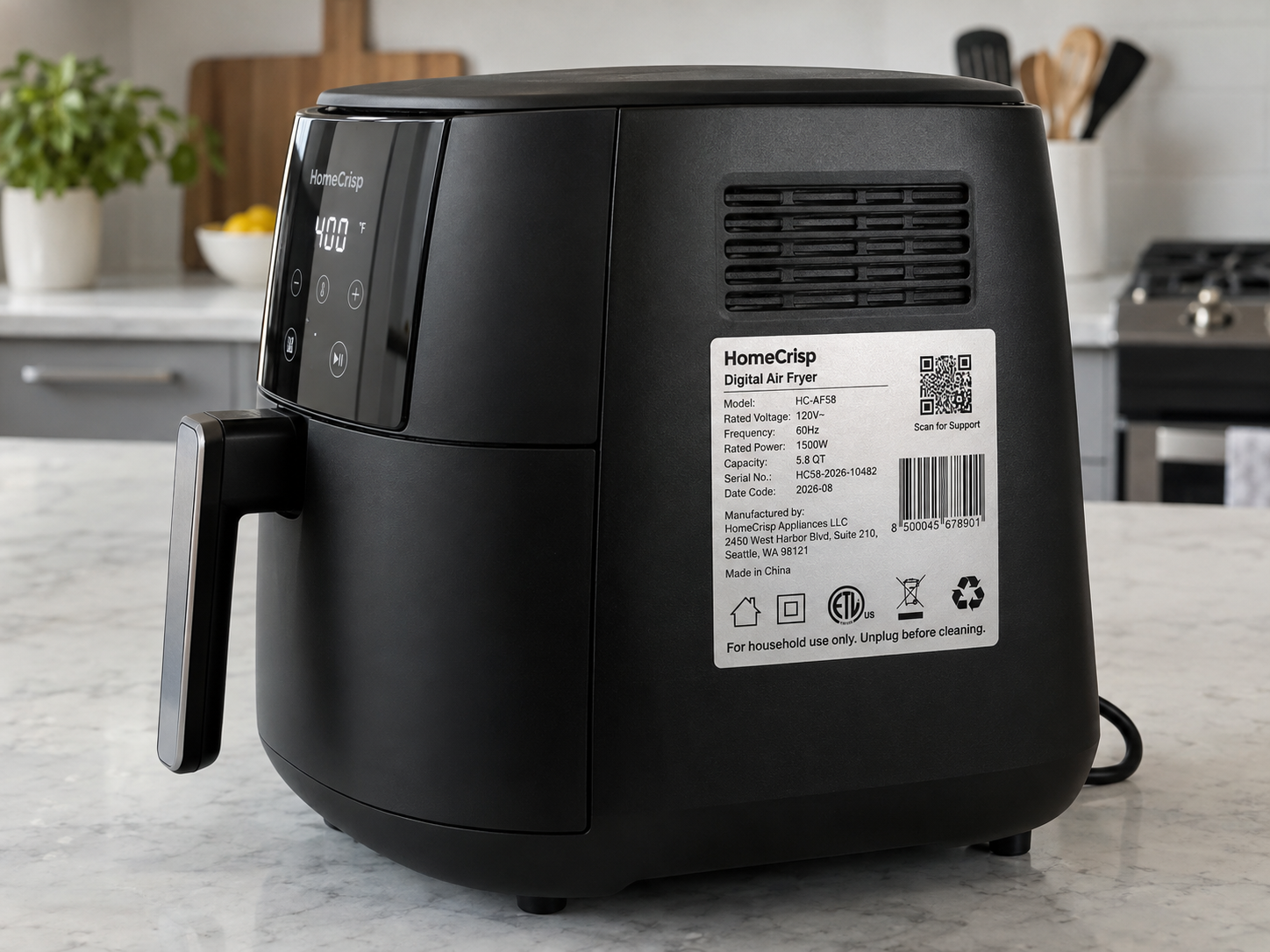
Air fryer wattage is the rate at which the appliance converts electricity into heat and airflow, powering both the heating element and the fan. In practice, it shapes how quickly the unit preheats, how fast it recovers heat after you open the basket, how evenly food crisps, and how much current it pulls from your circuit. Higher wattage can mean faster, steadier cooking, but it also places a heavier load on a kitchen outlet, so the number matters for both performance and safety. The rating is not the same as energy used, though. Wattage describes power at a moment in time, while total consumption depends on runtime.
A 1,500-watt air fryer running for 30 minutes uses about 0.75 kWh, because energy equals wattage multiplied by hours of use. That is why air fryers can look power-hungry on a label yet still be economical in daily use. Their small cooking chamber heats quickly and meals finish in less time, so the appliance often uses less electricity per meal than a large oven. Short cook times and a compact chamber drive efficiency, not a low wattage figure alone.
Most air fryers draw between 1,200 and 2,000 watts, depending on size, temperature setting and cooking mode. Rated maximum power commonly falls between 1,400 and 1,800 watts, and that figure describes what the unit can pull when its heating element is fully on, not a constant draw. Once the air reaches your set temperature, a thermostat switches the element off and on to hold it there. During active cooking, that cycling gives an average duty cycle of roughly 68 to 75 percent, so real consumption runs below the label figure.
The exact wattage for your unit is printed on its product label, usually on the underside or back of the base. You can also find it in the owner’s manual or on the manufacturer’s spec sheet. Use that number rather than a general class average when you calculate running costs or check how much load your outlet can handle. Two air fryers of similar capacity can carry different ratings, and the label is the only reliable guide for your specific model.
Air fryer wattage rises with size: small models typically use 800 to 1,200 watts, medium ones 1,200 to 1,800, and large or dual-drawer units 2,000 to 2,600. Bigger chambers and dual zones need more power to hold heat across a larger volume of air. Single-drawer models sit around 1,500 watts, while twin-drawer models come near 2,600 watts, according to Electrical Safety First as cited. Treat the ranges below as typical bands, not guarantees for any one product.
Brand and model matter, so check each manual or label rather than assuming a class wattage. A dual-drawer unit may split its power between two compartments, and its peak draw can approach the limit of a standard household circuit. Capacity in quarts is a useful starting point, but design, fan strength and mode settings all influence the final rating. Confirm the printed number before plugging a large unit into a shared kitchen outlet.
| Size | Typical wattage |
|---|---|
| Small (1-2 qt) | 800-1,200 W |
| Medium (3-6 qt) | 1,200-1,800 W |
| Large or dual-drawer | 2,000-2,600 W |
A good air fryer wattage is one matched to your basket size and circuit, not simply the highest number available. A unit that is too weak for its basket struggles to hold heat, while one that is more powerful than your outlet can comfortably supply invites tripped breakers. Fit comes first: capacity should reflect how much food you cook at a time and who you cook for. Power then needs to suit the circuit it will run on.
Is 1,500 watts a lot? It is mid-range and close to a typical choice for a standard air fryer. At that rating, the unit draws about 12.5 amps on a 120-volt supply, which is workable for most kitchens if little else is running on the same circuit. It offers brisk heating without moving into the dual-drawer territory that approaches 2,600 watts. For many households it is a sensible, balanced middle.
Household size changes the answer. A 4 to 6 quart model at 1,500 to 1,700 watts is suggested as a sweet spot for one or two people in a NYC apartment. Smaller models are more energy-efficient for singles or couples because they heat less air and food. A family of four generally needs a larger basket, which usually means higher wattage. Larger models suit large families, provided the kitchen circuit can support them.
Wattage matters for cooking performance, but higher wattage does not automatically produce crispier food. The real factor is the ratio of basket size to power. Your set temperature is the same regardless of wattage; what changes is how fast and how steadily the unit reaches and holds it. A lower-wattage unit can perform well with smaller loads, while an underpowered unit for its basket size tends to produce soggy food.
The clearest difference shows up in preheating. An 1,800-watt model reaches cooking temperature in about 2 to 3 minutes, while an 800-watt model can take 8 minutes or more. More generally, higher wattage often means a preheat of 2 to 3 minutes versus 5 or more. Faster heating also helps after you open the basket to shake or flip food, since the unit recovers lost heat sooner. That quicker recovery supports more even crisping.
Higher wattage comes with a trade-off: it also draws more electrical current. A powerful unit may cook beautifully but leave less room on a shared circuit for other appliances. Weigh speed and recovery against your kitchen’s electrical limits rather than chasing the largest number. For small portions, a modest-wattage model can be entirely adequate and easier on the circuit.
An air fryer’s power use depends mainly on its capacity and design, the temperature and time you choose, and how often you use it. Larger basket units and higher cooking temperatures increase power draw, while lower-heat settings use less electricity. Dual-drawer designs generally carry higher ratings than single baskets. Daily or multiple daily uses add up on electricity bills, even when each individual session is short.
Load size and element cycling also play a role. A fuller basket asks the heating element to work harder to recover heat, while a light load lets it switch off more often. Preheating adds extra running time before any food is cooking. Because the thermostat holds temperature by turning the element on and off, actual consumption stays below the rated figure. The main influences are:
Volts measure supply voltage, amps measure current, watts measure power, and watt-hours measure energy over time. They connect through a simple relationship: watts equal volts multiplied by amps, so amps equal watts divided by volts. A 1,500-watt air fryer on a 120-volt circuit draws roughly 12.5 amps while running. That current figure is what matters for breakers and cords, while watts describe how quickly the appliance uses energy.
Rated running watts and total energy consumed are different things. Watt-hours measure energy over time, and kilowatt-hours, or kWh, are the units typically shown on household bills. A high-wattage fryer that runs briefly can use less energy than a lower-wattage appliance left on for a long time. Keep power rate and energy used separate when reading labels or estimating costs.
| Unit | Measures |
|---|---|
| Volts | Supply voltage |
| Amps | Current |
| Watts | Power |
| Watt-hours | Energy over time |
A typical 25 to 30 minute air fryer cycle uses roughly 0.35 to 0.65 kWh. That figure sits below what the label might suggest because the heating element cycles off after the unit reaches its set temperature. Real usage therefore runs lower than rated power multiplied by time. The result depends on your model, temperature, load and how long you cook.
The basic formula is energy equals wattage multiplied by hours. A 1,500-watt air fryer running for 30 minutes would use about 0.75 kWh if the element ran at full power the whole time. That calculation gives a conservative upper estimate for continuous operation. Since thermostat cycling reduces the average draw, actual consumption for the same cook often lands lower.
Because cook times are short and the chamber is small, a single meal rarely uses much electricity. The bigger effect comes from repetition, since daily or multiple daily uses add to monthly consumption. Small habits such as skipping unnecessary preheats and cooking full batches can trim that total. Understanding per-meal energy helps you judge the appliance fairly against alternatives.
To calculate air fryer running cost, convert watts to kilowatts, multiply by hours of use, then multiply by your local electricity rate. Energy in kWh equals wattage divided by 1,000 times operating hours. Follow these steps with the wattage from your unit’s label. The result is the estimated cost of a single cooking session.
Take a 1,500-watt model running for half an hour: 1,500 divided by 1,000 gives 1.5 kW, and 1.5 kW times 0.5 hours gives 0.75 kWh. Multiply that by your price per kWh to get the cost. Your utility bill shows the rate, which varies by region and sometimes by time of day. Because real draw is lower with element cycling, the answer is a cautious estimate.
Does higher wattage cost more to run? Only if the runtime stays equal. A more powerful unit that preheats faster and finishes sooner can use similar or even less energy than a weaker one that needs longer. Compare watts multiplied by time, not wattage alone. Cost follows total kWh, so shorter cooking at higher power can offset the higher rating.
An air fryer often uses less total electricity per meal than an oven, because it heats a smaller chamber and cooks faster. Ovens may run at lower wattage for much longer, so wattage difference alone is misleading. A fair comparison multiplies watts by time. The figures below illustrate that point using shared criteria.
A 1,500-watt air fryer that cooks in about 20 minutes uses less energy than a 2,400-watt oven needing about 35 minutes. Against a conventional 3,500-watt electric oven, an air fryer uses 70 to 80 percent less electricity per meal. The smaller cavity needs less heating, and shorter preheating further cuts the total. These comparisons assume a similar dish cooked in each appliance.
There are exceptions. Large batches may favor the oven, since an air fryer would need several rounds to cook the same quantity. Microwaves, which heat food directly, can also use little energy for reheating, though they brown and crisp food differently. Choose by what you are cooking and how much. For small to medium portions needing crisp results, the air fryer is usually the efficient pick.
| Appliance | Example |
|---|---|
| Air fryer 1,500 W | About 20 min |
| Electric oven 2,400 W | About 35 min |
An air fryer can trip your circuit breaker if other high-draw appliances share its circuit. A standard 15-amp household circuit at 120 volts has a continuous limit of about 1,440 watts under the 80 percent rule, and a maximum of about 1,800 watts. A 1,500-watt air fryer draws about 12.5 amps, which is already near that limit. There is little headroom for anything else.
Shared loads cause most trips. A 1,000-watt microwave or 900-watt toaster running alongside the air fryer on the same circuit can exceed the limit. An 1,800-watt air fryer combined with a 1,000-watt microwave exceeds 23 amps and can trip the breaker. Knowing which outlets share a breaker is the key to avoiding surprises.
Use these practical steps: Plug the air fryer directly into the wall rather than a power strip or extension cord, which can add resistance and heat. Stagger appliances so the microwave, toaster and fryer do not run together. A dedicated outlet gives the most reliable result. If trips continue, move the fryer to a different circuit or choose a lower-wattage model.
A generator, inverter or power station can run an air fryer if its continuous output exceeds the appliance’s wattage with some headroom. A 2,000-watt inverter can cover a 1,500-watt unit, since it leaves a margin for startup and heating. Guidance commonly suggests at least 2,000 watts of continuous output. Check both the surge and running ratings before relying on a setup.
Dual-drawer models need higher output because their ratings approach 2,600 watts, which would overload a 2,000-watt source. The Anker SOLIX S2000 has 2,010 Wh of capacity and 1,500 W of continuous AC output, matching a 1,500-watt air fryer closely. Matching continuous output to the label wattage is more important than the battery’s size alone. Always leave headroom rather than running at the limit.
To estimate runtime, multiply battery watt-hours by an efficiency factor, then divide by the air fryer’s wattage. Inverter losses mean you never get the full rated capacity at the outlet. Because the element cycles, real runtime is often longer than the estimate suggests. Short, efficient cooking sessions stretch a battery much further.
Choose air fryer wattage by basket capacity, household size and circuit limits, not by the highest number. A right-sized basket suits the food you cook and avoids wasting energy heating unused space. Matching appliance size to food quantity reduces wasted energy. Smaller households can pick a modest model, while families may need a larger basket and a higher rating.
There is a trade-off between speed and circuit load. Higher wattage offers faster preheat and quicker recovery, but it draws more current and may crowd a shared circuit. Think about where you will plug the unit in and what else runs nearby. Excessive preheating can contribute to higher energy consumption, so heat only as needed. Adjusting settings and cooking efficiently keeps both bills and breaker risk low.
A few habits cut energy use without hurting results. Batch cooking fills the basket and makes each run count, while shorter cook times and lower-heat settings reduce consumption. Preheating efficiently, or skipping it for forgiving foods, saves further. Key tips include:
