
Our Location
304 North Cardinal St.
Dorchester Center, MA 02124

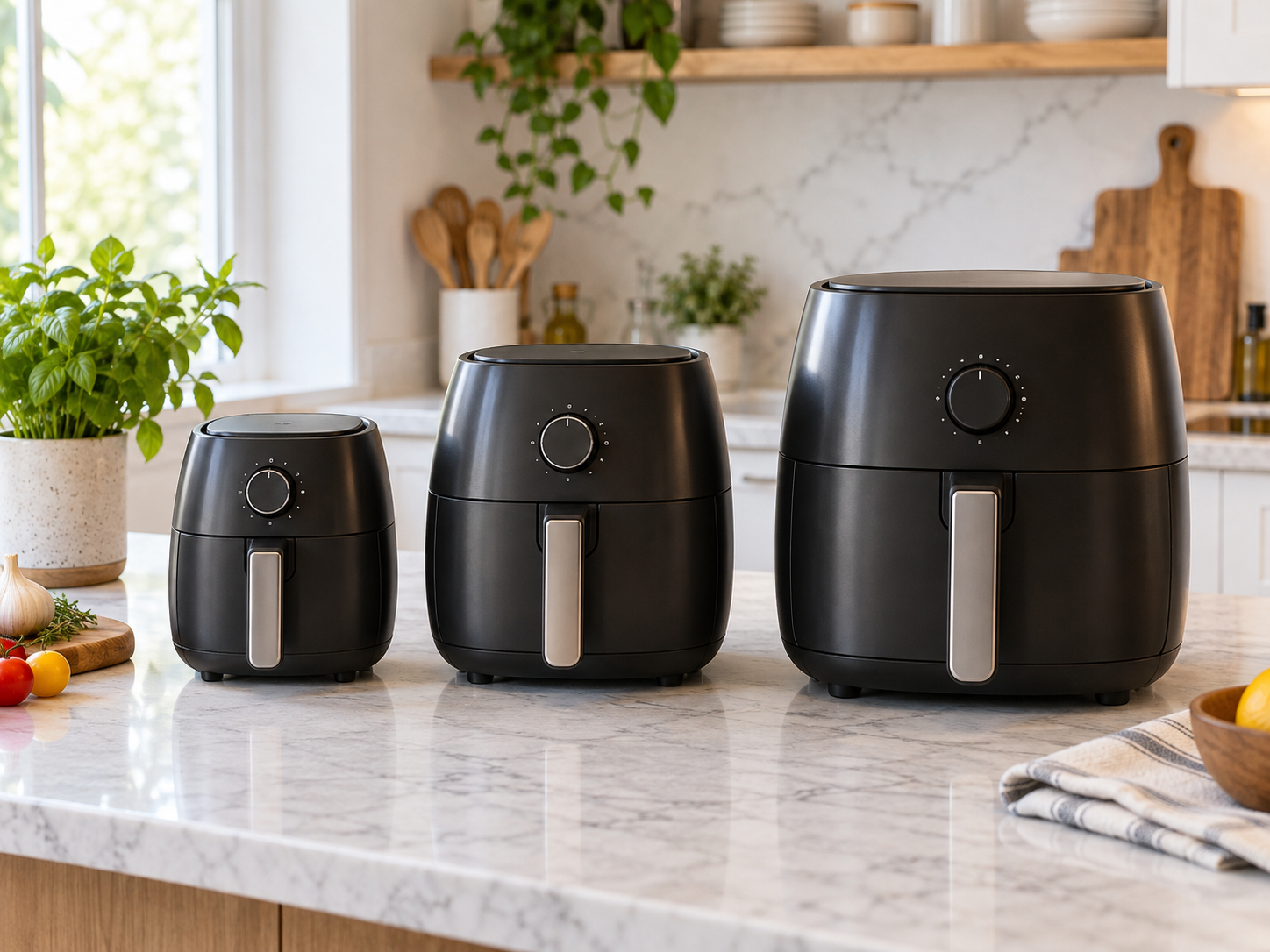
Air fryer sizes describe the rated volume of the cooking chamber, measured in quarts across a range that runs from under two quarts to more than twenty. The number printed on the box states total basket volume, while the food a basket holds in a single layer measures roughly two thirds of that figure.
Air fryer sizes fall into five practical tiers, and each tier feeds a predictable number of people from a single basket load. Wattage, footprint, and cooking time all scale with the quart rating, so the chosen size decides counter space and circuit load as much as portion count.
Household count sets the starting point, and a three-quart basket serves one person while a nine-quart dual-basket model serves a household of five or more. Food shape matters as much as headcount, and a flat cutlet demands basket floor area that a shakeable batch of fries does not require at the same weight.
This article defines air fryer sizes, measures every quart tier from mini to extra-large, separates rated capacity from usable capacity, and covers dimensions, servings, wattage, cooking time, limitations, and the three checks that identify the size of an existing unit.
Air fryer sizes are the rated chamber volumes manufacturers print on the box, expressed in quarts in the United States and in liters across most other markets. One quart converts to 0.95 liters, so a six quart basket measures 5.7 liters and a four liter model typically measures slightly over four quarts of rated volume.
The rating covers the whole chamber and not the food, which means a basket can accept far less food than its rated number suggests once air has to circulate around it. Reading the quart figure as chamber volume instead of food volume prevents an undersized purchase, and the measurement method behind the quart figure explains its gap.
Air fryer sizes come from a water fill of the empty basket to its rim, a method that records total geometric volume instead of the room food occupies. United States models carry quart ratings while European models carry liter ratings, and the two scales sit close enough that a five liter unit typically reads as 5.3 quarts.
Oven-style units break the pattern by carrying cubic foot ratings, and their one cubic foot cavity equals nearly thirty quarts of the same geometric volume. Converting every rating into one unit before comparing two models prevents a mismatch between quarts and liters on two spec sheets, and the chosen volume then changes how food cooks inside the chamber.
Air fryer size changes how food cooks because basket floor area determines how much of each piece meets moving hot air rather than a neighboring piece. Larger chambers carry larger fans, and their fan diameter climbs from roughly 3.4 inches in a two quart unit to six inches in the six and eight quart tiers above.
Airflow volume rises with that fan diameter, so a larger basket recovers its temperature faster after the drawer opens and browns a full load more evenly. Matching basket floor area to the flattest food a household typically cooks prevents stacked pieces, and the same volume question separates these baskets from the cavity of a full oven.
Air fryer sizes run from two to twenty-six quarts, while oven capacity runs from two to six cubic feet, a difference of roughly one order of magnitude. A standard thirty inch oven holds about five cubic feet, which converts to roughly 150 quarts and dwarfs the largest countertop basket by a wide margin.
Usable cooking surface tells a different story, and an oven rack accepts a half sheet pan while a six quart basket accepts about one hundred square inches of floor. Treating the two ratings as separate scales prevents a false comparison between quarts and cubic feet, and the quart range itself divides into five distinct tiers of its own.
Air fryer sizes divide into five tiers by quart rating: mini, small, medium, large, and extra-large, with each tier separated by roughly two quarts of volume. Tier boundaries track household count more closely than they track price, and the jump from four to six quarts typically adds one full serving to a single load.
Every tier shares one heating element and one fan arrangement, so the tier decides portion count and its footprint rather than the cooking method itself. Placing a household inside one of the five tiers before shopping prevents a basket bought two sizes wrong, and the mini tier sits at the bottom of the range at 1.6 quarts.
A mini air fryer size holds 1.6 to 2.5 quarts and feeds one person, cooking about six chicken wings or a single serving of vegetables per load. Its wattage typically stays between 800 and 1,300 watts at this tier, the lowest draw of any air fryer size, and the unit occupies under one square foot of counter.
Basket floor area near sixty square inches limits a mini unit to one layer of a single food, which cannot hold a main dish and a side together. Confirming that a household eats one portion at a time before buying the smallest tier prevents constant batch cooking, and the small tier answers that limit with more floor area.
A small air fryer size holds 3 to 4 quarts and feeds one or two people, cooking 8 to 12 chicken wings or two small chicken breasts. French fry capacity reaches roughly one and a half pounds at this tier, and a six inch baking pan can fit inside the basket for cakes and small casseroles.
Its usable floor area typically runs sixty to seventy-five square inches at this tier, enough for one flat layer of a main dish without a second food beside it. Checking whether a weekly menu generally includes a main dish and a side in the same run prevents a small basket from becoming the bottleneck the medium tier removes with its wider floor.
A medium air fryer size holds 5 to 6 quarts and feeds three or four people, cooking 18 to 24 wings or 4 medium chicken breasts. A five quart basket accepts two to three pounds of fries and a whole chicken near four pounds, while its wattage typically sits between 1,500 and 1,800 watts.
Their usable floor area climbs to between eighty-five and one hundred square inches, which places this tier at the point where a full meal can fit in one load. Counting the largest routine meal against a five quart load prevents an undersized purchase, and a larger household pushes the requirement up into the large tier above it.
A large air fryer size holds 7 to 10 quarts and feeds 4 to 6 people, cooking 30 to 40 wings or a whole chicken near 6 pounds. Its french fry capacity reaches four to five pounds at this tier, and an eight inch baking pan can fit the basket for larger casseroles and layer cakes.
Many large models split their volume into two drawers, and a nine quart unit typically runs as two independent 4.5 quart zones instead of one open chamber. Confirming whether a large rating describes one chamber or two zones prevents a basket that cannot hold a roast, and the extra-large tier removes that split with open racks.
An extra-large air fryer size holds 10 to 26 quarts inside an oven-style cabinet, feeding six or more people from racks rather than a single drawer. Two or three racks multiply its usable area, and a twenty-six quart cabinet accepts a twelve inch pizza or a nine by thirteen inch baking dish.
Its footprint grows with the volume, and an extra-large cabinet claims two to three square feet of counter against the single square foot a basket model needs. Measuring counter depth before choosing the largest tier prevents a cabinet that blocks an outlet, and every rating across these five tiers overstates the usable capacity beneath it.
Rated air fryer capacity states the volume of the empty basket, while usable capacity describes the food a basket holds in one layer, roughly two thirds of the rating. A six quart rating therefore delivers about four quarts of working space, so air has to move under, around, and over every piece inside the chamber.
Weight tells the practical story better than volume, and a single layer inside these basket models can hold about one to one and a half pounds of food. Discounting any rating by roughly a third before comparing two models prevents an overstated expectation, and a dual-basket layout splits that discounted volume once again into halves.
Single-basket air fryer sizes present one uninterrupted chamber, while dual-basket sizes divide the same rated total into two independent drawers of roughly half the volume each. A nine quart dual-basket model therefore offers two 4.5 quart zones, and neither zone can accept a whole chicken that a nine quart single basket accepts.
These two zones cook two foods at separate temperatures, which removes the second batch a single basket requires when a main dish and a side cook together. Deciding between one large zone and two small zones before purchase prevents a layout mismatch, and their exterior dimensions differ between the two layouts by several inches as well.
Air fryer size dimensions run from roughly eleven inches wide at the mini tier to seventeen inches wide at the largest dual-basket and oven-style models. Their height climbs with volume as well, and a five quart basket model stands near 13.5 inches while a nine quart dual-basket model stands near twelve inches.
Depth typically stays near twelve inches across most basket tiers, which keeps every unit inside the 24 inch depth of a standard base cabinet and its counter. Measuring the exterior rather than the quart rating prevents a unit that overhangs the counter edge, and counter space needs more clearance around it than the footprint alone.
| Air fryer size | Rated capacity | Typical footprint | Typical height |
|---|---|---|---|
| Mini | 1.6–2.5 qt | 11 x 11 in | 12 in |
| Small | 3–4 qt | 13 x 11 in | 13 in |
| Medium | 5–6 qt | 16 x 12 in | 13.5 in |
| Large | 7–10 qt | 17 x 15 in | 12 in |
| Extra-large | 10–26 qt | 20 x 17 in | 15 in |
Counter space for an air fryer size equals the footprint plus five inches of clearance at the rear and sides, where the exhaust vent releases hot air. A five quart basket model claims about one square foot of surface, and its clearance requirement generally raises the working allowance to nearly two square feet.
Upper cabinets set the second limit, since a standard cabinet run leaves eighteen inches of vertical space between the counter and the shelf above it. Measuring both footprint and cabinet height before purchase prevents a unit that cannot open under a shelf, and basket shape changes how the footprint performs at any volume.
Basket shape affects an air fryer size by setting how much of the rated volume lies flat, since a wide square basket spreads food across more floor area. A deep round basket of the same six quart rating stacks food instead, which forces a second layer and the uneven browning that this second layer can produce.
Manufacturers favor square baskets for this reason, and their square basket at six quarts typically delivers close to one hundred square inches of flat cooking surface. Comparing basket floor area alongside the quart rating prevents a deep basket bought for flat food, and floor area governs how many people each size feeds.
Air fryer sizes feed roughly one person per two quarts of rated capacity, which places a four quart basket at two servings and an eight quart basket at four. This ratio assumes one main dish in a single layer, and a menu of a main dish with a side halves the number of people one load serves.
Appetite shifts the ratio further, since a household with teenagers consumes portions closer to two adults each and can push a four person kitchen toward eight quarts. Counting servings instead of headcount prevents a basket sized for an average no meal matches, and the smallest households start that count at one or two servings per meal.
An air fryer size of 3 to 4 quarts feeds one or two people, holding two chicken breasts or a pound of fries in a single flat layer. Two people who cook a main dish and a vegetable together move up to five or six quarts, where floor area near one hundred square inches can accept both of them.
Counter space usually decides the choice at this level, and a three quart unit under a square foot suits an apartment kitchen with its short counter run. Matching the smallest tier to a two person menu prevents wasted volume and wasted preheat energy, and a family of four changes the calculation in the other direction.
An air fryer size of 5 to 6 quarts feeds a family of four, cooking 4 chicken breasts or a chicken near 4 pounds in one load. Manufacturers describe this tier as family size, and their five quart basket accepts up to four pounds of fries or five pounds of chicken wings.
Households with older children often need more, and their choice generally moves to a 6.5 quart single basket or a nine quart dual-basket model instead. Sizing for the largest routine meal rather than the average meal prevents batch cooking on weeknights, and households of five or more need more volume still.
An air fryer size of nine quarts or more feeds five or more people, and a dual-basket layout at that rating cooks a main dish and a side together. Oven-style cabinets from ten to twenty-six quarts serve the same households through two or three racks, cooking a twelve inch pizza that no basket accepts.
Its wattage at this level reaches 1,750 to 2,000 watts, which draws close to sixteen amps and typically needs a dedicated twenty amp kitchen circuit in practice. Confirming circuit capacity before installing the largest tier prevents a tripped breaker mid-cook, and food weight per tier states the same capacity in kitchen terms.
Air fryer sizes hold between one and five pounds of food per load, so the weight scales almost linearly with the quart rating across the basket tiers. A 3 quart basket takes 1 to 1.5 pounds of fries, a 5 quart basket 2 to 3 pounds, and an 8 quart basket 4 to 5 pounds.
Chicken wings track a similar curve, running 8 to 12 wings at 3 quarts, 18 to 24 at 5 quarts, and 30 to 40 at 8 quarts. Converting a weekly shopping quantity into pounds per load prevents a basket that forces two runs, and wattage rises with the volume carrying those pounds of food.
Air fryer sizes draw between 800 and 2,000 watts, and wattage climbs with chamber volume because a larger chamber needs more heat to reach the same temperature. These mini units at 2 quarts typically run 800 to 1,300 watts, medium units at 5 or 6 quarts run 1,500 to 1,800 watts, and large units approach 2,000 watts.
A standard household outlet supplies 120 volts on a fifteen amp circuit, which caps its continuous draw near 1,800 watts before the breaker becomes the limiting factor. Checking the rating plate against the circuit before plugging in a large unit prevents nuisance tripping, and higher wattage can shorten the cooking time each size needs.
Air fryer size affects cooking time through preheat duration and load density, and a larger chamber takes longer to reach its temperature than a smaller chamber does. A mini basket reaches 400 degrees Fahrenheit in about two minutes, while an oven-style cabinet of twenty-six quarts typically needs five minutes for the same setpoint.
Cooking time itself stays close across these tiers once temperature stabilizes, so most foods finish in twelve to twenty minutes at 375 to 400 degrees Fahrenheit. Counting preheat separately from cook time prevents an undersized basket from looking faster than it is, and each size carries limitations beyond the clock and the counter alone.
Air fryer sizes carry three limitations: an undersized basket overcrowds, an oversized cabinet consumes counter space, and neither extreme can store easily in a small kitchen. Overcrowding blocks airflow between pieces, which leaves the food steamed rather than crisped and adds several minutes to a cook that should finish on schedule.
Weight limits storage at the large end, since a nine quart dual-basket unit weighs near twenty pounds and stays on the counter instead of inside its cabinet. Weighing the daily footprint against the occasional large load prevents a unit that never leaves the cabinet, and a larger size handles small portions differently from a smaller one.
A larger air fryer size cooks small portions well, and a nine quart basket browns two chicken breasts as evenly as a four quart basket browns them. Their larger fans and wider baskets improve heat transfer at any load, which means excess volume costs preheat time and energy instead of cooking quality itself.
Energy cost stays modest across the gap, and a 1,800 watt unit running thirty minutes consumes 0.9 kilowatt hours against 0.75 for a 1,500 watt unit. Choosing the larger tier when counter space allows prevents the batch cooking a small basket forces, and an undersized basket browns unevenly for a mechanical reason of its own.
Food browns unevenly in an undersized air fryer because overlapping pieces shield each other from the airstream, leaving contact points pale while exposed surfaces darken normally. Moisture compounds the effect, since trapped steam between stacked pieces often holds their surface near 212 degrees Fahrenheit and stops the browning reactions above that point.
Shaking the basket redistributes these pieces and partially corrects the pattern, though a load beyond one and a half pounds in a small basket cannot cook evenly. Loading a basket to a single visible layer prevents the pale contact points entirely, and identifying the size of an existing unit starts the same calculation from its label.
Three checks identify the air fryer size of an existing unit: the rating label, a water measurement of the basket, and a count of one food layer. Each check takes under five minutes and needs a measuring cup, a flashlight, and the basket itself, with no model number lookup required at any stage.
These three checks confirm different figures, since the label states rated volume while the water test and the layer count both describe usable volume instead. Running all three checks before replacing a unit prevents an upgrade that repeats the same capacity, and the rating label gives the fastest of the three answers in under a minute.
To read an air fryer rating label, the sticker on its underside or the rear panel lists model number, voltage, wattage, and rated capacity in one block. Capacity appears in quarts, liters, or both, and a label reading 4.8 liters identifies a five quart unit, because the two scales differ by less than five percent.
Its wattage on the same label indicates the tier when the capacity line stays absent, and a figure near 1,700 watts places the unit near five quarts. Recording the label figures before any purchase prevents a replacement with the same capacity, and a water measurement verifies the label when the sticker has worn away completely.
To measure an air fryer basket volume, four cups of water poured into the empty basket equal one quart, and the count at its rim gives rated capacity. The crisper plate stays out during the measurement, because the plate displaces volume that the manufacturer already includes in the printed figure on the label.
Basket dimensions give the same answer through arithmetic, and multiplying their length, width, and depth in inches then dividing by 58 converts cubic inches into quarts. Measuring the basket instead of trusting a worn label prevents a size estimate off by two quarts, and a layer count translates that volume into servings.
To count a single layer of food, one pound of frozen fries spread across the basket floor shows whether the layer covers its surface without any overlap. A basket that holds one pound flat measures three to four quarts, while a basket that holds three pounds flat measures five to six quarts in most designs.
This layer count states usable capacity directly, which the rated figure never does, and the result predicts how many people one load feeds at a sitting. Running the layer count before an upgrade prevents a purchase that repeats the current limit, and the three figures together drive the final size choice.
Air fryer size selection follows three figures in order: servings per meal, usable floor area of the basket, and counter space the unit occupies with clearance. Servings set the tier at roughly two quarts per person, which puts one or two people at three or four quarts and a family of four at six.
Menu shape adjusts that figure upward, and a household cooking a main dish with a side in one run moves to a dual-basket model at nine quarts. Confirming that the chosen footprint plus five inches of clearance fits the available counter before purchase prevents a unit that never reaches the counter at all.
