
Our Location
304 North Cardinal St.
Dorchester Center, MA 02124

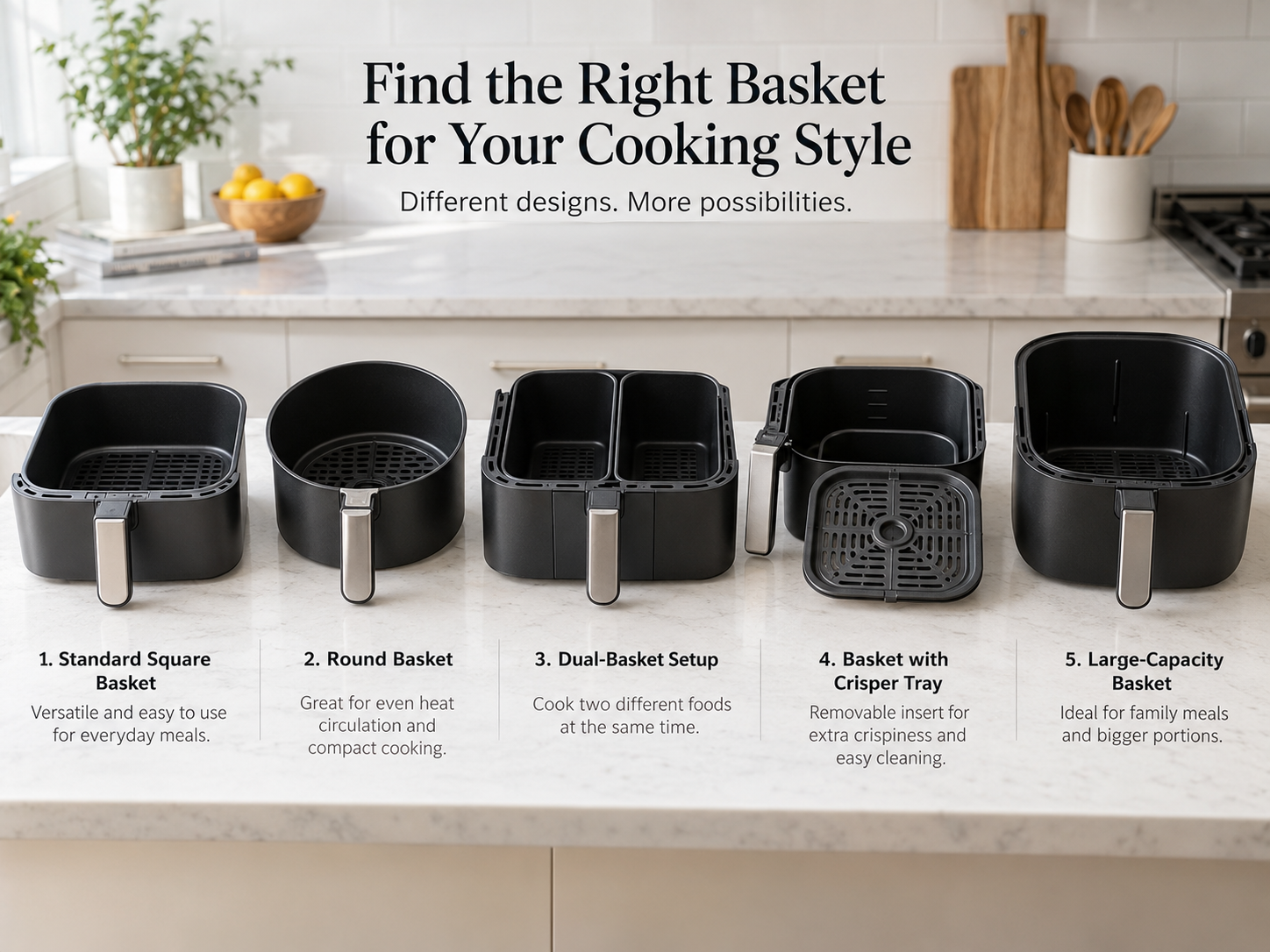
What is an air fryer basket is a question best answered by the part itself: the perforated drawer or insert that holds food inside the cooking chamber. Basket design sets the airflow under the food, the surface area available for a single layer, and the cleaning routine every cook repeats after dinner.
An air fryer basket is the perforated drawer that holds food while hot air passes through it, and its surface area matters more than its quart rating. Styles run from a single pull-out drawer to dual zones and flat trays, and coatings range from conventional non-stick to ceramic and bare stainless steel.
Quart ratings describe volume, while browning depends on the floor area a basket offers, which runs from 28 square inches on a 2-quart model to 75 square inches on a 6-quart model. Overcrowding that floor traps steam between the pieces, and trapped steam is the single reason air-fried food turns out pale instead of crisp.
This article explains what an air fryer basket is, the styles and sizes available, the coatings on the cooking surface, the cleaning routine each one needs, and the method for identifying the basket already sitting on a kitchen counter.
An air fryer basket is the perforated container that holds food inside the cooking chamber while the fan drives heated air across every exposed surface. Most baskets combine an outer drawer that catches drippings with a removable inner basket or crisper plate, and those perforations let air reach the underside of the food instead of sealing the food against a flat metal floor for the whole cook.
Basket construction usually starts with stamped aluminum or steel, which conducts heat quickly and carries a non-stick coating across every surface food actually touches during a cook. Recognizing the basket as the working surface of the whole appliance explains most cooking results, and the job of the basket inside the chamber follows directly from this airflow under the food.
An air fryer basket does three jobs at once: it supports the food, it channels air underneath through perforations, and it collects the fat that renders out. Airflow under the food matters, as contact with a solid surface blocks convection at the point of contact, and a blocked underside steams instead of browning during the 15 or 20 minutes a basket load needs.
Basket walls also reflect radiant heat from the element back toward the food, which explains why pieces near the wall typically brown faster than pieces in the center. Treating the basket as part of the heating system prevents disappointing results with frozen food, and the materials behind the performance of a basket deserve a closer look before any purchase.
An air fryer basket is made of aluminum or stainless steel, finished with a PTFE non-stick coating, a ceramic non-stick coating, or no coating at all. Aluminum dominates the market, as aluminum heats quickly and weighs very little, while stainless steel appears mainly on the frames, racks, and mesh inserts of oven-style units priced above 150 dollars.
These coatings sit on top of that metal and handle food release, and their durability decides how long a basket stays usable rather than how well it cooks. Checking the basket material before a purchase prevents a mismatch with metal utensils and abrasive pads, and the crisper plate inside the basket serves a separate purpose worth defining before any comparison of basket styles.
An air fryer basket holds food and catches drippings, while a crisper plate is the removable perforated insert that lifts food off the basket floor. The plate raises food roughly half an inch, and the 0.5-inch gap lets air circulate underneath, so the bottom of the food crisps at the same rate as the top of the food.
Removing the crisper plate suits wet batters, cake pans, and saucy dishes, though food resting directly on the floor typically browns unevenly on its underside during longer cooks. Keeping both parts on hand covers dry and wet cooking alike, and air fryer basket styles differ in how these 2 pieces come apart for loading the food and for cleaning the surfaces.
Air fryer basket styles fall into four groups: the single drawer, the pull-out basket with a separate inner insert, dual zones, and flat trays or racks. Each style changes loading, shaking, and cleaning more than it changes cooking temperature, and the choice generally follows the routine of a household, so a published performance figure matters less than a weekday cooking habit.
It also determines how many pieces reach the sink after dinner, which ranges from one solid drawer to a drawer, an insert, and a separate wire rack. Matching the style to an existing cleaning habit prevents a neglected appliance, and the drawer design remains the most common arrangement sold in stores today at prices between 50 and 120 dollars.
A drawer-style air fryer basket pulls straight out of the housing as one piece, with the cooking surface and the drippings tray formed into a single body. Drawer baskets suit fries, wings, and vegetables that benefit from a shake halfway through, since the whole load lifts out of the housing and returns in one quick motion within 5 seconds.
Grease pools on the same surface that holds the food, which means every cook washes a single part, though the floor of that drawer carries baked-on residue more readily than a removable insert does. Choosing a drawer keeps cleanup to one item in the sink, and pull-out baskets separate those two functions into 2 distinct parts, so the grease and the food never share one cooking surface.
A pull-out air fryer basket holds a removable mesh or perforated inner basket, which lifts out of the outer drawer and leaves rendered fat behind in the base. Separating the two parts keeps food away from pooled grease, and the separation typically produces crisper results with fatty items such as bacon or chicken thighs in the basket.
Those two parts also mean two items to wash, and the inner basket carries a handle release that can stiffen with baked-on residue over several months of use. Accepting an extra piece in the sink buys better drainage, and dual-zone air fryer baskets double the part count while they add real scheduling flexibility to weekday cooking for 4 people.
Dual-zone air fryer baskets place two independent drawers side by side, each with its own element, fan, and crisper plate inside one shared housing and control panel. Each drawer typically holds 4 to 5 quarts in a 9-quart or 10-quart unit, and the two zones run at different temperatures or finish together on a sync setting.
Surface area per drawer stays smaller than a single basket of equal total volume, so a large roast rarely fits either side of a 10-quart unit despite the generous combined capacity rating printed on the box. Weighing two small floors against one large floor prevents a mismatch with weekly menus, and flat trays take the available floor area in the opposite direction entirely.
Air fryer basket trays and racks replace the drawer in oven-style cabinets, where perforated sheets and wire shelves slide onto rails above a removable drip pan. Trays spread food across a wider floor than any drawer, and a toaster-oven cabinet can offer 126 square inches against the 77 square inches of the largest single basket.
These wire racks cost more effort at the sink, since grease bakes onto every rod and into every corner, and rotating trays midway through cooking replaces the simple shake a drawer allows. Trading convenience for capacity suits batch cooking and larger cuts, and basket shape changes usable floor area just as much as the style of the basket does.
A square air fryer basket holds more usable food than a round basket of equal quarts, because the corners add floor area where flat items actually sit. Manufacturers have moved toward square baskets for that reason, and a square floor accepts sandwiches, toast, and square pans inside the same 6-quart volume of the drawer.
They still appear on compact units, where the round shape follows the cylindrical chamber and keeps the footprint narrow on a crowded kitchen counter. Comparing floor shape rather than the quart rating alone prevents an unpleasant surprise, and published basket sizes make that comparison straightforward across the whole size range.
Air fryer basket sizes run from 2 quarts to 10 quarts in single-basket units, with surface area climbing from about 28 square inches to roughly 77 square inches. Capacity in quarts measures the volume of the whole drawer, while the floor of the drawer determines how much food cooks in one uncrowded single layer.
A 2-quart basket feeds one person, a 4-quart basket feeds two, a 6-quart basket feeds four, and a 10-quart dual-zone unit feeds five or six. Reading both numbers before buying prevents a basket too shallow for a whole chicken, and the inch measurements behind those quart figures deserve separate attention from every buyer.
| Basket size | Advertised capacity | Cooking surface area | Servings per batch |
|---|---|---|---|
| Mini | 2 qt | 28 sq in | 1 |
| Small | 4 qt | 55 sq in | 2 |
| Medium | 6 qt | 75 sq in | 4 |
| Large | 8 qt | 78 sq in | 5 |
| Dual-zone | 10 qt | 100 sq in total | 6 |
Air fryer basket dimensions run from roughly 7 inches square on a mini model to about 10 inches square with a 4-inch depth on the largest units. Six-quart baskets typically measure 9.5 inches across, and the extra half inch over a 5-quart basket matters when a store-bought pizza or a cake pan has to fit.
Depth rarely exceeds 4.3 inches as food stacked higher blocks the element above it, which caps practical loading at one layer of food regardless of the quart figure printed on the box. Measuring an intended pan against those inches prevents a useless accessory, and surface area translates those dimensions into a single figure that predicts real cooking performance in the basket.
Air fryer basket surface area describes the floor a single layer occupies, and it predicts browning far better than the advertised quart rating on the box does. Independent testing across twenty units found that a basket with 54.7 square inches outperformed one with 28.4 square inches, even where wattage and fan speed favored the smaller 2-quart model in the test.
Fifty square inches marks a practical floor for four servings, and baskets below 50 square inches of floor force batch cooking no matter what the capacity label on the box promises. Judging baskets by floor area rather than volume prevents an underperforming purchase, and the coating covering that floor introduces a separate set of tradeoffs.
Air fryer basket coatings come in three forms: conventional PTFE non-stick, ceramic non-stick marketed as PFAS-free, and bare stainless steel carrying no coating at all. Each option trades food release against durability, and the coating on a basket typically fails long before the motor, the element, or the housing shows any wear.
Manufacturers often mix materials within one unit, which is why a basket can carry PTFE while its crisper plate carries a ceramic finish in the same box. Reading the specification for each part prevents a false assumption about the whole appliance, and conventional PTFE non-stick generally remains the most widely sold basket surface of these 3 options.
PTFE non-stick air fryer baskets release food with almost no oil, and that coating appears on most aluminum baskets sold at mainstream price points today. Release quality stays excellent through a year or two of regular cooking, though metal tongs, abrasive pads, and empty preheating cycles can shorten the coating life considerably within 12 months.
Flaking or deep scratches end the useful life of the surface, since a damaged coating sheds particles into food and loses its release properties permanently. Treating the coating gently with silicone tools extends its service, and ceramic finishes answer the chemical concerns some households raise about PTFE coatings inside a basket.
Ceramic-coated air fryer baskets use a ceramic finish marketed as free of PFAS, PFOA, and PTFE, and several major brands now list the coating on new models. Food release starts as smooth as conventional non-stick, and the surface tolerates higher temperatures, which suits the 450-degree ceilings some newer air fryer units now advertise.
Its wear pattern differs: ceramic rarely flakes, yet it typically loses slickness sooner, so eggs and cheese start sticking after a year of frequent use. Expecting shorter non-stick life in exchange for a coating without fluorinated chemicals sets a realistic standard, and bare stainless steel removes coatings from the equation, so nothing on the cooking surface can wear away.
Stainless steel air fryer baskets carry no coating at all, which makes them the most durable surface available and the hardest one to clean after fatty food. Steel mesh baskets appear mostly in oven-style cabinets and in mesh inserts, and fully uncoated drawer baskets remain rare despite steady demand in public air fryer discussions.
Food sticks more readily on steel, so a thin film of oil or a perforated liner becomes part of the weekly routine instead of an occasional extra step. Accepting extra scrubbing buys a basket that outlasts the appliance, and the perforations shared by all 3 of these basket surfaces explain a cooking difference a solid oven tray cannot deliver.
Air fryer baskets cook differently than oven trays because perforations expose the underside of food to moving air instead of trapping it against a solid sheet. A solid oven tray conducts heat into the food from below, which browns the contact point while the surrounding moisture escapes slowly and softens the crust on every piece of food.
Chamber size compounds the difference, as a 6-quart basket surrounds food with a fraction of the air an oven cavity can hold and recirculates that air constantly. Understanding perforation and chamber volume together explains most crisping results, and basket shape refines the explanation in ways a cook can measure at home with a tape measure.
Air fryer basket shape affects crisping through floor area and wall proximity, since food touching a hot wall browns faster than food sitting in the center. Square baskets spread a batch into a thinner layer, which shortens cooking time by 2 or 3 minutes and reduces the shaking a round basket needs to brown every piece evenly.
These deep narrow baskets encourage stacking, and stacked food blocks the airflow crisping depends on, producing pale patches wherever 2 pieces of food overlap each other. Spreading food across the widest available floor prevents those patches, and the amount of food a basket holds follows directly from that same rule.
An air fryer basket fits roughly 1 pound of fries per 4 quarts of capacity, arranged in a single layer with visible space between the pieces. A 6-quart basket handles four chicken breasts, 2 pounds of wings, or a 4-pound whole chicken, provided nothing presses against the element guard sitting 4 inches above the food.
Filling a basket beyond two thirds of its floor traps steam between the pieces, and trapped steam typically adds 10 minutes to the cook while it still delivers softer, paler results. Cooking 2 smaller batches instead of 1 crowded batch saves time at the counter, and every load leaves residue for the cleaning routine to handle.
Cleaning an air fryer basket starts with a 10-minute soak in warm water and dish soap, followed by a soft sponge on the coated surfaces. It loosens rendered fat before any scrubbing begins, which protects the coating from the abrasive pressure baked-on residue demands after 3 or 4 neglected cooks in a row.
Drying matters as much as washing, since trapped moisture under a crisper plate leaves water spots and can corrode the rivets holding a handle in place. Cleaning after every cook rather than every third cook prevents that buildup entirely, and the dishwasher question follows close behind for most households with a basket in daily use.
Many air fryer baskets carry a dishwasher-safe rating, yet detergent and high-temperature drying cycles shorten the life of both PTFE and ceramic coatings over time. Manufacturers permit the dishwasher while appliance testers generally advise against it, and the gap reflects coating durability, not any safety concern about the wash cycle itself.
It takes about 2 minutes after a soak, which is shorter than the delay a warped or dulled basket eventually imposes on every cook for months after. Reserving the dishwasher for occasional deep cleaning balances both positions, and grease surviving a 10-minute soak still calls for a more dedicated method.
Baked-on grease leaves an air fryer basket after a paste of baking soda and water sits on the residue for 15 minutes before any gentle scrubbing. Baked-on fat resists soap because heat has turned it into a varnish, and alkaline baking soda breaks the film down without the scratching a metal pad causes.
A second option fills the drawer with hot water and a spoonful of detergent, then runs a short 5-minute cycle at 200 degrees to loosen the film across the whole floor. Choosing a chemical approach rather than an abrasive one preserves the coating, and basket liners reduce how frequently either of these 2 methods becomes necessary.
Air fryer basket liners come as perforated parchment rounds, silicone mats, and rigid ceramic dishes, each covering the floor while it still permits airflow underneath the food. Perforated parchment rated to 425 degrees can handle marinades and melted cheese, and the holes in those liners preserve the air circulation an unlined basket floor provides.
Solid liners block that circulation, which is why a liner belongs in the basket only under food and never during an empty preheat near the element. Using perforated liners for messy dishes cuts cleaning time sharply, though every air fryer basket still meets 3 limits no accessory can remove.
Air fryer baskets face three limitations: coatings that wear within a few years, chamber height near 4 inches, and floor area that punishes overcrowding immediately. Coating wear ends the basket long before the appliance fails, and replacement baskets cost between 30 and 100 dollars when a brand offers them separately at all.
Its height caps what a basket can cook, which rules out a tall loaf, a layer cake, or a turkey breast in most single-drawer models. Planning around these three limits prevents frustration with an otherwise capable appliance, and worn basket coatings cannot be repaired at home, which leaves replacement as the only route after 2 or 3 years.
An air fryer basket needs replacement once the coating flakes, bubbles, or shows deep scratches, because damaged surfaces shed particles and stop releasing food cleanly. These brown patches and matte areas signal heat damage rather than ordinary wear, and those marks typically appear after repeated empty preheating above 400 degrees at a time.
Replacement baskets exist for major brands, though the price of a spare basket approaches half the cost of a new unit carrying a fresh 2-year warranty. Inspecting the surface every few months catches damage early, and identifying an existing basket precisely makes that inspection far more straightforward for a household.
Three checks identify the basket already in a kitchen: the capacity marking on the unit, a tape measure across the floor, and the coating listed in documentation. Each check answers a different question, and the capacity marking settles quarts while measurement settles the surface area that actually governs cooking results.
Coating type rarely appears on the basket itself, so the manual or the brand support page becomes the only reliable source for that particular detail. Knowing all three details prevents a repeat purchase with the same shortcomings, and the capacity label answers fastest of these 3 available checks, which makes the label the first step.
To read the capacity, the marking stamped near the basket handle or printed on the housing states quarts or liters for that specific model and year. These figures describe total volume rather than usable space, and usable volume typically lands near two thirds of the printed number once single-layer loading limits apply.
Model numbers on the base panel resolve missing markings, since brand support pages list basket capacity beside wattage for every model they still sell online. Recording the capacity figure prevents guesswork when buying liners, and a tape measure answers the question a printed capacity label cannot, so both figures end up recorded.
To measure a basket by hand, a tape measure across the floor gives length and width, and multiplying those two figures produces the cooking surface area. A basket measuring 9 inches by 9 inches offers 81 square inches of floor, which sits comfortably above the 50-square-inch threshold 4 servings require in one layer.
Depth measured from the crisper plate to the element guard shows how tall a dish can be, and most single air fryer baskets stop near 4 inches of usable height there. Writing down both figures makes accessory shopping reliable, and the coating type completes the picture that these 2 measurements start for a household.
To check the coating, the manual or the brand support page states whether the basket carries PTFE non-stick, a ceramic finish, or bare stainless steel. It rarely settles the question visually, as ceramic and PTFE both present a smooth dark surface that looks nearly identical under ordinary kitchen light.
Support documentation sometimes lists different coatings for the basket and the crisper plate, and that distinction changes which utensils and cleaning pads stay safe. Confirming the coating before the first cook protects it for years, and the final decision rests on matching a basket to the cooking a household actually does each week.
Choosing an air fryer basket starts with surface area, where 50 square inches supports four servings and anything smaller forces batch cooking on a weekday evening. Style follows next, and a removable inner basket suits fatty food while a single drawer suits vegetables and frozen items needing a quick shake halfway through the cook.
Coating settles the last question, where ceramic suits households avoiding fluorinated chemicals and PTFE suits cooks who value release above the longevity of the coating, as a ceramic basket cannot match PTFE release after 2 years. Weighing floor area, style, and coating together produces a basket matched to a household menu instead of the marketing printed on the box.
