
Our Location
304 North Cardinal St.
Dorchester Center, MA 02124

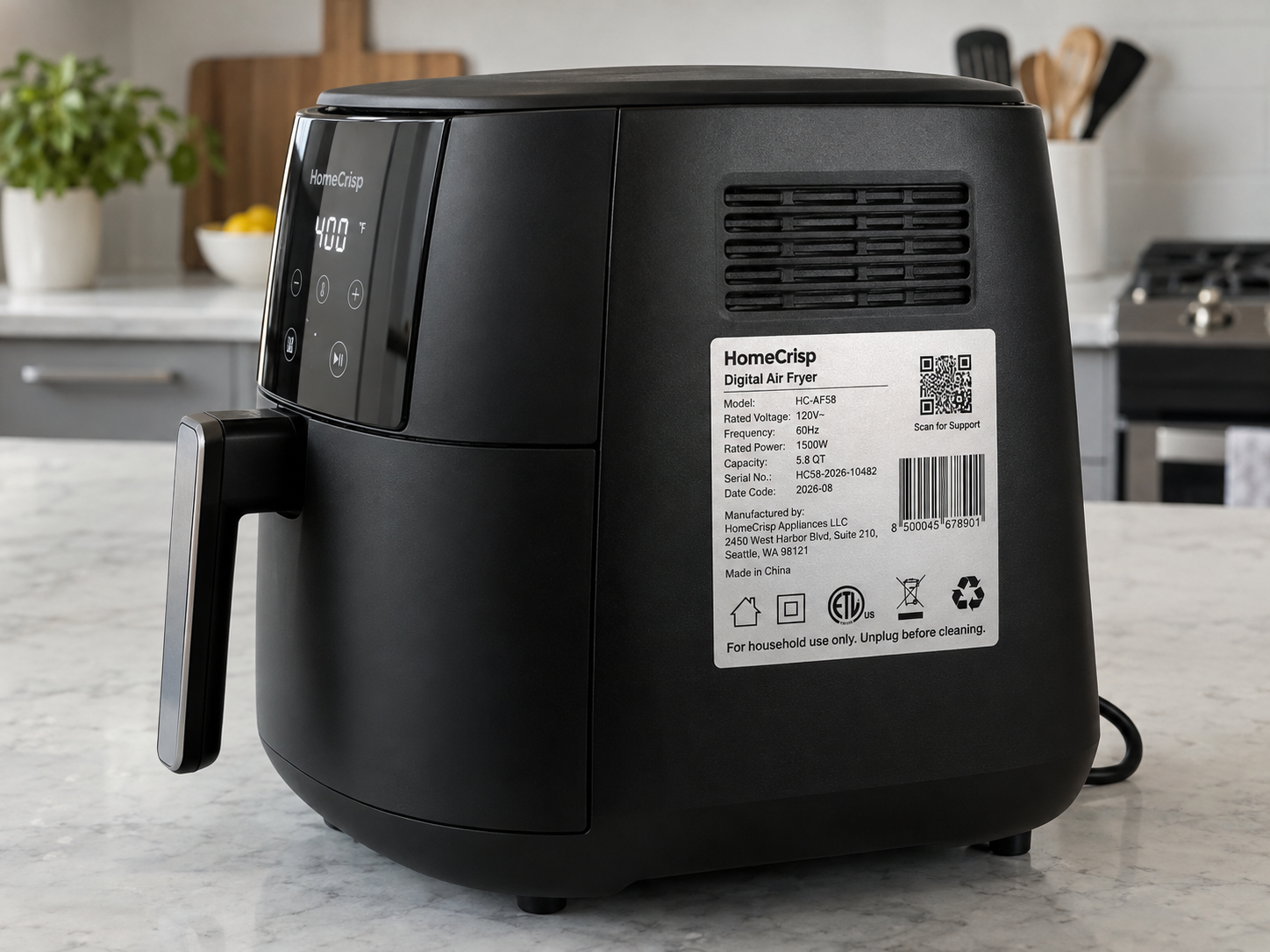
How many watts does an air fryer use is a question the rating label answers with a single figure between 800 and 2,000 watts on household models. Wattage states the electrical power the heating element and the fan draw together, and that figure sets preheat speed, cooking time, and the amperage the unit pulls from a kitchen circuit.
An air fryer draws 800 to 2,000 watts while its heating element runs, and a 30-minute cook at 1,500 watts consumes 0.75 kilowatt-hours. Running cost follows from that kilowatt-hour figure and the local electricity rate, which places most households between twelve and fifteen cents for a single basket load.
Wattage climbs with capacity across the size range, moving from 800 watts on a two-quart mini unit to 2,400 watts on a twenty-six-quart oven-style cabinet. Dual-basket models sit at the top of the range, since two heating elements share one plug and their combined draw approaches the limit of a fifteen-amp circuit.
This article explains air fryer wattage, the amperage and kilowatt-hours behind it, the running cost per use, month, and year, the comparison against an oven, and the method for reading the wattage of an existing unit before a replacement.
Air fryer wattage is the electrical power the appliance draws at full heat, printed on its rating label as a number between 800 and 2,000 watts on household models. Wattage combines the heating element, which consumes nearly all of that total, with the convection fan motor, and its small motor typically accounts for only thirty to fifty watts of the rated figure.
This label figure describes peak draw at the moment the element energizes, and it is not a steady load the unit typically holds through an entire twenty-minute cook at four hundred degrees. Reading the wattage before a purchase prevents pairing an eighteen-hundred-watt unit with a circuit already loaded, and that same figure converts directly into watts of heat and into amps of current.
Most air fryers use 1,400 to 1,800 watts, and the full household range runs from 800 watts on the smallest baskets to 2,400 watts on oven-style cabinets. Single-drawer basket models cluster tightly at 1,500 watts, which manufacturers typically treat as the point where a five-quart basket reaches four hundred degrees in under three minutes with a light load.
Ratings below 1,200 watts appear mainly on two-quart units, while figures above 2,000 watts belong to dual-basket drawers and twenty-six-quart cabinets carrying two separate elements inside one housing. Confirming the rating against the intended menu prevents an underpowered purchase, and wattage determines what it actually does with a full basket of cold frozen food.
Air fryer wattage determines how fast the element raises chamber temperature, how quickly it recovers after the drawer opens, and how hot the circulating air becomes. Wattage converts to heat at the element surface, and the fan distributes that heat across the basket at roughly 2,000 revolutions per minute, a speed most basket models can hold for a full hour.
Two units of equal capacity but unequal wattage behave differently at the same setting, because an eighteen-hundred-watt element recovers lost temperature in seconds while a twelve-hundred-watt element needs a full minute to close the same gap. Matching wattage to basket volume prevents long cook times, and that same wattage figure divided by voltage gives the amperage the wall outlet has to supply, a load it cannot carry indefinitely.
Air fryer wattage states power while amperage states current, and the two connect through voltage in the formula watts divided by volts equals amps on any household circuit. A fifteen-hundred-watt air fryer on a 120-volt supply draws 12.5 amps, and an eighteen-hundred-watt unit on the same supply draws a full fifteen amps of current.
It appears on the rating label, while amperage rarely does, so households can run that division themselves before plugging a large unit into an outlet other appliances share. Calculating amps before the first installation prevents a tripped breaker, and wattage differences across the size range start with the smallest models manufacturers still sell today.
Air fryer wattage by size follows capacity closely, rising roughly one hundred watts for every additional quart of chamber volume across the basket and the oven range. Five size tiers cover the market: mini at two quarts, small at three to four, medium at five to six, large at seven to ten, and oven-style above ten quarts of chamber volume.
Wattage inside each tier varies by about three hundred watts between brands, and that spread reflects element design and the temperature ceiling the manufacturer advertises on its own control panel. Reading the tier before comparing model numbers narrows the wattage question, and the mini tier at two quarts sets the floor of the entire household range.
A mini air fryer uses 800 to 1,300 watts, matching a chamber of 1.6 to 2.5 quarts and a single layer of about six chicken wings. Wattage at this tier heats a chamber small enough that 800 watts reaches four hundred degrees, though preheat generally runs closer to four minutes than the two minutes larger elements manage on a bigger chamber.
These units at 1,300 watts draw 10.8 amps, which leaves room on a fifteen-amp circuit they share with a toaster, a kettle, or a coffee maker. Choosing the mini tier caps running cost near seven cents per thirty-minute session, and the small tier raises both the wattage and the cost above these baseline figures.
A small air fryer uses 1,400 to 1,550 watts across a three-quart to four-quart basket, and 1,550 watts appears on several widely sold four-quart models. Wattage at this level pushes 1.5 pounds of fries to four hundred degrees, and the element can hold that temperature through a twenty-minute cook with only brief thermostat pauses.
Small units at 1,550 watts draw 12.9 amps, which exceeds the twelve-amp continuous limit applying to a fifteen-amp circuit under a sustained three-hour load of its own. Confirming the outlet before the first cook prevents nuisance tripping, and the medium tier carries the wattage most households actually end up buying for daily use.
A medium air fryer uses 1,500 to 1,800 watts across five-quart and six-quart baskets, which covers the largest share of the units sold each year. Wattage in the medium tier reaches four hundred degrees in two to three minutes, and 1,750 watts typically appears on popular five-quart models with a four-pound fry capacity.
Its top rating of 1,800 watts draws the full fifteen amps a standard receptacle supplies, while fifteen-hundred-watt models leave 2.5 amps of headroom on the same kitchen circuit. Checking circuit load before an eighteen-hundred-watt purchase prevents a breaker trip during dinner, and the large tier holds wattage at a similar ceiling while it adds basket volume.
A large air fryer uses 1,700 to 1,800 watts across seven-quart to ten-quart baskets, and wattage stops climbing where the 120-volt circuit sets its limit. Wattage stays flat across the large tier because 1,800 watts already draws fifteen amps, so manufacturers add basket floor area rather than additional element power.
Large units therefore heat a bigger chamber with the same element output, which stretches preheat to four or five minutes at a four-hundred-degree setting with a full basket. Accepting slower preheat in exchange for capacity suits batch cooking, and oven-style cabinets break through this wattage ceiling by adding a second heating element.
An air fryer oven uses 1,400 to 2,400 watts across cabinets of ten to twenty-six quarts, and 2,400 watts appears on the largest countertop models sold in the size range. Wattage in an oven-style cabinet heats a chamber four times the volume of a basket, so its element runs longer at any given temperature setting on the panel.
These cabinets above 1,920 watts exceed the continuous limit of a twenty-amp circuit, which is why their manuals typically specify a dedicated twenty-amp outlet for them. Verifying the circuit rating before installation prevents repeated tripping at the panel, and dual-basket units reach a similar wattage through an internal arrangement placing two elements side by side.
A dual-basket air fryer uses 1,800 to 2,470 watts, since each drawer carries its own heating element and both elements can run at the same time. Wattage splits across two four-and-a-half-quart zones in a nine-quart model, and each zone draws roughly half of that total when both drawers cook at one temperature setting.
Dual-basket units at 2,400 watts draw twenty amps, which is why several models ship with a plug that a standard fifteen-amp receptacle cannot accept without an adapter. Confirming receptacle type before delivery day prevents an appliance nobody can plug in, and this rated wattage still overstates what the unit typically consumes across a complete cook.
Rated air fryer wattage states the draw at full element output, and actual wattage averages fifty to seventy percent of that figure across a complete cook. It applies during preheat and the first minutes of cooking, when the element runs continuously to close the gap separating chamber air from the set temperature.
Actual consumption drops once the chamber stabilizes, because the thermostat cuts the element and leaves only the fan drawing its thirty to fifty watts of motor load. Using the rated figure for circuit sizing and the actual figure for cost prevents two different errors, and thermostat cycling explains the whole gap separating one figure from the other.
An air fryer draws full wattage only while the element runs, which typically accounts for half to two thirds of the clock time in a twenty-minute cook. Thermostat cycling switches the element off within a degree or two of the setpoint, and the fan continues moving air through the chamber between those cycles.
Cycling frequency rises with basket load, because cold food pulls heat out of the chamber and the element answers with longer on-periods at the start of its cook. Treating rated wattage as an hourly figure overstates cost, as the element cannot run for a full hour, and converting wattage into amps gives the number the breaker panel actually sees on a kitchen circuit.
An air fryer draws 6.7 to twenty amps at 120 volts, and that figure comes from dividing its rated wattage by the standard supply voltage of a household outlet. Amperage rises in a straight line with wattage: 1,000 watts gives 8.3 amps, 1,500 watts gives 12.5 amps, and 1,800 watts gives the full fifteen amps a standard receptacle supplies.
Continuous-load rules cap a fifteen-amp circuit at twelve amps and a twenty-amp circuit at sixteen amps, which places most fifteen-hundred-watt units near that first continuous ceiling. Comparing calculated amps against the breaker rating before purchase prevents a shared circuit failing mid-cook, and that same wattage figure converts directly into kilowatt-hours of consumed energy.
| Rated wattage | Amps at 120 volts | kWh per 30-minute cook | Cost per cook at 17 cents |
|---|---|---|---|
| 800 W | 6.7 A | 0.40 kWh | 7 cents |
| 1,200 W | 10.0 A | 0.60 kWh | 10 cents |
| 1,500 W | 12.5 A | 0.75 kWh | 13 cents |
| 1,800 W | 15.0 A | 0.90 kWh | 15 cents |
| 2,400 W | 20.0 A | 1.20 kWh | 20 cents |
An air fryer uses 0.8 to 2.4 kilowatt-hours per hour of element runtime, matching its rated wattage divided by 1,000 across a full hour of cooking. Most units land between 1.4 and 1.7 kilowatt-hours per hour, and that range reflects the fourteen-hundred-watt to seventeen-hundred-watt band covering standard single-basket models sold today.
Real sessions rarely last an hour, so a fifteen-hundred-watt unit cooking for twenty minutes consumes 0.5 kilowatt-hours before thermostat cycling typically reduces that figure even further. Measuring consumption per session rather than per hour prevents an inflated estimate, and the session figure translates directly into the running cost on a monthly utility bill.
An air fryer typically costs seven to twenty cents to run for a thirty-minute cook at the seventeen-cent national average utilities charge for a kilowatt-hour of electricity. Cost follows from three numbers only: rated wattage, session length, and the local rate, which ranges from eleven cents to forty-one cents across states and utilities.
Households paying forty-one cents pay roughly 2.4 times the national figure for the same cook, while an eleven-cent rate cuts that same session down to eight cents for them. Running the calculation at the local rate rather than a national average prevents a misleading comparison, and the cost per single use starts that sequence of figures.
An air fryer costs about thirteen cents per use for a thirty-minute cook at 1,500 watts, and five cents for a twelve-minute batch of frozen fries. Per-use cost equals wattage times hours divided by 1,000, multiplied by the rate, which produces 0.75 kilowatt-hours and thirteen cents in that standard case.
Shorter cooks cut that figure proportionally, so a twelve-minute batch of frozen fries at 1,500 watts costs about five cents including the preheat it needs first. Tracking cost per use rather than per hour keeps the estimate realistic, and the monthly cost multiplies that same figure by the cooking frequency a household keeps.
Air fryer cost per month reaches about four dollars for a fifteen-hundred-watt unit run thirty minutes a day, a routine totaling 22.5 kilowatt-hours over thirty billing days. Monthly consumption scales with both wattage and frequency, and a seventeen-hundred-watt unit on that same schedule reaches 25.5 kilowatt-hours and about 4.30 dollars in charges.
Households cooking twice a day double that figure to roughly eight dollars, while occasional weekend use generally holds their monthly total under 1.50 dollars. Comparing the monthly figure against the oven it replaces shows the actual saving, and the annual figure compounds this same arithmetic across all three hundred sixty-five days.
An air fryer costs about forty-seven dollars per year at 1,500 watts, based on a thirty-minute daily cook at the seventeen-cent national average rate for electricity. Annual cost climbs to roughly fifty-three dollars at 1,700 watts and 75 dollars on a twenty-four-hundred-watt oven-style cabinet running under that same daily schedule.
They finish the year near twenty-five dollars at 800 watts, which is less than half of the figure a large basket model typically produces. Weighing annual cost against the purchase price shows the true payback period, and oven wattage sets the baseline these running costs can be measured against.
Air fryer wattage tops out near 2,400 watts, while a full-size electric oven typically draws 2,000 to 5,000 watts from a dedicated 240-volt circuit of its own. An oven cavity of five cubic feet holds roughly thirty times the air of a six-quart basket, so it spends far more energy heating empty space than a basket ever needs.
Cost per hour separates these two appliances clearly: a three-thousand-watt oven costs about fifty-one cents an hour, against twenty-five cents for a fifteen-hundred-watt air fryer. Choosing the air fryer for small batches cuts cooking energy by roughly half, and higher wattage inside that same range changes cooking speed in ways buyers can feel.
Higher air fryer wattage cooks food faster at equal capacity, because a larger element can restore chamber temperature more quickly after the drawer opens in the middle of a cook. An eighteen-hundred-watt unit and a twelve-hundred-watt unit both reach four hundred degrees, and their real difference shows in preheat length and recovery rather than in final temperature.
Wattage advantages disappear when capacity rises with power, as an eighteen-hundred-watt ten-quart basket heats four times the air of a twelve-hundred-watt two-quart basket in its chamber. Comparing watts per quart rather than watts alone prevents a false speed expectation, and the preheat time shows that ratio more directly than any other figure.
Air fryer wattage sets preheat time directly, and a fifteen-hundred-watt five-quart basket reaches four hundred degrees in two to three minutes from a completely cold start. It lengthens to four or five minutes at 800 watts, and an oven-style cabinet of twenty-six quarts needs five minutes even at its full 2,400 watts of output.
Watts per quart explains that pattern: three hundred watts per quart preheats quickly, while one hundred watts per quart on a large cabinet typically stretches the wait considerably. Accounting for preheat inside total cook time prevents an underestimate, and household size determines which wattage makes that wait acceptable in ordinary weekday practice.
A family of four needs an air fryer between 1,600 and 1,800 watts, paired with a five-quart to eight-quart basket able to hold four chicken breasts at once. Wattage at that level keeps recovery short when a full basket of cold food drops chamber temperature by fifty degrees at the start of a long cook.
Dual-basket models at 1,800 to 2,000 watts suit the same household, and their two drawers can finish a main dish and a side within one cooking cycle. Matching wattage to the largest routine meal prevents a second cooking run, though every wattage figure meets the limits a kitchen circuit imposes on it.
Air fryer wattage meets three limits in a kitchen: the breaker rating, the continuous-load rule, and the gauge of any cord between the plug and the wall. Kitchen countertop receptacles sit on twenty-amp small-appliance branch circuits, which supply 1,920 watts continuously and leave little room for a second heating appliance beside them.
Older kitchens with fifteen-amp circuits cap continuous draw at 1,440 watts, a figure most fifteen-hundred-watt units exceed the moment their heating element energizes. Checking the breaker capacity before a high-wattage purchase prevents repeated tripping, and a fifteen-amp circuit shows this failure more clearly than any other case in a kitchen.
An air fryer trips a fifteen-amp circuit when its draw combines with another appliance already running on the same branch, such as a kettle or a microwave. A fifteen-hundred-watt unit alone draws 12.5 amps and usually holds, while that same unit beside a nine-hundred-watt coffee maker pushes their combined total past twenty amps.
It follows a thermal curve, so a brief overload often passes while a sustained one heats the bimetallic strip inside the breaker until its contacts finally open. Moving the air fryer to an unshared receptacle prevents the trip, and cords introduce a separate limit appearing at the very same wattage figure.
An air fryer at 1,500 watts exceeds what most power strips can carry safely, since typical strips list a single fifteen-amp ceiling shared across every outlet on them. Cord gauge determines the real limit, and a sixteen-gauge extension cord rated for thirteen amps heats up under a fifteen-amp air fryer load on its longest run.
Manufacturers therefore specify a direct wall connection, and a twelve-gauge appliance cord under six feet remains the only common substitute they generally accept. Plugging the unit directly into the wall prevents cord overheating, and the rating label identifies the wattage every one of these circuit limits applies to.
Three sources give the wattage of an air fryer already on the counter: the rating label, a plug-in energy meter, and the model number in the manual. Each source answers a slightly different question, and the label gives the rated figure while a meter gives the average draw appearing during a real cook.
Label wattage suffices for circuit math, while meter readings suffice for cost math, and the manual resolves those cases where the sticker has worn away completely. Identifying the wattage before an upgrade prevents buying a unit with the same limits, and the rating label answers fastest of these three available sources.
To read the wattage, the rating label on the underside or the rear panel lists volts, hertz, and watts together in one printed block near its feet. These figures state maximum draw, and a 120-volt unit marked 1,750 watts confirms both its tier and the 14.6 amps it pulls at full heat.
Worn labels leave voltage legible more often than wattage, since the wattage line sits closest to the rubber feet and abrades against the counter over time. Photographing the label at the time of purchase prevents a later guess, and a plug-in meter verifies the number this label claims during one actual cook.
To measure actual draw, a plug-in energy meter sits between the wall outlet and the air fryer plug, and it records watts through a complete cook. Meter readings show the cycling pattern directly, peaking at rated wattage during preheat and dropping to fan-only draw of thirty to fifty watts between its cycles.
Total kilowatt-hours on the meter after one session give the figure cost calculations need, and it typically lands near two thirds of the rated estimate. Measuring one typical session prevents an overstated annual figure on the bill, and the model number confirms the rating when neither the label nor the meter is available.
To check the model number, the same panel that carries the rating label prints a code the manufacturer ties to a published specification sheet posted online. These sheets list rated wattage, voltage, capacity, and temperature range together, which resolves conflicts between a worn label and an ambiguous meter reading on the same unit.
Model families reuse a single wattage across several capacities, so the code identifies the element rating even when the basket size differs between two of them. Recording the model number alongside the wattage prevents a repeat of the same limits, and the final decision rests on matching wattage to the household using it.
Choosing an air fryer wattage starts with the circuit, since a shared fifteen-amp circuit caps the practical rating near 1,400 watts regardless of basket size or brand name. Household size sets the second figure, and 1,500 to 1,800 watts covers three to five people without stretching preheat past the three minutes they can comfortably wait.
Watts per quart resolves the remaining choice, where two hundred fifty to three hundred watts per quart typically delivers fast preheat and even browning across a single layer of food. Confirming the circuit rating, the household size, and the watts-per-quart ratio before purchase prevents both a tripped breaker and a basket that cannot keep up.
