
Our Location
304 North Cardinal St.
Dorchester Center, MA 02124

 ByAlan
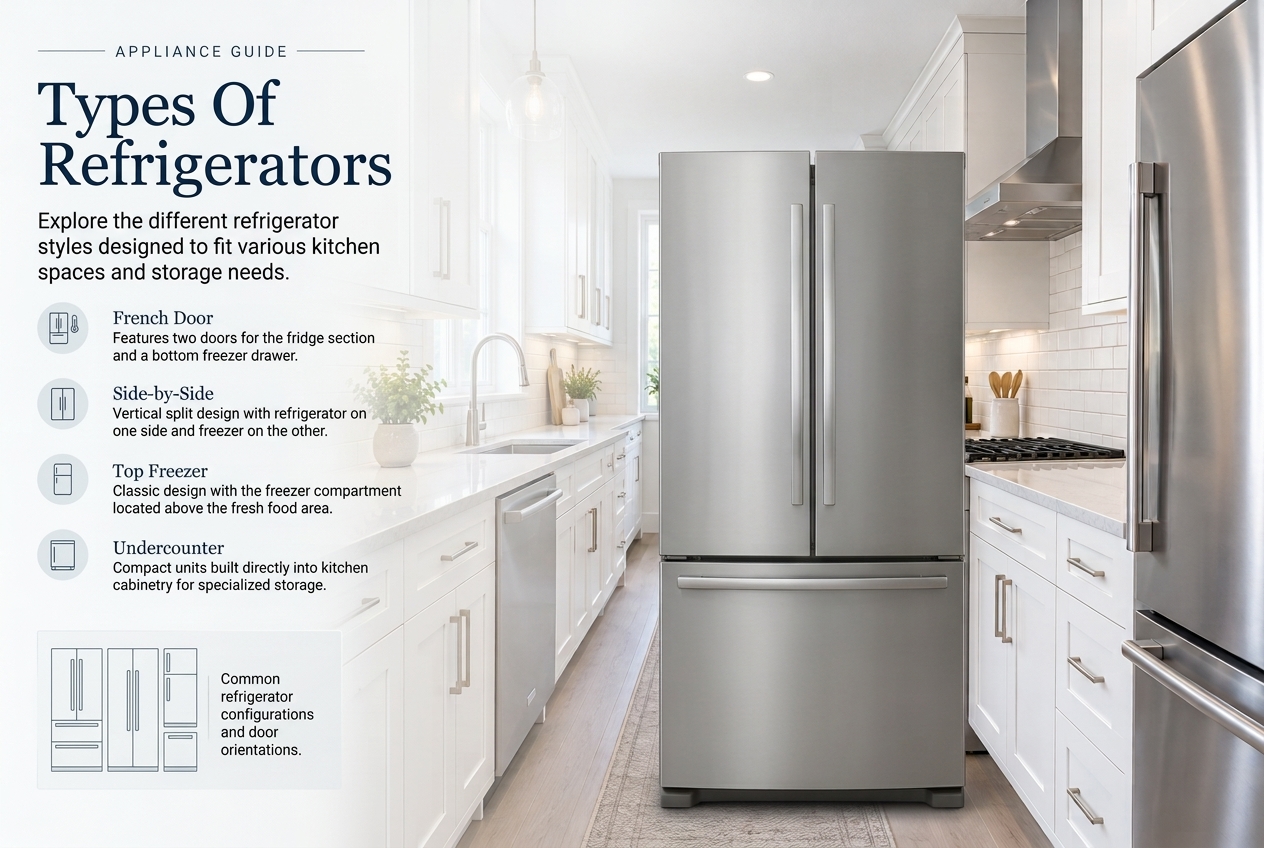
There are three ways to sort refrigerators: by door and freezer layout, by installation style, and by cooling technology. Layout determines how you get to your food, installation determines how the appliance fits into your kitchen, and cooling technology determines the way heat is drawn out of the cabinet. Home buyers usually weigh the first two. The third is what accounts for the different behavior of some small or specialist units compared with a standard kitchen model.
This guide is written for home buyers comparing their options, as well as for anyone curious about how fridges differ. It covers each style, the principal cooling systems, and the trade-offs involving capacity, efficiency and cost, and then converts those differences into a practical sequence of decisions.
Because no live price or efficiency data was provided for this article, it describes general tendencies instead of precise figures. Capacities, dimensions, energy ratings and prices all depend on brand, model, region and year. Before you buy, consult the manufacturer’s specification sheet and any local energy label.
To get a full comparison, read the sections in order. If you already know which question you want answered, go straight to the layout, installation or cooling section.
A refrigerator is an appliance that keeps food at a low, controlled temperature to slow spoilage by removing heat from an insulated cabinet. The main types of refrigerators are separated by layout (top-freezer, bottom-freezer, side-by-side, French-door and compact), by installation (freestanding, counter-depth and built-in) and by cooling technology (compressor, absorption and thermoelectric). The same fridge belongs to one category in each group, such as a freestanding, French-door, compressor model.
Searchers asking what type of refrigerators there are, or which is the best type of refrigerator, are usually mixing these three questions. No single type is best for everyone, because the answer depends on kitchen dimensions, household size, budget and how often you use frozen food. Separating the classification methods makes comparisons fairer, since a layout choice does not dictate a cooling technology.
The three classification methods used in this guide are:
The sections that follow cover each method in turn, then compare capacity, efficiency and cost, review features, and finish with a selection process, common problems and a short FAQ.
Style describes where the freezer sits relative to the fresh-food compartment and how the doors open. These choices change how far you bend, how wide the shelves are, how much clearance the doors need and how the available volume is split between fresh and frozen food. Two models with similar total capacity can feel very different in daily use.
Layout also tends to align with household habits. Households that store large amounts of fresh produce or wide platters need different shelf geometry from households that rely on frozen meals. The five styles below are presented with their main strengths and limits so you can match them to your routine.
A top-freezer refrigerator places the freezer compartment above the fresh-food section, each behind its own door. It is the simplest and most traditional layout, usually offered in narrower widths and often at lower prices than other full-size styles. The fresh-food compartment is large and the shelves are full width, which suits everyday groceries.
The main limit is access: the fresh section sits at and below waist height, so you bend more often for items on lower shelves and crisper drawers. Freezer space is typically modest. The pros and cons are:
A bottom-freezer refrigerator puts the fresh-food compartment at eye level and the freezer in a pull-out drawer below. Because most people open the fridge more often than the freezer, this layout reduces bending for daily items. The drawer lets you see stored items from above instead of reaching into a deep shelf.
The trade-off is that frozen items are lower and the drawer can be harder to organise when full, so you may need to dig through layers. Pricing usually sits above top-freezer models. The pros and cons are:
A side-by-side refrigerator splits the cabinet vertically, with the freezer on one side and the fresh-food section on the other, each with a narrow door. Both compartments run from top to bottom, so frozen and fresh items are reachable without deep bending. The narrow doors need less swing space, which helps in tight aisles.
The narrow compartments limit shelf width, so large platters, pizza boxes and wide trays may not fit flat. Many models include external dispensers, which supports the layout’s popularity. The pros and cons are:
A French-door refrigerator has two doors that open outward over a wide fresh-food compartment, with a freezer drawer underneath. The wide opening gives full-width shelves that hold platters and large containers, and opening a single narrow door lets less cold air escape than a single wide one.
These models generally offer large capacity and the broadest feature range, but they are wider and need enough clearance to open both doors and pull out drawers. They usually cost more than top-freezer and many other styles. The pros and cons are:
Mini fridges and compact refrigerators are small units, often placed on a counter or under a desk, designed for limited storage. Their capacity is small, so they supplement rather than replace a main refrigerator. Many include a tiny freezer compartment, which typically cannot hold ice cream firmly or store food for long periods, so check the stated freezer rating before relying on it.
Common uses include:
Installation style describes how a refrigerator sits in the kitchen, which affects appearance, cost, ventilation and cabinetry. A freestanding refrigerator is a standard-depth unit that stands on its own and typically projects beyond the surrounding countertop. A counter-depth model is shallower, so its doors sit closer to the edge of the cabinets and the kitchen looks more streamlined, but interior volume is usually lower than that of a similar standard-depth unit.
A built-in refrigerator is designed to sit flush within cabinetry, often with a custom panel that matches the cupboards. Built-in models are generally the most expensive and may need professional installation and planned ventilation. Ventilation matters for every type, since the condenser must release heat, and manufacturers specify clearances around the sides, top and rear. Always follow the installation manual for the exact model.
The table compares the three installation styles on common criteria, with general tendencies rather than exact figures.
| Criterion | Freestanding (standard depth) | Counter-depth | Built-in |
|---|---|---|---|
| Appearance | Projects beyond cabinets | Nearly flush with cabinets | Flush, often panel-ready |
| Interior capacity | Highest for a given width | Lower than standard depth | Varies by model |
| Typical cost | Lowest of the three | Usually higher | Generally highest |
| Installation | Simple, plug in and level | Simple, needs depth planning | May need cabinetry work and a professional |
| Ventilation | Clearances around the unit | Clearances still required | Designed into the enclosure |
In practice, freestanding suits most households and replacements, counter-depth suits kitchens where appearance and aisle space matter, and built-in suits planned renovations with matched cabinetry.
Cooling technology describes how a refrigerator removes heat from its cabinet. Each system works differently, which affects noise, efficiency, cooling power and the setting where it makes sense. Nearly all household kitchen refrigerators use a compressor, while other systems appear mainly in portable, off-grid or specialist products.
Understanding these systems explains why a quiet hotel minibar, a small thermoelectric cooler and a full-size family fridge perform so differently. It also shows why the cooling method is rarely the deciding factor for a kitchen purchase but matters a great deal for travel, camping or laboratory use.
Compressor refrigerators use the vapor-compression cycle, the most common household technology. A compressor pressurises a refrigerant, which releases heat through the condenser coils, expands and cools, and then absorbs heat from inside the cabinet through the evaporator. The cycle repeats while a thermostat controls the compressor’s run time.
Some models use single cooling systems for both compartments, while dual-system models cool fridge and freezer separately, which can limit odour and moisture transfer. Inverter compressors adjust speed instead of switching fully on and off, which generally reduces noise and temperature swings and can improve efficiency. Their potential savings depend on the model and the energy label.
Absorption refrigerators use heat, not a compressor, to drive the cooling cycle. A heat source such as electricity, gas or propane warms a refrigerant-and-absorbent solution, which moves the refrigerant through the system and cools the cabinet. Without a compressor there are few moving parts, so they run very quietly.
They are generally less energy-efficient than compressor models and cool more slowly, and they need to be level to work properly. Typical uses include:
Thermoelectric refrigerators use the Peltier effect: electric current passing through a junction of two different materials moves heat from one side to the other. This is solid-state cooling with no refrigerant and no compressor, so the units are lightweight and quiet apart from a fan.
Their cooling power is limited, and they typically cool to a set difference below the surrounding air temperature, so performance falls in a hot room or vehicle. They suit small portable coolers, desktop beverage chillers and car units, but they are rarely suited to full-size kitchen refrigeration.
Magnetic cooling is an emerging approach that uses the magnetocaloric effect, where certain materials change temperature when exposed to a magnetic field. It is mostly in development and not a mainstream consumer option. Ultra-low-temperature laboratory units are a specialised class that reach far lower temperatures than household freezers, used to store samples and biological materials.
These types rarely matter to home buyers, because they are not designed for kitchen food storage. Their relevance is mainly:
Layout types differ most clearly in how they use space, and price tendencies follow features and size. Top-freezer models tend to be the most economical, bottom-freezer and side-by-side models sit in the middle, and French-door and built-in models tend to cost the most. These are tendencies, not guarantees, because brand, finish, capacity and features can reverse the order.
The table summarises general tendencies for layouts and technologies on the criteria that matter most to buyers. It is not based on measured data, so treat it as a starting point and confirm with specifications.
| Type | Space and access | Efficiency tendency | Price tendency |
|---|---|---|---|
| Top-freezer | Large fresh section, bending needed | Often efficient for its size | Lower |
| Bottom-freezer | Eye-level fresh food | Varies by model | Mid to higher |
| Side-by-side | Narrow shelves, easy access | Varies; dispensers can add use | Mid |
| French-door | Wide shelves, large capacity | Varies; larger size uses more energy | Higher |
| Compact compressor | Small capacity | Low total use, higher per litre | Low |
| Absorption / thermoelectric | Small to medium | Generally lower efficiency | Varies by use |
Efficiency depends more on size, insulation, compressor type and features than on layout alone. Larger units and those with through-door dispensers or ice makers can use more energy. Inverter compressors may help, but check the specific model’s rating.
Energy labels and annual operating cost estimates help compare models. In the United States, the EnergyGuide label gives an estimated yearly energy use and cost, and the Energy Star mark identifies qualifying models; other regions use their own labels. These estimates are based on standard test conditions and local electricity rates, so real cost varies with room temperature, door opening habits and how full the fridge is.
Features change convenience more than the basic type does, but they also add cost, energy use and potential repair complexity. Weigh each feature against how often you would use it. The more components a refrigerator has, such as dispensers, valves and sensors, the more parts can fail over its life.
Common features and their practical effects are:
Prioritise features you will use weekly, since occasional extras raise purchase price and the odds of repair. A simple model with good insulation and a reliable compressor can serve many households better than a loaded one.
The best type of refrigerator is the one that fits your space, matches your household’s storage needs and stays within budget. Work through the decision in sequence so that physical limits come before preferences:
Budget should include operating cost, not just the purchase price, because a cheaper model with high energy use can cost more over its life. Reliability matters as well: check warranty length, the availability of parts and service in your area, and independent reviews. Fewer complex features generally mean fewer repair risks.
Measure the opening and the route before you shop, because a refrigerator that does not fit through the door cannot be used. Record each dimension and compare it with the model’s specification sheet. Follow these steps:
Include the packaging in your delivery calculation if possible, and ask the retailer whether the delivery team will remove doors or haul away the old unit.
Capacity needs rise with household size, shopping frequency and the amount of frozen or bulk food you store. A small household that shops often needs less volume than a family that shops weekly and freezes meals. Manufacturers list capacity in cubic feet or litres, so compare the same unit across models and check how much is usable shelf space.
Layout should follow how you cook and store food. The table gives general matching guidance; actual needs vary.
| Household need | Layouts that tend to fit |
|---|---|
| One or two people, tight budget | Top-freezer, compact |
| Mostly fresh food, daily use | Bottom-freezer, French-door |
| Narrow aisle, frequent freezer use | Side-by-side |
| Entertaining, large platters | French-door |
| Extra drinks or room storage | Mini fridge |
Consider aisle space too: wide doors need more clearance, while narrow doors suit galley kitchens.
Each type has typical drawbacks, and knowing them in advance prevents disappointment. Most relate to access, door clearance, noise, cooling power or repair cost rather than to the basic cooling function.
Noise varies: compressors can hum or cycle audibly, while absorption units are very quiet and thermoelectric units rely on a small fan. Inverter models are typically quieter than fixed-speed compressors.
Repair versus replacement depends on age, repair cost and remaining warranty. A common rule of thumb is to consider replacement when a repair quote is a large share of a new unit’s price, especially for an older model with a failed sealed-system part such as the compressor. Compare the quote with current prices, and factor in energy savings from a newer unit.
Buying well means comparing prices, timing the purchase and considering delivery and installation services. Retail promotions on appliances often cluster around holiday weekends and model changeovers, but dates vary by retailer, so compare current offers instead of assuming a schedule. Used units can save money, though they carry unknown wear and usually no warranty.
Related guides on refrigerator sizing, energy labels and repair costs can help with each step. Keep the manual and receipt for warranty claims.
These short answers summarise the main points and point to the sections that explain them.
What types of refrigerators are there?
By layout: top-freezer, bottom-freezer, side-by-side, French-door and compact. By installation: freestanding, counter-depth and built-in. By cooling: compressor, absorption and thermoelectric. See the main types section above.
Which type of refrigerator is best?
It depends on space, household size and budget. Top-freezer suits value, French-door suits wide storage, and side-by-side suits narrow aisles. See the choosing section.
Which type is most efficient?
Efficiency depends more on size, insulation, compressor type and features than layout. Smaller units without dispensers usually use less energy, so check each model’s energy label. See the comparison section.
How do types differ in cooling?
Compressor units use vapor compression, absorption units use heat, and thermoelectric units use electric current across a junction. See the cooling technology section.
Is a counter-depth refrigerator worth it?
It gives a flush look but usually has less interior capacity and costs more. See the installation section.
