
Our Location
304 North Cardinal St.
Dorchester Center, MA 02124

 ByAlan
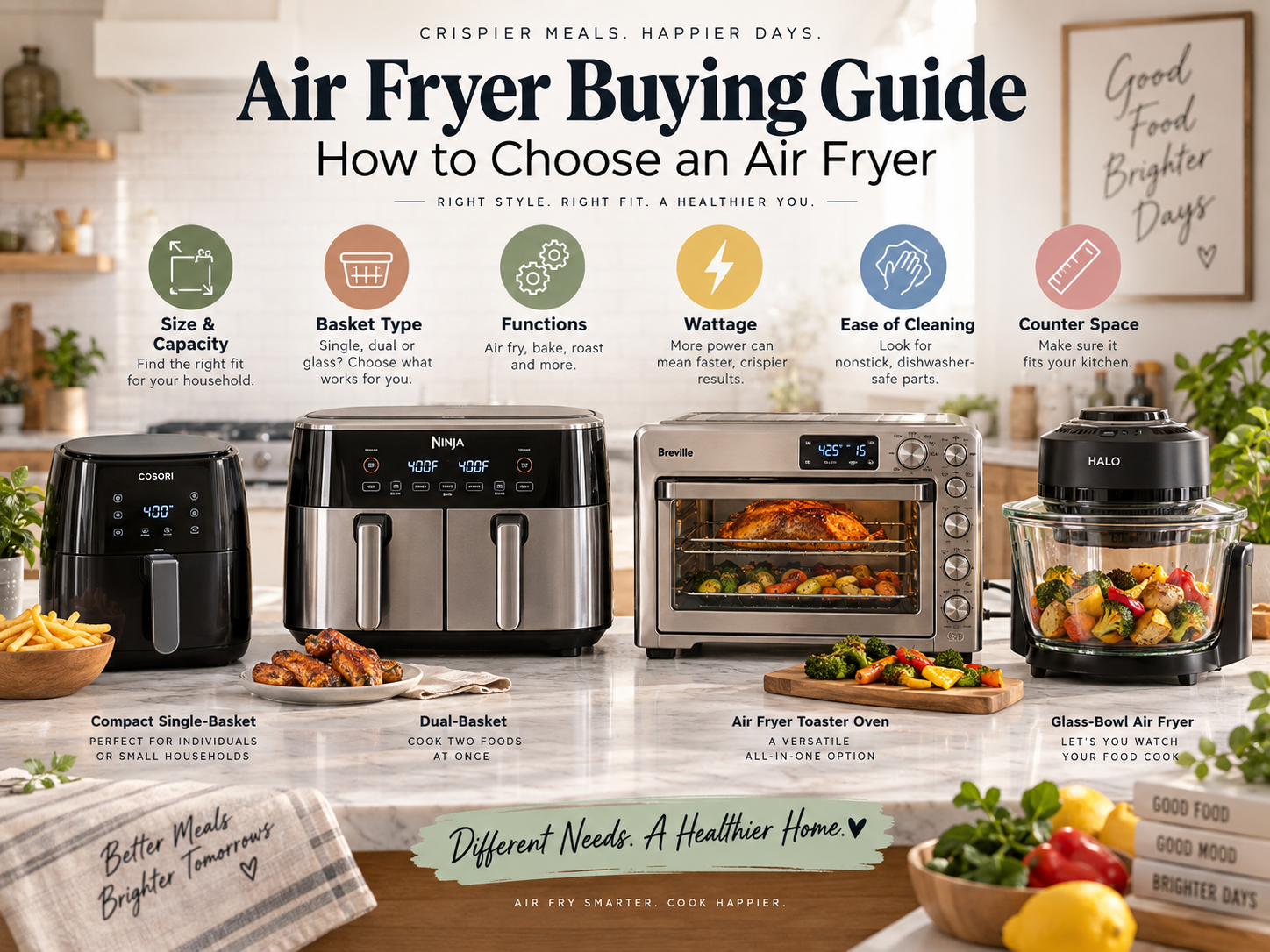
An air fryer is a countertop appliance that circulates hot air rapidly to crisp food, much like a small convection oven. The result resembles deep frying while using far less oil. Choosing one well depends on capacity, style, power, controls, cleanup, space and budget. Capacity is the first decision, because it shapes everything else. A unit that is too small forces you to cook in several rounds, and each round costs time. Crowded food also browns unevenly and turns soft instead of crisp, which defeats the purpose of buying the appliance in the first place.
The quart number on the box is only part of the story, because total volume is different from usable cooking surface. Food crisps best when it sits in a single layer with air moving around it, so basket shape and base area matter as much as the label. Style matters too. Basket, oven-style and dual-basket models each suit different foods, batch sizes and kitchens, and each comes with its own trade-offs. Picking the wrong style can leave you with awkward cooking habits or a bulky machine that ends up unused on the counter.
Power, controls and cleanup then separate a convenient appliance from a frustrating one. Wattage affects how quickly the unit heats and how well it holds temperature, while digital controls and removable coated parts make daily use easier. Finally, physical fit counts. You need counter room with clearance for ventilation, a cord that reaches an outlet, and a price that reflects build quality and warranty. Working through these factors in order makes the decision far simpler than comparing long feature lists across dozens of similar models.
A good starting rule for basket-style models is about 1 quart of capacity per household member. That puts one or two people in the 3-4 quart range, three or four people in the 5-6 quart range, and larger households or batch cooks at 8 quarts or more. Larger households can choose either a big single basket or a dual-basket unit, depending on whether they cook one large batch or two different foods. Treat these tiers as a baseline, then adjust for how you actually cook, such as snacks versus full dinners.
Verify usable surface area, not just total volume, before settling on a size. Laboratory measurements have often found usable space smaller than the manufacturer-claimed capacity, so a nominal 5-quart basket may hold less than expected. If you regularly cook for guests or prepare meals ahead, lean toward the larger tier, since an oversized unit costs a little counter space while an undersized one costs quality every time you cook. Think about your usual portions, the largest item you plan to cook, and whether leftovers are part of your routine.
| Household size | Recommended capacity | Typical use |
|---|---|---|
| 1-2 people | 3-4 qt | Snacks, single portions |
| 3-4 people | 5-6 qt | Main dish plus side |
| 5+ people or batch cooking | 8+ qt single or dual-basket | Large batches |
For a family of four, a 5-6 quart air fryer is the usual fit, large enough to cook a main dish and a side in one batch. That range follows the 1 quart per person guideline, which suggests about 4 quarts as a minimum for four people and gives you extra room. The extra headroom matters because food needs space around it for air to circulate and brown properly. Packing a four-person meal into a small basket usually means stacked food and uneven results.
Go larger when your cooking habits demand it. Bigger cuts such as whole chicken pieces, batch cooking for the week, and reheating leftovers all call for more surface area than a typical dinner for four requires. Families with teenagers or frequent guests may also find that a 6-quart basket becomes the practical minimum rather than a comfortable upper limit. For larger families, 7 quarts or more is a sensible target, since it reduces the number of rounds you must cook.
A dual-basket model is a strong alternative when two foods need different settings. You can cook crispy potatoes at one temperature while a protein finishes at another, and both can be timed to finish together for the table. This flexibility suits busy weeknights, when a main and a side would otherwise have to be cooked one after the other. The catch is that each zone holds less than one large basket, so check the capacity of each side.
Consider your usual dinner before choosing between these options. If you mostly cook one-pan style meals, a single 5-6 quart basket keeps things simple and easy to clean. If your dinners combine very different foods, the extra zone can save time and reduce compromise on temperature. Either way, match the model to the food you actually cook rather than to the largest number on the packaging.
Compare usable capacity by looking at basket dimensions, depth and shape rather than relying on the quart label alone. Size labels vary by brand, and a cylindrical or egg-shaped basket often gives less flat cooking area than its volume suggests. Square baskets usually offer a larger cooking surface than egg-shaped baskets of similar stated capacity. Check the measured width and length of the base, since that is where food actually sits.
Surface area matters more than the quart number because food crisps best in a single layer. Overcrowding blocks air circulation, which slows browning and leaves some pieces pale or soggy while others cook through. A wide, flat basket lets fries, wings or cutlets spread out, while a deep, narrow one encourages stacking. When two models share a quart rating, choose the one with the larger base and enough depth for the tallest foods you cook.
The right air fryer type depends on what you cook, how much you cook at once, how much counter space you have and how much you value crisping. The main choices are basket-style, oven-style and dual-basket models, with lids for multi-cookers and toaster-oven air-fry settings as occasional alternatives. Toaster-oven air-fry modes generally cannot match the crispiness of a true air fryer, so they suit people who want one appliance for many jobs. If crisp results are the priority, a dedicated air fryer remains the stronger choice.
Format shapes your daily routine more than the number of presets does. A basket asks you to shake food, an oven-style unit lets you slide trays in and out, and a dual-basket model asks you to manage two zones. Think about which workflow you would repeat several times a week and which one you would find tiresome. The comparison below summarizes how the three main types differ before the sections that follow explain each in detail.
| Type | Crisping | Capacity/versatility | Footprint | Best for |
|---|---|---|---|---|
| Basket | Superior | Smaller surface | Compact | Fries, wings |
| Oven-style | Less aggressive | Larger, multi-function | Larger | Pizzas, trays |
| Dual-basket | Strong | Two smaller zones | Wider | Main plus side |
Basket-style air fryers are compact, easy to use and known for superior crisping, which makes them ideal for fries, chicken wings and small batches. Food sits in a pull-out basket while hot air circulates around it, so results are quick and consistent for many everyday dishes. They are the most common format, and for many households they are the simplest way to start air frying. Their small footprint also makes them easier to fit on a crowded counter or tuck away in a cabinet.
Easy shaking is one of the main advantages of a basket model. You can pull the basket out, toss the food and slide it back in within seconds, which helps fries and wings brown on all sides. That hands-on rhythm gives you good control over doneness and lets you check progress without opening a door or reaching into a hot cavity. For snack-sized portions, the process feels quick and uncomplicated.
The limits come from the smaller cooking surface. Because the basket is relatively compact, you must often shake or flip food during cooking, and large items or full family meals may not fit in a single layer. Cooking more than one round adds time and can leave early batches cooling while later ones finish. If you regularly feed several people at once, the basket size needs careful attention.
A basket model suits you best if crisp texture is your priority. It works well for one or two people, for small families that cook simple sides and proteins, and for anyone with limited counter room. Pair it with a sensible capacity, following the 1 quart per person guideline, and check the base area for single-layer cooking. That combination delivers the strongest crisping performance without taking over the kitchen.
Oven-style air fryers hold more food and offer more versatility, handling pizzas, sheet-pan meals, trays and sometimes rotisserie cooking. Many add functions such as baking, toasting and grilling, so they can replace a small toaster oven while still air frying. Multiple racks allow you to cook larger quantities at once, which suits families and anyone who prepares full meals. They are a good match for larger items that would never fit inside a basket.
The trade-offs are footprint and crisping strength. Oven-style units take up noticeably more counter space and tend to crisp less aggressively than basket models, especially when food is spread across several trays. You may need to rotate trays or accept slightly softer results on lower racks. If your goal is the crispiest fries, a basket model usually has the advantage.
Cleaning is another consideration. Shelves, racks, a window and a door add corners and surfaces that collect grease, so cleanup takes longer than rinsing a single basket. Look for removable trays and parts that are easy to wash, and check that the interior is easy to reach. If you value versatility and larger meals over compact size, the extra upkeep is often worth it.
Dual-basket air fryers cook two foods at different temperatures and times simultaneously, which suits families preparing a main and a side. Each zone runs on its own settings, so chicken and vegetables can both finish at the same moment without compromising on heat. That flexibility saves time on busy evenings and removes the need to cook in sequence or keep one dish warm. It is a strong choice for households that routinely cook more than one component.
The compromise is that each zone has less capacity than one large basket. A combined total can sound generous, yet an individual drawer may still be too small for a large cut or a big batch of fries. Verify the capacity and base area of each zone, not only the combined figure, before you buy. Also allow for a wider footprint, since two drawers need room to pull out fully.
Most households should look for an air fryer rated between 1,400 and 1,800 watts for fast preheating and even browning. Wattage affects how quickly the unit reaches temperature and how well it maintains heat once cold food goes in. A weaker element can struggle to recover, which slows cooking and may leave food less evenly browned. Higher wattage is not automatically better, but the range above gives a reliable balance of speed and performance.
Plug your air fryer into a dedicated outlet rather than a power strip or extension cord. High-wattage appliances draw a lot of current, and thin cords or shared strips can overheat or trip protection. Avoid running other high-wattage appliances, such as a kettle or microwave, on the same circuit at the same time. The short cords on most air fryers, usually 3-4 feet, make a nearby wall outlet the practical choice anyway.
Older homes may need their circuits evaluated before you add a high-wattage model. Wiring in older kitchens may not handle several heavy appliances at once, and a circuit that trips frequently is a sign to take seriously. If you are unsure, ask a qualified electrician rather than guessing. Wattage, local voltage and the outlet you plan to use should all line up before you buy.
The features worth paying for are the ones that improve safety, control and cleanup, such as a secure basket lock, clear venting and useful temperature control. A temperature range covering 200-450°F lets you reheat gently and also crisp aggressively. A dishwasher-safe non-stick or ceramic coating saves effort every time you cook. These basics matter far more than long lists of presets or extras that you may never touch.
Some extras are nice to have but easy to skip. A viewing window, a shake reminder, keep-warm mode and app connectivity can be convenient, yet none of them changes how well the machine crisps food. A rotisserie function is worth skipping unless you know you will use it regularly. Spending on a feature you ignore leaves less budget for capacity, power and build quality.
Prefer a few well-designed controls over many presets. A simple time and temperature interface lets you cook anything, while a dozen presets often just repeat the same settings under different names. Judge the cleaning design too, since a basket that is awkward to wash will end up neglected. Use the shortlist below to separate essentials from optional extras.
A digital air fryer is worth choosing if you value precision, because digital controls hold temperature more accurately than manual dials. They let you set an exact temperature and time, which makes results easier to repeat from one meal to the next. That consistency helps with delicate foods and with recipes that specify a precise setting. For most buyers, this reliability is the main reason to prefer digital.
Manual models are a reasonable option for simple needs. They often cost less, and a basic dial is quick to learn and has little to go wrong. The trade-off is that they usually omit advanced digital features and offer coarser control over temperature and timing. If you mostly reheat snacks or cook fries, a manual dial may be enough.
Do not confuse digital controls with a long list of presets. The most useful interface is one that gives you clear control over time and temperature, not one that offers many programs you will rarely use. Presets can be handy as starting points, but you will likely adjust them anyway. Judge the display for readability and the buttons for responsiveness rather than counting modes.
Your cooking style should decide. If you cook varied meals, follow recipes or want repeatable results, digital controls justify a modest price increase. If budget is tight and your cooking is simple, a well-built manual model can serve you well. Either way, prioritize capacity and build quality before control style.
Plan on more counter space than the appliance’s own footprint, because ventilation and operation both need room. Allow clearance on all sides, following the 5-6 inch rule, and a typical 5-quart model needs about 16 x 16 inches of counter space including that clearance. Measure the space in operating mode, accounting for the lid or door swing and the drawer pulling out fully. Check cabinet height as well, since heat and steam rise from the unit.
Cord reach is another practical limit. Most air fryers have short cords of 3-4 feet, so the outlet needs to be close to where the unit will sit. If the appliance is heavy or bulky, consider where you will store it, since lifting it onto the counter each time becomes a chore. A unit that stays out only works if the space truly suits its size.
Most home cooks are well served by a mid-range model in the $80-150 range, while premium units above $200 are justified mainly for dual zones and smart connectivity. Weigh capacity, power, build quality, coating and controls at each tier rather than judging on price alone. The table below shows what each tier typically offers and who it suits. Spend where it improves daily use, such as usable size and easy cleaning.
Cheap is not always economical. A $50 unit that fails after 6 months costs more over time than a $100 unit that lasts 5 years. Durability, coating quality and support all affect how long a model keeps working. Lower-priced models can still make sense for occasional use, provided you accept their limits.
Check the warranty before you buy. Aim for at least 1-2 years of coverage, since the shortest warranty among tested models was only 60 days. A longer term suggests confidence in the build and gives you protection if the heating element or controls fail. Balance warranty length against the price so the total cost of ownership stays reasonable.
| Tier | What you typically get | Who it suits |
|---|---|---|
| Budget (about $50) | Basic basket, manual controls | Occasional use |
| $80-150 | Solid capacity, digital controls | Typical home cooking |
| $200+ | Dual zones, smart connectivity | Larger families |
The most common air fryer mistakes are buying too small, judging by price alone, ignoring cleaning design, overvaluing presets, skipping space measurement and overlooking the warranty. Insufficient capacity is the most frequent owner complaint, and it is also the easiest to avoid. Match the size to your household and the food you cook, not to the lowest price. The list below collects the errors worth checking before purchase.
Capacity errors go beyond buying too small. Some buyers choose the largest total capacity without checking the usable base area, then find that food still has to be stacked. Surface area and basket shape matter more than the quart label, so compare dimensions as well as volume. A moderately sized model with a wide base can outperform a larger but narrower one.
Feature mistakes are just as costly. Paying for presets while accepting poor cleaning or controls leaves you with a machine that is annoying to maintain and slow to adjust. Skipping a measurement of your counter and cabinet can leave you with a unit that does not fit. Ignoring the warranty leaves you unprotected if the unit fails early.
Buyers in Australia, the UK and India should check local voltage, plug standards and the wattage rating against their own outlets before ordering. A model designed for one region may not suit another, so confirm the exact model number and its electrical specifications. Never assume that an imported unit will work safely without the correct plug and voltage rating. Matching the appliance to the local supply is the first step in any regional purchase.
Capacity is usually advertised in US quarts or liters, depending on the market. One US liquid quart is about 0.946 liter, so the two units are close, but the conversion tells you nothing about usable capacity. Confirm the basket dimensions and usable surface area rather than relying on the label. The household guideline of about 1 quart per person still applies as a starting point.
Apply the same buying logic everywhere. Choose a size for your household, a style for your food, and a wattage and temperature range suited to your kitchen and supply. Check the warranty terms that apply in your country, since coverage can differ by region. Local availability may narrow your options, so compare the exact models on sale near you.
Choose an air fryer by the food you need to fit, not by the largest quart number or the longest feature list. The best model depends on household size, at roughly 1 quart per person, along with counter space and the features you will actually use. Work through the numbered steps below in order, and each decision narrows the next. This sequence keeps the process simple and prevents costly mismatches.
Quick matches can help you check your decision. For snacks and single portions, a 3-4 quart basket is enough, while family dinners usually call for 5-6 quarts. For batch cooking or larger households, look at 8 quarts or more, or a dual-basket model. Always confirm the usable surface area before you commit.
Finish with power, cleanup and cost. Look for 1,400-1,800 watts, a 200-450°F range, digital controls and a dishwasher-safe coating. Make sure the unit fits your counter with room for ventilation, and look for a warranty of at least 1-2 years. If a model passes every step, it is likely to serve you well for years.
