
Our Location
304 North Cardinal St.
Dorchester Center, MA 02124

 ByAlan
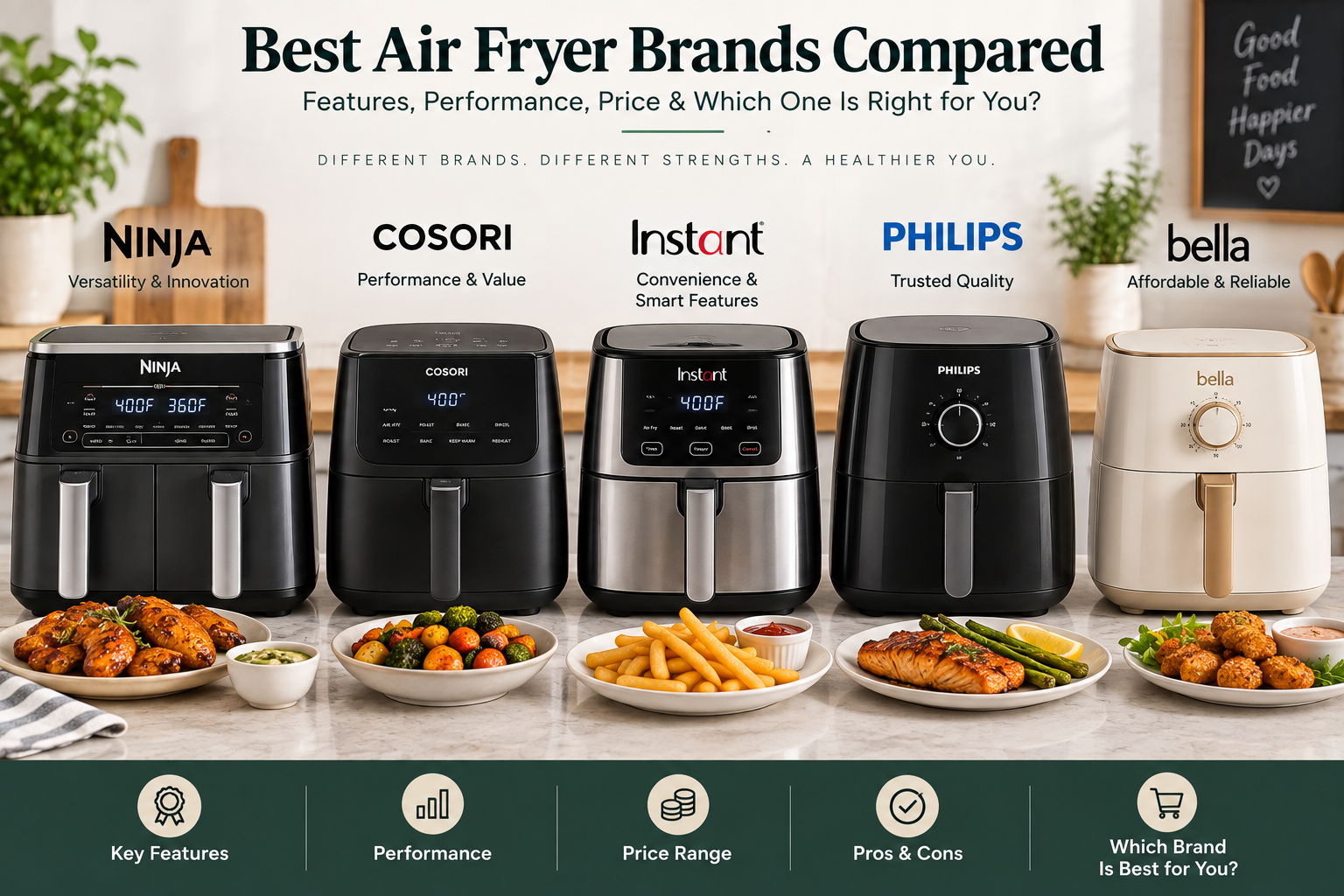
For most households, Ninja, Instant, and Cosori are the safest air fryer brands to buy, because they balance cooking performance, basket capacity, and price better than most rivals. Their mid-range models, typically priced between $100 and $150, suit families of two to five people and rarely require a premium budget. Still, the brand name only narrows your list. The decision is made at the model level, where one unit can differ sharply from another bearing the same logo. That is why shoppers should treat brand reputation as a starting filter rather than a final verdict on any single machine.
Three model-level details matter more than the label: basket capacity, heater wattage, and how well the unit is built. The crisper plate is a quick build-quality check, since a flimsy or warped plate often hints at corners cut elsewhere. Counter footprint and ease of cleaning should also decide between similar models, because a machine that is bulky or awkward to wash tends to end up unused. Weigh these practical points first, and the brand comparison that follows becomes far easier to interpret.
Ninja is the best overall air fryer brand for general use, and it has the strongest record of repeated top ratings among the brands most shoppers consider. The Ninja Air Fryer XL has held the Good Housekeeping Best Overall title since that publication’s 2020 testing, and one review also named Ninja the top air fryer brand. Its appeal comes from powerful heating elements paired with large baskets, a combination that suits everyday cooking such as fries, wings, and reheated leftovers. That makes Ninja a sensible benchmark against which other brands can be measured.
Instant and Cosori are close rivals, and they stand out for intuitive digital controls and multiple preset functions that simplify cooking for newer users. Together with Ninja, they form the mid-range core of the market, where capacity, performance, and price line up most comfortably for typical households. Above them sits a premium tier led by Philips and Breville, which focuses on advanced technology and oven-style versatility at higher cost. Below them are specialty and entry-level names such as Cuisinart, Chefman, T-fal, and Dash, each aimed at a narrower need or a tighter budget.
Ninja, Instant, and Cosori are the mid-range leaders because each delivers dependable cooking, generous capacity, and useful features at prices that do not stretch most budgets. They typically sit in the $100 to $150 range and comfortably serve households of two to five people, which covers the majority of home cooks. Choosing among them mostly comes down to whether you value raw power and basket size or a more guided, preset-driven experience. All three are widely cited, so reviews and replacement accessories are easy to find.
Ninja is the power-and-capacity pick, though it can cost slightly more than the others. A Best Deal listing for the Ninja Air Fryer XL showed prices of $180 and $120, so checking current pricing pays off. The Ninja AF150AMZ, with its 5.5-quart basket, handles about 3 pounds of fries or wings in a single load. That is enough to feed a family without cooking in several rounds, which is where larger baskets earn their cost. Shoppers who batch-cook regularly will notice that advantage quickly.
Instant is priced roughly in the middle, between budget brands and Ninja, so it never looks suspiciously cheap while still offering extra functions. Cosori similarly emphasizes digital controls and multiple presets, which help beginners dial in settings without guessing. If you want simple, guided operation, Instant and Cosori are strong choices; if you want maximum heating strength and a bigger basket, Ninja is the better match. Any of the three suits a household of two to five.
Philips and Breville are worth the extra cost only if you want advanced technology, oven-style versatility, and stronger build quality, and you have the counter space. For simple frying of fries and wings, a mid-range basket model usually does the job for far less money. These premium brands target tech-savvy cooks who will actually use the extra features. If you will not, the added price buys little you will notice day to day.
Philips is known for its proprietary Rapid Air technology and distinctive touches such as cooking windows, which let you watch food without opening the unit. That kind of design appeals to cooks who like monitoring progress and fine control rather than simply pressing a preset button. Premium pricing and a larger footprint come with the territory, so measure your counter before committing. The upgrade is about refinement and engineering rather than a guaranteed jump in crispness.
Breville leads the oven-style category. Its multifunction appliances combine air frying with convection baking and toasting, effectively replacing a countertop toaster oven. The Breville Smart Oven Air Fryer Pro has been cited as a best all-rounder and was listed on Amazon at $399.95. It is a large unit, so it demands real space and a willingness to pay for versatility. For households that want one appliance to do several jobs, that trade can make sense.
The Breville Joule Oven Air Fryer Pro goes further as a large toaster oven with an app that connects to recipes and videos. That suits cooks who enjoy guided, connected cooking and want one machine to handle baking, toasting, and air frying. Oven-style designs are also harder to clean than basket models, which is a real cost of the extra capability. Weigh that upkeep alongside the price before deciding the premium is justified.
Cuisinart, Chefman, T-fal, and Dash serve specific needs: Cuisinart offers reliable toaster-oven hybrids, Chefman is a strong entry-level option, T-fal uses infrared heating, and Dash makes compact budget units. These brands trade breadth for focus, so they suit shoppers with a clear purpose, such as a small kitchen, a first air fryer, or a hybrid oven. The table below summarizes what each brand does best, using measured figures where available. Capacity is the detail to watch, because these models are often smaller than mid-range leaders.
Capacity measurements show how small some entry models are. The Dash Tasti-Crisp DCAF260 measured 2.4 quarts and has a footprint under one square foot, which fits tight counters and dorm kitchens. The Chefman RJ38-2T measured about 1.8 quarts and is a basic model, making it a gentle introduction for beginners cooking for one. Neither is built for family batches, so expect to cook in rounds if you feed more than one or two people. Their appeal is price and size rather than volume.
T-fal takes a different approach. Its Infrared Air Fryer 7.3 Quart uses infrared rather than convection to heat food, so it behaves differently from the typical rapid-air basket design. Cuisinart’s toaster-oven hybrids suit people who want air frying and oven tasks in one appliance without paying premium prices. Because oven-style units are harder to clean, factor in upkeep as well as price. Match each brand to a specific need instead of treating them as general-purpose rivals to Ninja.
| Brand | Best for |
|---|---|
| Cuisinart | Toaster-oven hybrids |
| Chefman | Entry-level beginners |
| T-fal | Infrared heating |
| Dash | Compact, budget units |
Air fryer brands fall into three tiers: mid-range leaders Ninja, Instant, and Cosori at roughly $100 to $150; premium Philips and Breville; and specialty or budget names Cuisinart, Chefman, T-fal, and Dash. The table lays out each brand’s tier, typical style, standout feature, and best use. Ninja, Instant, Cosori, and Philips are the most-cited names in North America, while TomaChef is a value option. Prices vary by retailer and model, so confirm a specific model’s current price before relying on any tier. Treat the tiers as a rough guide to where each brand tends to sit.
The brands overlap more than their logos suggest. Basket models from Ninja, Instant, and Cosori compete directly on capacity and presets, differing mainly in power, controls, and price. The real divides come from style: oven-style and toaster-oven designs from Breville and Cuisinart add versatility but are harder to clean than basket models. Infrared from T-fal and compact units from Dash serve narrower needs than the general-purpose leaders. Use the table to shortlist two or three, then compare exact models.
| Brand | Tier | Style | Best for |
|---|---|---|---|
| Ninja | Mid-range | Basket | Power, capacity |
| Instant | Mid-range | Basket | Presets |
| Cosori | Mid-range | Basket | Digital controls |
| Philips | Premium | Basket | Rapid Air |
| Breville | Premium | Oven | Versatility |
| Dash | Budget | Compact | Small spaces |
The specific model’s basket size, wattage, and ease of cleaning matter more than the brand name. Major brands share rapid air circulation, touch controls, and a 400°F maximum, so features alone rarely separate them. Because those basics are common, the differences that affect daily use sit in the model details. A well-chosen model from a lesser-known name can outperform a poorly matched one from a famous brand. Start with these criteria before looking at the logo.
Style is the first big choice: basket, dual-zone, oven-style, or glass basket. Basket models are simplest to clean, dual-zone units cook two items at once, oven-style appliances add baking and toasting, and glass lets you watch food. Each style changes counter space, cleanup effort, and cost, so pick the format that matches how you cook. Price features follow a pattern too: digital models cost more than mechanical ones, and stainless steel costs more than plastic. Paying for features you will not use is the easiest way to overspend.
Capacity should follow household size. Two- to four-quart units suit smaller households, while 10-quart or larger models suit larger families. Wattage matters because it reflects how much heating power the unit brings to that space. Ease of cleaning decides whether you keep using the appliance, so favor removable, easy-to-wash parts. Check these three specifications on the exact model before buying.
Choose basket size by household: two- to four-quart units suit singles and small spaces, while a 5.3-quart basket comfortably serves two to five people. Larger baskets help families batch-cook wings and fries, avoiding repeated rounds, but they claim more counter space. That counter tradeoff is real, so measure your available area before settling on a size. Confirm the model’s quart capacity before buying, because naming alone does not tell you.
Oversizing has costs. A large basket for one or two cooks means longer preheats and more space used for less food, which wastes both time and energy. Smaller baskets heat quickly and fit tight kitchens, though they limit batch size. A 4-quart Ninja model, for example, is described as ideal for dorm rooms or solo cooks. Size to your typical meal, not your largest occasional gathering.
Glass and non-toxic air fryers can be worth it if you want to avoid nonstick coatings or watch food cook, but they come with limits. Shoppers worried about Teflon can look for ceramic nonstick, glass, or stainless steel cooking surfaces instead. Check the coating material on each specific model rather than trusting a general label. Materials vary widely even within a single brand.
Glass cooking vessels replace nonstick metal and give you visibility, so you can judge browning without interrupting the cycle. However, the trays and accessories in many glass models are often still nonstick, which can undercut the goal of avoiding coatings entirely. Read the specifications for every surface that touches food, not only the main vessel. A glass bowl alone does not make the whole unit coating-free.
Glass has practical limits too. Capacity can be smaller, and cleaning differs from a standard removable basket. Stainless steel and ceramic nonstick options add other routes for avoiding traditional coatings, usually at a higher price. If coatings concern you, decide whether visibility or material is the priority and shop accordingly. Then verify the exact model’s materials before purchasing.
Gourmia, GoWISE USA, BELLA, PowerXL, and Kalorik are brands often flagged for weaker reliability, though these are reputation concerns rather than proven defects in every model. Customers of Gourmia and PowerXL have reported disappointment, lower Gourmia prices may reflect poorer build quality, and some BELLA owners say their air fryers suddenly stopped working. Quality varies by model, so a bad reputation does not condemn every unit and a good one does not guarantee yours. Treat these names as prompts for closer scrutiny.
Before buying any of them, check current reviews for the exact model and look at durability, coating type, and warranty length. A very low price paired with thin reviews is a sign to look elsewhere, while a solid warranty reduces risk. Compare the unit against mid-range leaders such as Ninja, Instant, or Cosori at similar prices. Often a modestly higher spend buys much better reliability.
Match the brand to your situation: Ninja, Instant, or Cosori for most families, a compact unit for small spaces, and Philips or Breville for tech-savvy cooks wanting versatility. Mid-range brands at $100 to $150 suit households of two to five. Named brands like Ninja, Instant, and Breville may cost a little more than unknown ones. A smaller 4-quart model works for dorm rooms or solo cooks, and Dash suits tight counters. Beginners can start with Chefman as an affordable entry point.
Basket versus oven-style is the main tradeoff. Basket models cook quickly and clean easily, while oven-style units like Breville’s or Cuisinart’s can replace a toaster oven but demand space and more cleaning. Availability at major retailers varies by region, so confirm local stock before settling on a model. Budget shoppers should avoid the cheapest option by default and check reviews instead. Pick the format first, then the brand.
Evaluate an air fryer by measuring your space, cooking test foods, and verifying the temperature before the return window closes. Start by measuring countertop space and your usual batch size, since size depends on both. Then cook wings and frozen fries, judging crispness and evenness across the basket. Compare noise, cleanup, controls, and temperature range during real use. Read recent reviews and confirm the return policy beforehand.
Do not trust the dial. In one review, the Cosori Dual Blaze CAF-P583S-KUS Smart measured 363°F when set to 350°F. That gap can change cooking times and browning, so an oven thermometer or probe reading helps. Knowing your unit’s offset lets you adjust recipes confidently. A large deviation is a reason to return the unit.
Follow a simple sequence: measure space, run the food tests, check temperature, and judge cleanup. Note whether the crisper plate feels sturdy and whether the controls are intuitive. Keep packaging until you are satisfied so a return stays easy. Decide within the return window rather than after habits form.
Clean your air fryer every time you use it, because leftover grease and residue build up and affect performance and lifespan. Let the unit cool, empty grease into the trash, then wash the basket and tray with warm soapy water. Use the dishwasher only if the manufacturer recommends it. Routine cleaning is quicker than scrubbing baked-on buildup later.
Protect the coating by avoiding abrasives such as steel wool or harsh scouring pads, which can scratch nonstick surfaces and shorten their life. A soft sponge is enough for most residue, and soaking loosens stubborn spots. Dishwasher-safe ceramic or nonstick baskets make cleanup easier, which matters when choosing a model. Oven-style units take more effort than basket types.
Good maintenance extends the life of the appliance and keeps food tasting right. Wipe the exterior and heating area as needed, following the manual’s guidance. Dry all parts fully before reassembly. Small habits like these keep the machine performing for years.
