
Our Location
304 North Cardinal St.
Dorchester Center, MA 02124

 ByAlan
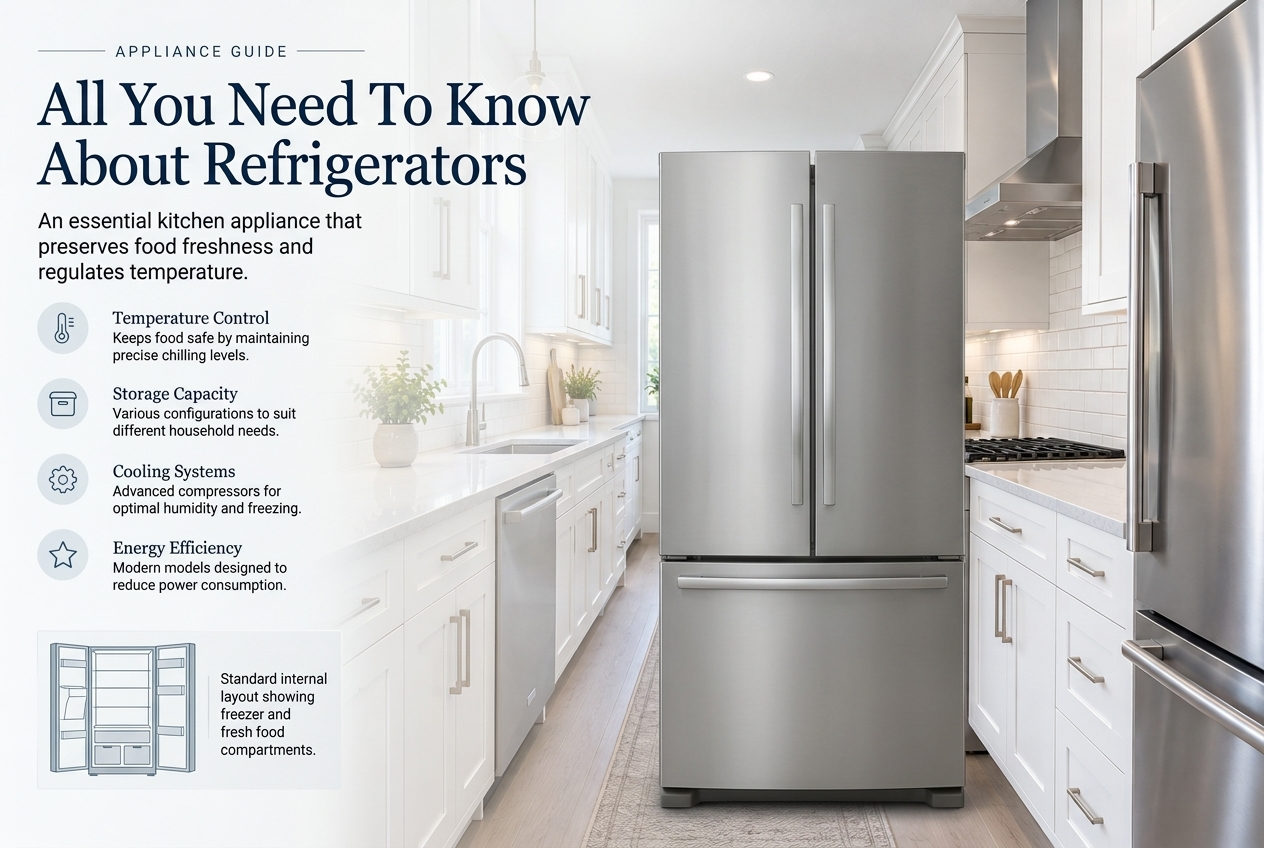
A refrigerator is an electric appliance that keeps food and drinks cold to slow spoilage. It removes heat from an insulated interior and releases it into the surrounding room, holding the inside at a steady low temperature. Most homes use one to store fresh produce, dairy, meat, leftovers and beverages.
“Fridge” is the everyday short form of the same appliance, so “refrigerator vs fridge” is a difference of wording, not of product. A refrigerator differs from a freezer in temperature: a refrigerator holds food just above freezing for short-term storage, while a freezer holds it below freezing for long-term storage. Many household models combine both in one cabinet, with separate compartments and separate temperature targets.
This guide explains how a refrigerator works, the cooling technologies behind it, the main layouts, the size and dimension ranges, the features that change price, the right temperature settings, running costs, common faults and how to choose a model. Exact specifications vary by brand and model, so check the manufacturer’s documentation before buying or installing.
A refrigerator keeps food cold by moving heat out of the interior and releasing it outside the cabinet. A refrigerant circulates through a sealed system, absorbs heat inside the compartments, and discharges that heat through coils at the back or base. This is why the air around a running refrigerator feels warm and why the unit needs space for airflow.
The cooling depends on a small set of parts working together. A thermostat senses the interior temperature and switches the cooling system on and off to hold the set point. The door gasket then protects that work by sealing the opening, so warm room air does not leak in each time the door is closed.
Steady cold temperatures slow food spoilage because the bacteria and mold that cause it grow more slowly in the cold. Cold does not stop this growth, which is why refrigerated food still spoils eventually. Temperature swings are a problem because food that warms repeatedly gives microbes more time to multiply. A stable interior, a good seal and clear airflow matter as much as the cold itself.
Refrigerators use three main cooling technologies: compressor, absorption and thermoelectric. They are listed here from the most common household option to the most niche. Each removes heat from the interior in a different way, and each suits a different setting, capacity and power source.
The choice matters mostly when shopping outside the standard home kitchen. Nearly every full-size household refrigerator uses a compressor, so the other two appear in recreational vehicles, off-grid cabins, hotel rooms, offices and small portable coolers. The trade-offs involve efficiency, noise, capacity and how low the temperature can go.
A compressor refrigerator cools through the vapor-compression cycle. The compressor squeezes the refrigerant gas, which makes it hot; the condenser coils release that heat and turn the gas into liquid; the liquid then expands and turns cold in the evaporator, where it absorbs heat from the interior. The refrigerant returns to the compressor and repeats the loop.
This design is the standard for home use because it cools large volumes, reaches freezing temperatures and runs efficiently on ordinary household power. An inverter compressor adjusts its speed to match demand, while a standard compressor switches fully on and off. Inverter models generally run more quietly and hold temperature more evenly, but they usually cost more and use more complex electronics that can be costlier to repair.
An absorption refrigerator cools with heat instead of a compressor. A heat source, such as electricity or gas, drives a refrigerant-and-absorbent mixture through a cycle with no moving mechanical parts, which is why these units run almost silently.
That quiet, flexible fuel use suits recreational vehicles, cabins and off-grid settings, where propane can replace mains power. The trade-offs are lower efficiency than compressor models, slower cooling and sensitivity to being level. Capacity is typically modest, so they are chosen for their power flexibility and silence, not for everyday family storage.
A thermoelectric refrigerator uses the Peltier effect: electric current passing through a junction of two materials moves heat from one side to the other. It is solid-state cooling, with no compressor and no refrigerant, and a small fan usually helps shed the heat.
Mini fridges and small portable coolers use this method because it is compact, light and quiet. Its limits are capacity and cooling range: it cools to a set difference below the surrounding air, so it struggles in a hot room and cannot reliably make freezing temperatures. It suits a desk, bedroom or car, not a main kitchen.
Door and freezer layout is the main way home refrigerators are categorized, because it determines how you reach food, how much usable space you get and where the freezer sits. Two models of the same total volume can feel very different in daily use depending on whether the freezer is on top, below or beside the fresh-food section.
The first split is between a refrigerator-only unit with no freezer and a refrigerator-freezer combination. Refrigerator-only models give all the space to fresh food and suit a second unit in a kitchen, pantry or garage. Combination models are the household default. The table compares the main layouts by access, capacity and typical use; capacity descriptions are general tendencies, not guarantees for any one model.
| Layout | Access | Capacity tendency | Typical use |
|---|---|---|---|
| Top-freezer | Freezer at eye level, fresh food below | Roomy fresh-food area | Budget-conscious households |
| Bottom-freezer | Fresh food at eye level, freezer drawer below | Good fresh-food access | Households that use fresh food daily |
| Side-by-side | Narrow vertical doors | Narrow shelves, tall storage | Tight aisles |
| French door / quad door | Wide fresh-food space, bottom freezer | Wide shelves | Larger kitchens and families |
| Compact, mini, specialty | Varies | Small | Dorms, offices, bars, garages |
In short, the layouts trade price, shelf width, freezer convenience and kitchen clearance against one another. No layout is best in every case.
A top-freezer refrigerator places the freezer compartment above the fresh-food section, each with its own door. This is the simplest and most traditional layout, with straightforward controls and few extras to fail.
It generally sits at the lower end of the budget range and gives a spacious fresh-food compartment for its footprint. It suits renters, first homes, secondary kitchens and households that want dependable basics. The main trade-off is bending to reach the lower shelves, where produce and everyday items often end up.
A bottom-freezer refrigerator puts fresh food at eye level and the freezer in a pull-out drawer below. Because most people reach for fresh items far more often than frozen ones, this layout reduces bending in daily use.
The trade-off is freezer access. You must bend or crouch to use the drawer, and items at the back of a deep drawer are harder to see, so baskets or dividers help. These models usually cost more than top-freezer units of similar capacity, and the drawer can hold bulky packages less conveniently than an open shelf.
A side-by-side refrigerator splits the cabinet vertically, with the freezer on one side and fresh food on the other. Its narrow doors need less swing space, which helps in tight aisles and galley kitchens.
The limit is width. Each compartment is slim, so large items such as party platters, wide pizza boxes and big trays may not fit flat. The tall freezer side does offer vertical storage and easy eye-level access to both compartments, and many models include door dispensers for water and ice.
A French door refrigerator has two doors that open outward over a wide fresh-food compartment, with a freezer drawer beneath. The wide opening takes large platters and trays, and the narrow door swing suits tighter spaces than one wide door would.
Quad door models add two more doors, typically splitting the lower area into separate freezer and flexible-temperature sections. These layouts commonly carry extra features such as ice makers, water dispensers and special drawers, which raises both the price and the number of parts that could need repair. They tend to suit larger households and kitchens with the space for wide cabinets.
Compact, mini and specialty refrigerators serve small spaces or specific storage jobs, and they differ widely in capacity and cooling method. The main kinds are:
Matching the model to the location matters more here than in a kitchen, because ambient conditions and ventilation vary greatly.
Refrigerator size is measured two ways: internal capacity in cubic feet (cu ft) and external width, height and depth. Capacity tells you how much food the cabinet holds, while external dimensions tell you whether it fits your space and gets through the doors on the way in. The two do not always move together, since thick insulation and machinery can reduce interior volume.
Household size is the usual guide to capacity: larger households need more cubic feet, and people who shop in bulk or entertain often need more still. Full-size models commonly fall roughly between 14 and 30 cubic feet, with widths of about 24 to 36 inches or more, and heights near 60 to 70 inches or taller. These are typical ranges, not standards, and individual models vary, so rely on the manufacturer’s listed dimensions.
| Measure | Typical full-size range | What it affects |
|---|---|---|
| Capacity | About 14-30 cu ft | Food storage for the household |
| Width | About 24-36+ in | Cabinet opening and door style |
| Height | About 60-70+ in | Ceiling or cabinet clearance |
| Depth | Varies with type | Aisle space and kitchen look |
Narrower top-freezer units sit toward the smaller end of the width range, while French door and side-by-side models sit toward the larger end. Always leave allowance for door swing, handles and ventilation beyond the stated dimensions.
A standard-depth refrigerator extends past the front edge of the kitchen counters, while a counter-depth model is shallower and sits closer to flush with them. Counter-depth units give a built-in look and keep walkways clearer, but the doors and handles still protrude somewhat.
The trade-off is capacity. A shallower cabinet holds less food than a standard-depth model of similar width and height, and counter-depth units often cost more per cubic foot. They suit open-plan kitchens and tight aisles where appearance and clearance matter; standard depth gives better value when storage is the priority.
Measure both the final opening and the route the refrigerator must travel, and compare each against the model’s listed dimensions. Follow these steps:
Door removal can sometimes ease a tight fit, but check what the manufacturer allows before attempting it.
Refrigerator features change daily convenience and the purchase price, and many also change repair risk. Features fall into groups by purpose: dispensing, storage organization, and connectivity and appearance. Each is worth buying only if you will actually use it.
Every added component is another part that can fail. Water dispensers, ice makers, electronic controls and multiple drawers add cost up front and can add repair cost later. A simpler model with fewer moving parts is usually cheaper to buy and to maintain, while a feature-rich one trades that simplicity for convenience.
Ice makers and water dispensers supply ice and chilled water either inside the cabinet or through the door. Internal ice makers keep the door surface clean and free up door space, while door dispensing lets you fill a glass without opening the refrigerator.
Both usually need a water line connected to the refrigerator, so installation requires a nearby supply and correct fittings. Some models make nugget ice, the soft, chewable kind, as an option. Dispensers and ice makers are among the more common sources of faults, so weigh the convenience against the added repair risk.
Interior storage design determines how well a refrigerator fits your food. Useful elements include:
Good organization reduces forgotten food and improves airflow, which supports even cooling.
Smart refrigerators connect to home networks and may offer alerts, remote temperature monitoring or voice-assistant control, depending on the model. They add convenience, such as a door-open alert, but also add electronics, software and cost that a basic unit avoids.
Finish affects appearance and upkeep. Stainless steel is common, black finishes offer a different look, and panel-ready models accept custom cabinet panels for a built-in appearance. Fingerprint resistance and cleaning ease vary by finish and brand, so check the manufacturer’s care guidance.
The refrigerator compartment should be at or below 40°F (4°C), and the freezer at 0°F (-18°C), according to widely used food safety guidance such as that from the US Food and Drug Administration. Staying within these limits keeps cold-slowed bacterial growth in check, which is the purpose of refrigeration.
Do not trust the dial alone, since control settings are often just numbers or relative levels. Place an appliance thermometer in a glass of water on a middle shelf, wait several hours, and read it; for the freezer, place it between packages. Check again after changing the setting, because the interior takes time to stabilize. Temperatures also vary inside the cabinet, with the door shelves warmer than the back of the middle shelves.
Food freezing in the refrigerator, or the interior running too warm, usually signals a setting or airflow problem. Items freezing often mean the setting is too cold or that food sits against the cold air vent. Warm readings can come from overpacking that blocks air circulation, a weak door seal, a dirty coil or a thermostat fault. Useful habits include:
A refrigerator runs continuously, so its electricity use accumulates over its life and can exceed the savings from a cheaper purchase. Actual consumption depends on the model, its age, the room and how it is used, so check the label for the manufacturer’s estimate.
Energy efficiency ratings, such as the ENERGY STAR label in the United States, indicate that a model meets efficiency criteria set by the program. In practice, a rated model typically uses less electricity than a comparable unrated one, which lowers running costs over time. The yellow EnergyGuide label, where used, shows estimated annual use so models can be compared. Estimates assume standard conditions, so a hot kitchen or frequent door opening can raise real use.
Power setup matters too. A refrigerator should have a dedicated outlet so it does not share a circuit with other heavy loads, and a surge protector can shield its electronics from voltage spikes. Avoid extension cords where possible, since an undersized cord can overheat; if one is unavoidable, follow the manufacturer’s guidance and use a heavy-duty cord rated for the load. Check the nameplate for the unit’s amp draw.
Most refrigerator problems show as a symptom that points to a likely cause, such as warm air, odd noises or water on the floor. Matching the symptom to a cause helps you decide between a simple fix and a service call, without guessing at a specific model’s fault.
Try simple, safe steps first: confirm the unit is plugged in, check the temperature setting, clear vents and clean accessible coils. Call a technician for sealed-system issues, electrical faults or repeated tripping of a breaker, since these involve refrigerant or wiring that need professional handling. Always unplug the refrigerator before touching internal parts.
| Symptom | Likely cause | First step |
|---|---|---|
| Not cold enough | Dirty coils, weak door seal, thermostat issue | Clean coils and check the seal |
| Fridge warm, freezer cold | Evaporator fan or airflow blockage | Clear vents; listen for the fan |
| Humming or knocking | Compressor or fan operation, loose items | Check level and nearby objects |
| Water leak | Blocked drain or loose water line | Check the drain and connections |
| No ice | Frozen or disconnected water line, shutoff | Check supply and ice maker switch |
A refrigerator that is not cooling enough most often has dirty condenser coils, a faulty evaporator fan, a worn door seal or a failing thermostat. Dust on the coils reduces heat release, a stalled fan stops cold air circulating, a leaky gasket lets warm air in, and a faulty thermostat misreads or mis-controls temperature.
When the refrigerator is not cooling but the freezer works, the cause is usually airflow: the evaporator fan or an air passage between the compartments is blocked or frosted. Start by clearing vents, cleaning the coils and checking the seal. If the problem persists, a technician should check the fan, thermostat and sealed system.
Humming is normal when the compressor and fans run, but loud or changing hums, and knocking, can come from a failing fan, loose parts or a unit that is not level. Knocking can also be the ice maker or normal expansion and contraction of materials.
Water leaks typically come from a blocked defrost drain or a loose or damaged water line, while an ice maker that is not making ice often points to a frozen line, closed supply valve or a switched-off ice maker. Check these basics first, and call a technician if leaks or faults continue.
Regular upkeep reduces wear and protects efficiency. Useful practices include:
These habits help the refrigerator hold temperature with less work, which supports a longer working life.
Choose a refrigerator by working through your constraints in order, starting with the physical space and ending with budget. This order prevents falling for a model that is attractive but does not fit your kitchen or household.
Budget tiers broadly follow layout and features: top-freezer models are generally cheapest, and French door and feature-heavy models cost most. Used units can save money but may have unknown history, higher energy use and no warranty, so inspect seals, check cooling and confirm return terms. As final checks, compare brand reliability and warranty terms, and read independent reviews and owner feedback, treating any single source with caution.
