
Our Location
304 North Cardinal St.
Dorchester Center, MA 02124

 ByAlan
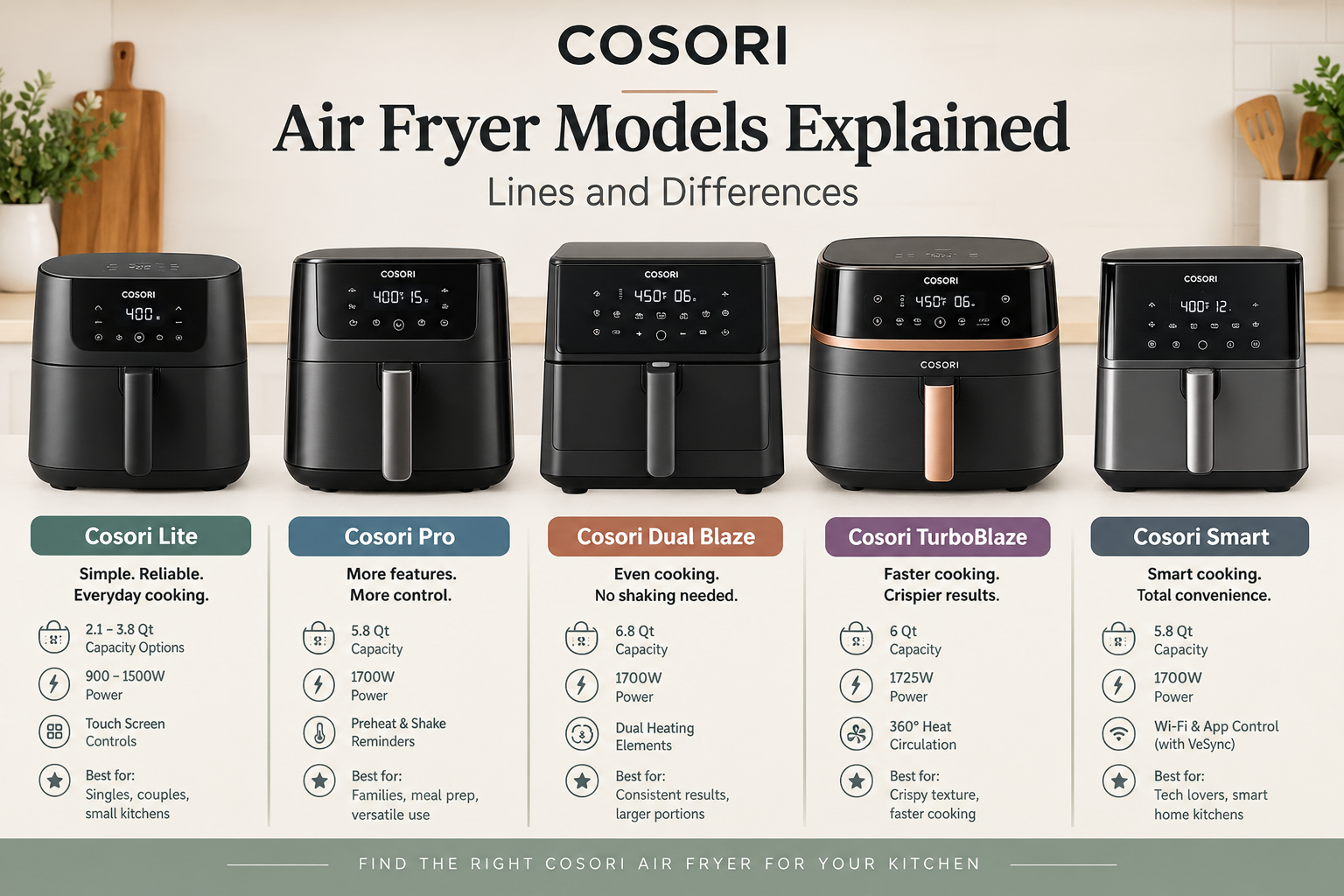
Cosori air fryer models run from a 2.1-quart Lite Mini up to a 13-quart oven, and ten single-basket, dual-basket, and oven bodies sit in between. Capacity across those bodies runs from 2.1 quarts in the Lite Mini to nine quarts in the dual-basket line, and rated power runs from 1,000 to 1,800 watts across the published lineup.
Cosori model numbers begin with CAF on current units, and the letters after the dash name the line while the digits track capacity. Older bodies carry CP, CS, and CO prefixes instead, and those three groups include the 3.7-quart and 5.8-quart units covered by the 2023 recall.
Differences between the numbers sit in motor type, basket count, coating, and app support rather than in the heating layout, which stays broadly consistent across the range. Each family also carries its own baskets and crisper plates, and a replacement part typically has to match the model number that produced it.
This article explains what the model numbers mean, how the six families differ, what each body measures in quarts, watts, and counter width, which numbers the recall covered, and which model suits a given household size and kitchen counter.
Cosori air fryer model numbers carry a three-letter prefix, a capacity code, and a region suffix, and the prefix marks the generation that a unit belongs to. CAF marks the current naming scheme, while CP, CS, and CO mark earlier Pro bodies, and the digits track capacity, so CAF-L501 holds five quarts in a single Pro basket.
A trailing S marks a smart body with Wi-Fi, and letters after the dash mark colour and market, which is why CAF-DC601-KUS and CAF-DC601S-WUSR share one platform. Reading the capacity digits before the suffix prevents ordering a 2.1-quart body instead of a six-quart one, and brand comparisons outside Cosori answer a related speed question buyers raise next.
Cosori air fryers reach a set temperature in about three minutes, which sits slightly behind Ninja bodies on preheat while holding a steadier temperature through the cycle. Cosori answers with a wider heat range, and the TurboBlaze covers 90 to 450 degrees against the 105 to 400 degrees a comparable Ninja basket covers on its own panel.
Coating differs as well, since Cosori publishes a PFAS-free ceramic basket across current models while competing bodies typically pair ceramic with a coated aluminium shell underneath. Owners who cook frozen food daily notice the heat ceiling first, and they typically feel the preheat difference only inside the first minute. Weighing heat range against preheat speed prevents overpaying for a spec that never gets used, and the Cosori oven bodies raise a different question inside the brand, where their layout changes entirely.
A Cosori air fryer cooks inside a pull-out basket, while a Cosori air fryer oven cooks on racks behind a door across 13 to 32 quarts. Basket bodies hold four to nine quarts and heat one layer of food, and oven bodies hold three racks, a rotisserie spit, and a crumb tray below them.
Footprint separates them more than capacity, as a 13-quart oven takes about twenty inches of counter width against twelve inches for a six-quart basket. Choosing the basket body keeps the counter clear for other work, and the published lines split further by capacity, motor type, and control panel.
Cosori air fryer lines divide into Lite, Pro, TurboBlaze, Iconic, dual-basket, and oven families, and each family carries its own capacity band and control panel. Lite covers 2.1 and four quarts, Pro covers five and 5.8 quarts, TurboBlaze and Iconic cover six and 6.5, and the dual bodies cover nine quarts between their two drawers.
These families share one ceramic basket standard and one temperature philosophy, while motor type, display, and app support change from the entry bodies upward. Picking the family before the model number cuts the list to two or three candidates, and the single-basket bodies hold most of the published lineup, as they cover four of the six families.
Single-basket Cosori air fryer models cover the Lite, Pro, TurboBlaze, and Iconic families, and capacity runs from 2.1 quarts up to 6.5 quarts in one drawer. The Pro LE holds five quarts at 1,500 watts, the Pro II holds 5.8 quarts, and the TurboBlaze holds six quarts at 1,725 watts.
This group shares a square basket and a removable crisper plate, which spreads food across more floor area than a round basket of the same rated volume. Confirming that one layer of food fits the basket floor prevents a second batch, and the dual-basket bodies answer that batch problem with two zones under fully independent control.
Two-basket Cosori air fryer models hold nine quarts in total, and the dual-basket body splits that volume into two 4.5-quart drawers that run under separate timers and separate controls. Rated power reaches 1,750 watts across both zones, and the panel carries eight presets, a shake reminder, and a sync setting that lands both drawers together. These two drawers can also run one at a time, which cuts the draw on the circuit when only one dish needs cooking.
The TwinFry body takes a different route, since a removable divider converts its two 4.5-quart zones into one continuous nine-quart basket at 1,500 watts. Measuring seventeen inches of counter width before ordering prevents a fit problem, and the TurboBlaze line explains what the newer motor actually changes inside these single-basket bodies.
The Cosori TurboBlaze runs a DC motor with five fan speeds, and the body cooks up to 46 percent faster than the older Pro generation it replaced. Capacity sits at six quarts with 1,725 watts, the range covers 90 to 450 degrees, and nine functions cover air fry through proof and keep warm.
A smart version adds Wi-Fi and a tenth function at 6.5 quarts, which raises weight from 13.2 to 14.1 pounds on the same counter footprint. Choosing the standard body saves about ten dollars when app control stays unused, and the Iconic line carries the same motor inside a shell built from considerably heavier materials.
The Cosori Iconic costs 249 dollars because the body uses stainless steel instead of moulded plastic and carries a five-year limited warranty on the whole unit. Capacity reaches 6.5 quarts at 1,725 watts, and the footprint measures 11.8 by 11.8 by 11.6 inches at 14.1 pounds without the handle attached to it.
Cooking performance tracks the TurboBlaze closely, so the premium buys materials, a brighter display, and a quieter shell rather than faster or more even results. Paying for steel makes sense when the appliance stays on the counter permanently, and the Lite family sits at the opposite end of the lineup on price and on capacity.
The Cosori Lite Mini holds 2.1 quarts, and the body feeds one person or two small sides while taking under nine inches of counter width. A four-quart Lite version sits above it with smart control, and both bodies run below 1,500 watts on a standard kitchen circuit without overloading it.
Basket depth limits what fits, since a whole chicken or a full tray of fries cannot sit in one layer inside a 2.1-quart drawer. Matching the smallest body to a single-person routine prevents wasted counter space, and the oven bodies cover the opposite requirement, where capacity generally matters more than footprint.
A Cosori air fryer oven adds racks, a rotisserie spit, and a glass door, and the 13-quart body holds a whole chicken or two pizza trays. Rated power runs near 1,800 watts, the cavity takes three rack positions, and the door lets food get watched without the drawer being pulled out.
Cooking speed falls behind a basket body, as a larger cavity holds more air that the same heater has to bring up to temperature. Families that already own a toaster oven gain less from it, and they generally keep a basket body for speed on smaller weeknight portions. Choosing an oven body pays off when toast and roasting matter, and two six-quart bodies sit close enough together that a direct comparison typically settles the choice between them.
The Cosori TurboBlaze and the Iconic share a DC motor and 1,725 watts, and the Iconic adds half a quart, a steel body, and 120 dollars. Both bodies cover 90 to 450 degrees with a PFAS-free ceramic basket, and both sit inside a footprint under twelve inches square on the counter.
Warranty separates them further, since the Iconic carries five years against the two years a standard Cosori basket body carries at registration. Buying the Iconic buys durability and looks instead of cooking speed, and the older Pro numbers raise the same question one tier below them in the lineup.
The Cosori Pro LE holds five quarts and the Pro II holds 5.8 quarts, and both bodies run an AC motor at 1,500 to 1,700 watts. The Pro II adds four presets, a keep-warm function, and a shake reminder, while the Pro LE keeps a simpler nine-preset panel at 99 dollars.
Both bodies preheat more slowly than a DC motor line, and a full basket of fries typically takes three to four minutes longer to crisp. Choosing a Pro body saves thirty dollars when speed matters less than capacity, and the nine-quart bodies split that capacity in two very different ways.
The Cosori dual-basket body keeps its two 4.5-quart zones permanently separate, while the TwinFry body removes a divider and turns both zones into one nine-quart basket. Rated power differs by 250 watts, as the dual-basket body draws 1,750 and the TwinFry draws 1,500 across the same nine quarts of volume.
Shape follows that difference, so the TwinFry runs nineteen inches wide and eleven deep while the dual-basket body runs seventeen wide and fifteen deep. Choosing the divider body suits a whole chicken, which cannot lie across two separate zones, and motor type explains why two bodies at similar wattage can cook at noticeably different speeds.
Cosori air fryers use either an AC or a DC motor, and the DC bodies spin the fan faster at lower current while holding a steadier speed. A DC body reaches 450 degrees in about four minutes and cooks up to 46 percent faster than the AC generation that preceded it.
Five fan speeds arrive with that motor, and each speed pairs with a function so delicate food gets less airflow than a basket of frozen fries. Paying for a DC body pays for time rather than capacity, and the published quart ratings show where each of these motors sits across the lineup.
Cosori air fryers measure 2.1 quarts at the smallest and 13 quarts at the largest, and the middle of the lineup clusters between five and 6.5 quarts. Rated volume counts the whole basket, and usable area sits lower because food needs one layer over the crisper plate to brown evenly on all sides. A six-quart rating typically leaves about four quarts of usable floor once the crisper plate sits inside, and that figure decides real batch size.
| Line | Capacity | Baskets | Wattage |
|---|---|---|---|
| Lite | 2.1 to 4 qt | One drawer | Under 1,500 |
| Pro | 5 to 5.8 qt | One drawer | 1,500 to 1,700 |
| TurboBlaze | 6 to 6.5 qt | One drawer | 1,725 |
| Iconic | 6.5 qt | One drawer | 1,725 |
| Dual basket | 9 qt | Two drawers | 1,500 to 1,750 |
| Oven | 13 to 32 qt | Three racks | 1,800 |
These quart figures cover one drawer, and a nine-quart dual body holds two 4.5-quart halves instead of one continuous nine-quart cooking space. Reading the quart column against household size prevents a two-batch routine, and serving counts turn these capacity ratings into real portions at the table.
A six-quart Cosori air fryer feeds three to five people in one cycle, and a nine-quart dual body feeds the same number across two separate dishes. A 2.1-quart Lite basket feeds one person, and a five-quart Pro body feeds two or three when the food sits in a single even layer.
Portion counts drop with frozen food, since surface ice adds five to eight minutes and often pushes a full basket into two consecutive cooking runs. Matching basket volume to the largest regular meal prevents weeknight double cooking, and the wattage rating explains what each of these cycles can cost across a month.
Cosori air fryers use 1,000 to 1,800 watts, and the TurboBlaze and Iconic draw 1,725 while the nine-quart dual body draws 1,750 watts across two zones. A 1,750-watt body pulls about fifteen amps at 120 volts, which fills a standard kitchen circuit during a full heating and crisping cycle.
Energy use follows runtime, so a twenty-minute cycle at 1,725 watts consumes roughly 0.6 kilowatt-hours and costs about nine cents at average residential rates. Two bodies drawing 1,725 watts can still differ in runtime, because a faster motor generally reaches temperature sooner and shortens the whole cycle by minutes. Running one zone instead of two halves that draw on a dual body, and the temperature range sets the ceiling every one of these functions works within.
Cosori air fryers reach 450 degrees on current bodies, and the TwinFry pushes to 465 degrees while older Pro bodies stop at 400 degrees instead. The floor of the range sits at 90 degrees, which supports proofing dough and dehydrating fruit across a timer that runs up to 48 hours.
Oven bodies hold a wider cavity at the same ceiling, so the heat spreads across three racks rather than one basket floor and crisper plate. Confirming the ceiling before buying prevents a shortfall on frozen food, and the body footprint decides where all of that heat can sit on a counter.
Cosori air fryers need nine to twenty inches of counter width, and a six-quart basket takes twelve inches while a nine-quart dual body takes seventeen inches. Height runs eleven to twelve inches on basket bodies, and the TurboBlaze measures 14.4 by 11.8 by 11.9 inches with the handle included in that figure. Cabinets above the counter matter as well, and they need three or four inches of clearance so steam can escape from the opened drawer.
Rear clearance matters more than width, because the vents exhaust backward and cannot clear heat without four to five inches of open space behind the body. Measuring width, depth, and rear clearance before ordering prevents a return, and the basket coating decides how food releases from it once the body fits.
Cosori air fryer baskets carry a PFAS-free ceramic coating on current models, and the coating releases food without added oil at the 450-degree ceiling their panels allow. Ceramic sol-gel layers sit over an aluminium shell, and that shell carries heat across the perforated crisper plate within two or three minutes of starting.
Older Pro baskets used a conventional nonstick film instead, which is why replacement baskets list by model number rather than by rated capacity. Hand washing the ceramic keeps its release life longer, and the published dishwasher ratings differ by part, which often surprises owners who machine wash them.
Cosori air fryer baskets and crisper plates carry a dishwasher-safe rating across current models, and the powered housing never goes into a dishwasher at all. Oven racks and the crumb tray share that rating, and the cavity itself takes a damp cloth once the unit has cooled completely. Crisper plates lose their coating first, as their perforations trap detergent and they sit closest to the food through every crisping cycle.
These manuals still recommend hand washing coated parts, as detergent alkalinity near pH eleven typically dulls a ceramic surface across twenty or thirty cycles. Hand washing the basket and machine washing the racks keeps both surfaces intact, and the function list decides what these parts can cook once they are back in place.
Cooking functions on a Cosori air fryer set a temperature, a time, and a fan speed together, and nine or ten functions appear on current panels. Air fry runs the fan at full speed near 400 degrees, whereas proof holds 90 degrees and dehydrate holds 130 degrees across several hours instead.
Frozen, reheat, and keep warm change runtime rather than temperature, and those three presets typically save two or three minutes of manual entry. Selecting a function instead of a manual temperature prevents an overcooked batch, and the app adds another layer of control on the smart bodies alone.
Cosori air fryers work fully without the app, and the smart bodies keep every function on the panel whether or not a phone ever connects. The app adds recipe presets, remote start, and a cooking log, and it runs only on the S-suffix bodies that carry Wi-Fi hardware inside, so a standard body cannot be paired with it at all.
Non-smart bodies skip that radio entirely, which is why a CAF-DC601 costs about ten dollars less than the CAF-DC601S at the same rated capacity. Skipping the smart body saves money when a phone never enters the kitchen, and fan noise rises on every one of these models once the cycle starts.
A Cosori air fryer runs between 60 and 83 decibels, and the nine-quart dual body sits at the top of that band with two fans running. Noise tracks fan speed, so the lowest of five speeds runs near 60 decibels and the highest reaches the upper end during a crisping cycle.
DC motor bodies run quieter at the same airflow, and that difference is audible across a small kitchen when both units sit on one counter. Placing the unit on a rubber mat can drop perceived noise by two or three decibels, and it also stops the body from creeping forward. Selecting a lower fan speed for delicate food reduces the noise, and a set of older model numbers carries a separate safety concern owners can still check.
Cosori recalled about two million air fryers in 2023, and the recall covered 3.7-quart and 5.8-quart bodies sold under the older Pro naming scheme rather than the current CAF numbering. Affected numbers include CP158-AF, CP137-AF, CS158-AF, CO158-AF, and the CAF-P581 series, where a wire connection can overheat and cause a fire or burn.
Current CAF bodies fall outside that list, and the replacement programme swaps an affected unit for a newer model at no cost to the owner. Checking the number on the base label against the recall list prevents running an affected unit, and current prices show what a replacement body can cost today.
Cosori air fryer models cost between 60 and 250 dollars, and the Lite Mini sits at the bottom of that range while the steel Iconic sits at the top. The Pro LE lists at 99 dollars, the TurboBlaze between 120 and 130, the nine-quart dual body at 170, and the 13-quart oven at 140.
Dual-basket bodies typically carry a forty dollar premium over a single basket of similar total volume, which pays for the second heater and fan. Sale pricing moves these figures by twenty or thirty dollars through the year, and they typically fall furthest on the older Pro bodies. Comparing price against zone count prevents paying twice for the same capacity, and three simple checks identify the Cosori air fryer model a kitchen already holds.
Cosori air fryer identification rests on three checks: the label under the base, the basket arrangement inside, and the display and fan-speed markings across the control panel. Each check takes under a minute with the unit unplugged, and the three together separate the Lite, Pro, TurboBlaze, Iconic, dual-basket, and oven families.
None of the three checks depends on the packaging, and a second-hand unit arriving without a box typically resolves to one published model number. Recording that number before ordering parts or checking the recall list prevents a mismatch, and the base label answers it most directly of these three checks.
To read the label, unplug the unit, tip the body onto its side, and read the printed plate on the underside of the base panel. The plate prints the model number, the wattage, the voltage, and the frequency, where CAF-DC601-KUS appears beside 1,725 watts and 120 volts.
These region suffixes sit on the same line, and a KUS ending marks a North American unit while an AUS ending marks another sales market. Photographing the plate keeps that number available for parts and recall checks, and the basket arrangement confirms the family that the plate has named.
To count the baskets, open the appliance and count the drawers, crisper plates, and racks that the body accepts before checking anything else on it. One square drawer marks a Lite, Pro, TurboBlaze, or Iconic body, two drawers mark the dual-basket line, and three racks mark an oven cavity.
A removable divider inside one wide drawer marks the TwinFry body, which no other Cosori basket model carries at any rated capacity. Counting the drawers settles the family within seconds, and the display then resolves which generation inside that family a unit belongs to at a glance.
To check the display, power the unit on and read the function names and the fan-speed indicator printed around the touch panel on the front. Nine or ten function names with five fan speeds mark a TurboBlaze or Iconic body, and a shorter preset list marks an older Pro body.
A Wi-Fi symbol confirms an S-suffix smart body, and a sync setting beside the timer narrows the unit to the nine-quart dual-basket line. Reading the display after the label confirms both family and generation, and these two facts can drive the choice between all the published model numbers.
One or two people suit a 2.1-quart Lite Mini or a five-quart Pro LE, and both bodies take under twelve inches of counter width in a small kitchen. A five-quart basket holds two pounds of fries or two chicken breasts, which covers a two-person dinner without a second cooking run.
A six-quart TurboBlaze suits the same household differently, since faster preheating matters more than volume when most meals cook in one single batch. Confirming the largest regular batch before purchase prevents buying capacity that stays unused, and larger households usually invert that calculation entirely.
A family of four or more suits a nine-quart dual body or a 13-quart oven, and either one cooks a main dish and a side together. Two 4.5-quart zones handle about four pounds of food in total, which covers a family meal inside a single twenty-minute cooking cycle.
Counter width decides between them, as the dual-basket body needs seventeen inches while the oven needs twenty inches and more clearance above it. Households that host regularly can pair a nine-quart body with an oven body, though they rarely need both of them running at once. Confirming portion size, counter width, and dish count narrows the lineup to a single model number that fits the kitchen and prevents a second purchase.
