
Our Location
304 North Cardinal St.
Dorchester Center, MA 02124

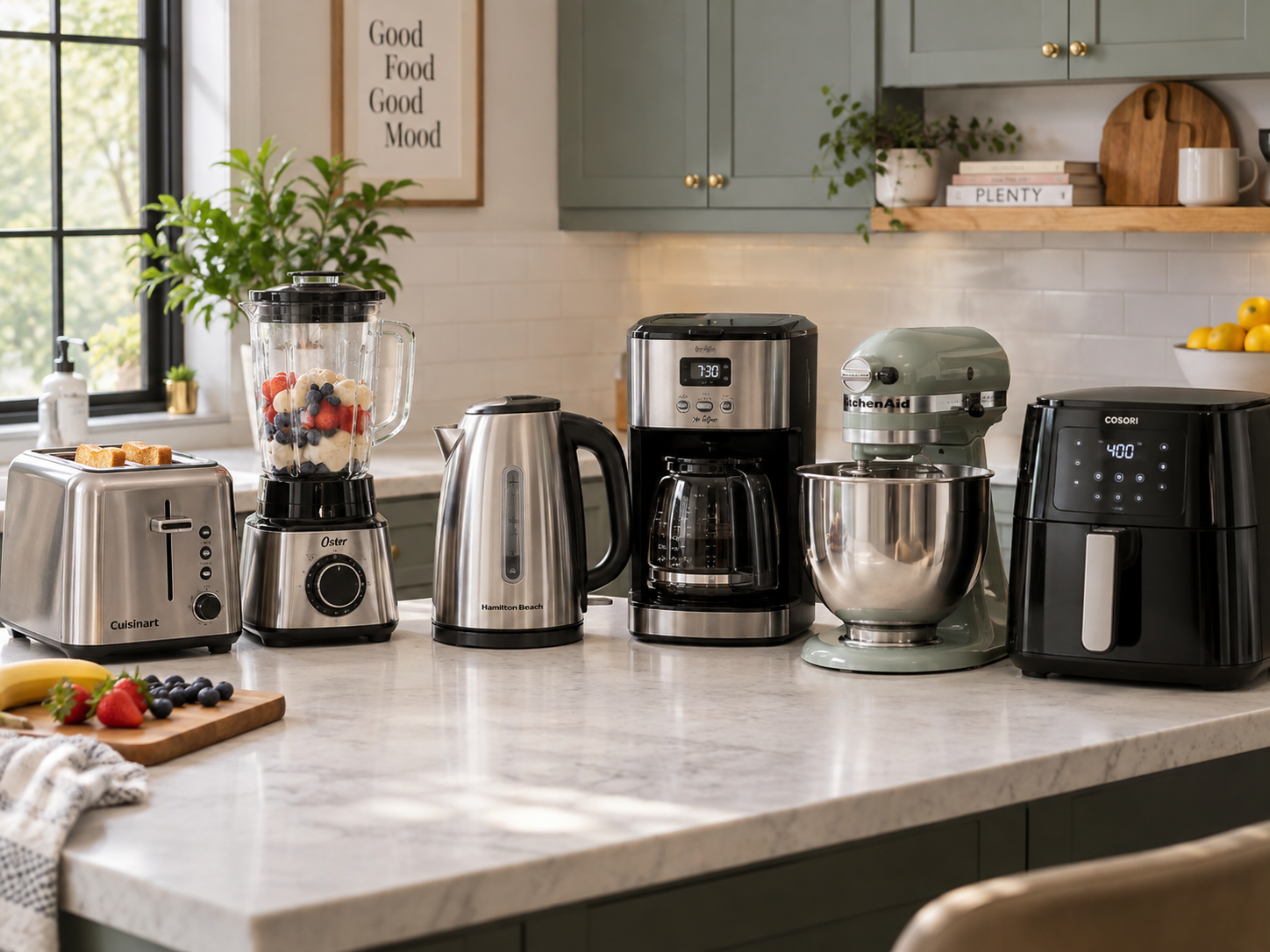
Essential small kitchen appliances are the portable countertop appliances that handle heating, cooking, food preparation, and beverages in a kitchen that has no other equipment yet. In a first kitchen, they cover tasks a range and refrigerator alone cannot.
Three factors decide whether an appliance belongs in a starter set: how many separate tasks it performs, how often it gets used in a week, and how much counter space and electrical capacity it takes from the two 20-ampere kitchen circuits required by the National Electrical Code. Wattage, capacity, and physical footprint are the numbers that answer those questions.
A first kitchen also differs from an established one in what it lacks. There is usually no second oven, no stand mixer, and limited counter and cabinet space, so each appliance has to justify its space with regular use. Buying a full matched set at once is the common alternative approach, and it typically produces appliances that sit unused.
This article defines what counts as essential, explains how to separate essential from optional appliances, classifies the main categories, covers each appliance with its verified wattage and capacity, gives sizing and running-cost figures, explains what kitchen circuits can carry, states the limits of a starter set, and ends with the factors to decide on.
Essential small kitchen appliances are countertop appliances that handle a daily cooking, heating, preparation, or beverage task that no other equipment in the kitchen covers.
The category is defined by function, not by price or brand. A small kitchen appliance is a portable, plug-in unit used on a countertop, which separates it from major appliances such as the range, refrigerator, and dishwasher that are installed and connected permanently. For the full boundary between the two groups, see our guide on What Are Small Kitchen Appliances?
The word essential has no official definition, and no government agency or standards body publishes a required list. The Association of Home Appliance Manufacturers uses the industry term portable appliances for this group, which describes the physical format rather than the priority order.
The practical consequence is that essential status depends on the household. An electric kettle is essential in a home that drinks tea daily and optional in one that does not, so the test is the task performed rather than the product category.
An appliance earns a place in a first kitchen if it performs a task you do at least several times a week and no existing equipment performs it well.
Three checks apply in order. First, name the specific task, such as reheating single portions, boiling water, toasting bread, or blending. Second, check whether the range, oven, or an appliance you already own does the same job at acceptable speed and cost. Third, check whether you have the counter space to leave it out, because appliances stored in a cabinet get used less.
Energy and speed can settle borderline cases. The Department of Energy’s Energy Saver guidance states that a toaster or convection oven uses one-third to one-half as much energy as a full-sized oven, which makes a countertop oven worth its space in a household that cooks small portions.
This test removes most duplicate purchases. A multicooker with a slow cook program and a separate slow cooker perform overlapping tasks, so buying both adds cost and counter use without adding capability.
Essential appliances perform frequent general tasks. Specialty appliances perform one narrow task, so they earn counter space only in households that do that task often.
The differences are measurable. A blender handles smoothies, sauces, soups, and crushed ice; a waffle maker makes waffles. A microwave reheats almost any portion of leftovers; an electric egg cooker cooks eggs. The number of tasks per unit of counter space is what separates the groups.
Cost follows the same pattern but not reliably. Specialty appliances are often cheaper to buy, so total spending is a poor guide to value; the cost per use matters more, and it rises quickly for an appliance used a few times a year.
Storage is the practical difference in a first kitchen. Essential appliances stay on the counter because they are used repeatedly; specialty appliances occupy cabinet space that a small kitchen usually needs for cookware and food.
Starter appliances fall into three functional groups: heating and cooking appliances, food preparation appliances, and beverage appliances.
For practical comparison, these options can be grouped into those three categories by the task they perform. This grouping is editorial and is not an official industry classification; manufacturers and retailers use their own category structures.
Heating and cooking appliances convert electricity into heat and cook or reheat food, and they draw the most power. Food preparation appliances use electric motors to cut, blend, or mix, and they draw less power but run for shorter periods. Beverage appliances heat water or brew coffee and are usually the most frequently used items in the set.
The next sections cover one appliance at a time, each with the same six fields: definition, distinguishing feature, operating method, common application, relevant measurement, and main limitation.
A countertop microwave is a portable oven that heats food with microwave energy produced by a magnetron, without heating the oven cavity itself.
Its distinguishing feature is that no element touches the food or the surrounding air. According to the Food and Drug Administration, a magnetron produces microwaves that reflect off the metal interior, pass through glass, paper, and plastic, and are absorbed by food, where they make water molecules vibrate and produce heat through friction.
The common application is reheating leftovers, defrosting, softening butter, and cooking single portions. The FDA notes microwave cooking can be more energy efficient than conventional cooking because food cooks faster and the energy heats the food rather than the whole oven compartment.
The relevant measurements are interior capacity and cooking wattage. Compact starter models cluster at 0.7 cubic feet and 700 watts, including the Mainstays 0.7-cubic-foot 700-watt model listed by Walmart at $59.00 with a 17.56-inch by 12.72-inch footprint, and the Chefman 0.7-cubic-foot 700-watt model listed by Best Buy at $79.99. Larger 1.1-cubic-foot models are rated 1,000 watts, such as the Farberware Classic listed by Home Depot.
The main limitation is uneven heating. The FDA explains that microwaves heat the outer layers of thick food and the interior is cooked mainly by heat conducted inward, so dense foods need stirring or standing time, and a microwave does not brown or crisp food.
A toaster browns bread with radiant heat from resistance elements. A toaster oven adds an enclosed cavity that bakes, broils, and reheats.
The distinguishing feature between the two is the enclosure. A slot toaster does one job in a small footprint; a toaster oven works as a small second oven and replaces the full-size oven for small batches.
Both operate by passing current through high-resistance metal elements, which convert electrical energy directly into heat. The Department of Energy states that electric resistance heating converts all incoming electrical energy into heat.
The common application is toast, bagels, reheating pizza, melting cheese, and baking small portions. The relevant measurements are wattage and cavity capacity. Hamilton Beach lists a 2-slice digital toaster at 850 watts through Home Depot, while Cuisinart rates the TOB-1010 toaster oven broiler at 1,800 watts with a 0.5-cubic-foot cavity that fits an 11-inch pizza or six slices of toast, in an 18.5-inch by 15.35-inch by 9.84-inch body.
The main limitation is the trade-off between the two. A slot toaster cannot bake, and a toaster oven at 1,800 watts takes far more counter space and, at 120 volts, draws 15 amps, which is the full rating of a 15-ampere circuit.
An electric kettle heats water in a sealed vessel with an immersed or concealed resistance element and shuts off automatically at boiling.
The distinguishing feature is that the element heats water directly inside the vessel rather than heating a pot from below, so almost no heat escapes to the surrounding air.
Operation is simple resistance heating with a thermostat or steam switch that cuts power when the water boils. Variable-temperature models hold a set temperature instead of boiling, which is used for tea and pour-over coffee.
The common application is boiling water for tea, coffee, instant foods, and blanching. The relevant measurements are wattage and capacity: Cuisinart rates the PerfecTemp CPK-17P1 at 1,500 watts with a 1.7-liter capacity, listed at $129.95, and its basic cordless tea kettle carries the same 1,500-watt and 1.7-liter rating.
The main limitation is the single function. A kettle heats water and nothing else, and at 1,500 watts it draws 12.5 amps on a 120-volt circuit, which is a large share of one kitchen circuit while it runs.
A multicooker is a programmable pot that pressure cooks, slow cooks, steams, and sautés. A slow cooker performs only long low-temperature cooking.
The distinguishing feature is pressure. A multicooker seals and builds pressure to shorten cooking time, while a slow cooker is unsealed and works over several hours.
Both use a resistance element in the base to heat the inner pot, with electronic or mechanical controls setting temperature and time. Crock-Pot’s programmable models allow cook times from 30 minutes up to 20 hours with an automatic warm setting.
The common application is beans, stews, rice, soups, and cuts of meat that need long cooking. The relevant measurements are capacity and wattage, and the two rise together: Instant Brands rates the Instant Pot Duo at 700 watts for 3 quarts, 1,000 watts for 6 quarts, and 1,200 watts for 8 quarts, all at 120 volts and 60 hertz. Crock-Pot lists its 6-quart Choose-a-Crock at 16.1 inches by 10.5 inches by 11.4 inches and 20.5 pounds, with a one-year warranty.
The main limitation is fill and timing rules. Pressure models require minimum liquid and maximum fill levels set by the manufacturer, and total time includes heat-up and pressure-release periods that are not part of the programmed cook time, so the manual sets the correct use for a specific model.
An air fryer is a compact convection oven that circulates hot air rapidly around a basket to crisp food surfaces without submerging them in oil.
The distinguishing feature is airflow speed in a small enclosure, which produces browning that a microwave cannot and preheats faster than a full-size oven.
Operation combines a resistance element with a high-speed fan. Food sits in a perforated basket so heated air reaches all surfaces, which is why single-layer loading matters more than in a conventional oven.
The common application is frozen foods, potatoes, chicken pieces, vegetables, and reheating fried leftovers. The relevant measurements are basket capacity and wattage: Ninja rates the 4-quart AF100WM at 1,550 watts, listed by Walmart at $79.00, and the 5-quart Air Fryer Pro AF141 at 1,750 watts, 14.6 amps, 120 volts, measuring 14.84 inches by 11.3 inches by 10.39 inches.
The main limitation is batch size against power draw. A 4-quart basket holds roughly 2 pounds of French fries according to Ninja, so larger meals need multiple batches, and at 1,750 watts a 5-quart model draws 14.6 amps, leaving little headroom on a single 20-ampere circuit.
A blender is a motor-driven appliance with a fixed jar and blade assembly. An immersion blender puts the same motor and blade on a handheld shaft.
The distinguishing feature is where the food sits. A countertop blender processes food inside its own jar, while an immersion blender is lowered into a pot, jug, or bowl and blends in place.
Both convert electricity into rotation through an electric motor, and the load changes the current draw: thick mixtures and frozen ingredients make the motor work harder than thin liquids. For the mechanism behind that behavior, see How Small Kitchen Appliances Work: Watts, Power and Heating Explained.
The common application for a countertop blender is smoothies, frozen drinks, and puréed soups; for an immersion blender it is blending soup directly in the pot and small batches of sauce. The relevant measurements are motor wattage and jar capacity: Home Depot lists the Ninja Professional BL610 at 1,000 watts with a 72-ounce pitcher, and Cuisinart rates the Smart Stick immersion blender at 300 watts in a 15.5-inch-long body about 2.25 inches across.
The main limitation is run time rather than power. Motor-driven appliances have maximum continuous run times and rest periods set by the manufacturer, and an immersion blender cannot crush ice or process dry ingredients the way a 1,000-watt countertop blender can.
A coffee maker heats water and passes it through ground coffee. Drip models brew multiple cups at once; single-serve models brew one portion per cycle.
The distinguishing feature is batch size per cycle, which determines both energy per cup and how long the appliance runs each morning.
A drip model heats water in a small resistance-heated tube and drips it over a filter basket, then often holds the finished pot on a warming plate. Single-serve models heat a measured volume for each cup.
The common application is daily coffee for one to four people, with larger carafes used for households and guests. The relevant measurements are carafe capacity and energy per brew. Cuisinart lists its 12-Cup Classic Programmable model at $99.95 with brewing programmable up to 24 hours in advance. Silicon Valley Power’s appliance energy chart puts a drip coffee maker at 0.12 kilowatt-hours per brew and a single-serve brewer at 0.26 kilowatt-hours per brew.
The main limitation is the warming plate. The same chart lists a coffee maker with the warmer running at 0.4 kilowatt-hours per hour, which is more energy than the brew itself, so leaving the plate on costs more than making the coffee.
A hand mixer is a handheld motor unit with removable beaters that mixes batters, whips cream, and creams butter and sugar.
The distinguishing feature is that the user holds and moves the mixer, unlike a stand mixer that holds the bowl and runs unattended. That makes it far smaller and easier to store in a first kitchen.
Operation uses a variable-speed electric motor that drives two beater shafts. Hamilton Beach’s Professional hand mixer line uses five speed settings, which change the power delivered to the motor.
The common application is cake batter, whipped cream, mashed potatoes, and cookie dough in small batches. The relevant measurement is motor wattage together with the number of speeds, since low speeds prevent splashing and high speeds handle stiff mixtures.
The main limitation is capacity and duration. A hand mixer cannot knead bread dough or run unattended, and heavy mixtures shorten the allowed continuous run time set in the manual.
Match capacity to household size, then check that each appliance’s wattage and footprint fit the counter space and circuits you actually have.
Capacity should follow the number of people you cook for rather than the largest available size. A larger multicooker or air fryer draws more power, weighs more, and needs more storage, and pressure models also have minimum fill levels that make very small batches impractical.
The table below lists verified manufacturer and retailer figures for common starter appliances, with current at 120 volts calculated from the rated wattage.
| Appliance | Model used for figures | Capacity | Rated wattage | Current at 120 V | Footprint (W × D) |
|---|---|---|---|---|---|
| Countertop microwave | Mainstays 0.7 cu ft | 0.7 cubic feet | 700 watts | 5.8 amps | 17.56 in × 12.72 in |
| Toaster oven | Cuisinart TOB-1010 | 0.5 cubic feet | 1,800 watts | 15 amps | 18.5 in × 15.35 in |
| 2-slice toaster | Hamilton Beach 22796 | 2 slices | 850 watts | 7.1 amps | Not published |
| Electric kettle | Cuisinart CPK-17P1 | 1.7 liters | 1,500 watts | 12.5 amps | Not published |
| Multicooker | Instant Pot Duo 6-quart | 6 quarts | 1,000 watts | 8.3 amps | Not published |
| Slow cooker | Crock-Pot Choose-a-Crock 6-quart | 6 quarts | Not published | Not applicable | 16.1 in × 10.5 in |
| Air fryer | Ninja AF141 | 5 quarts | 1,750 watts | 14.6 amps | 14.84 in × 11.3 in |
| Countertop blender | Ninja BL610 | 72 ounces | 1,000 watts | 8.3 amps | Not published |
| Immersion blender | Cuisinart CSB-179 | Not applicable | 300 watts | 2.5 amps | 2.25 in × 2.25 in |
The table shows that heating appliances carry the high wattage figures while motor-driven appliances stay near or below 1,000 watts, and that the two largest footprints belong to the toaster oven and the microwave. A microwave, toaster oven, and air fryer left out together occupy about 675 square inches, or roughly 4.7 square feet of counter.
Running cost depends on how long an appliance runs, not on its wattage. Short high-wattage cycles cost less than long low-wattage ones.
The calculation is watts multiplied by hours, divided by 1,000, which gives kilowatt-hours. The Energy Information Administration reported a United States residential average of 18.34 cents per kilowatt-hour for June 2026, and rates vary widely by state and utility.
The table below uses measured energy-per-use figures from Silicon Valley Power’s appliance energy chart, with cost calculated at that national average.
| Task | Energy use | Cost at 18.34 cents/kWh |
|---|---|---|
| Toaster, one use | 0.04 kWh | Less than 1 cent |
| Microwave, 5 minutes | 0.12 kWh | About 2 cents |
| Drip coffee maker, one brew | 0.12 kWh | About 2 cents |
| Single-serve coffee maker, one brew | 0.26 kWh | About 5 cents |
| Coffee warming plate, one hour | 0.4 kWh | About 7 cents |
| Toaster oven, one hour | 0.75 kWh | About 14 cents |
| Electric oven, one hour | 2.3 kWh | About 42 cents |
The figures show that countertop cooking is cheap per use and that the full-size oven is the most expensive option per hour, which matches the Department of Energy’s finding that a toaster or convection oven uses one-third to one-half the energy of a full-sized oven.
In a first kitchen, these appliances cover reheating, small-batch cooking, browning, blending, and hot drinks, which are the tasks that come up daily.
Reheating is the most frequent task, and a microwave handles it fastest because the energy goes into the food rather than a cavity. Browning and crisping need dry radiant or convection heat, which is why a toaster oven or air fryer is used for the same leftovers when texture matters.
Small-batch cooking is where a multicooker or slow cooker replaces stovetop attention. Dry beans, stews, and grains cook without monitoring, which suits a schedule that does not allow standing at a range.
Preparation and drinks fill in the rest. A blender or immersion blender handles smoothies and soups that cannot be made with hand tools in reasonable time, and a kettle or coffee maker covers hot drinks that would otherwise occupy a burner every morning.
A 20-ampere, 120-volt kitchen circuit carries 2,400 watts. Two heating appliances running together can exceed that and trip the breaker.
Section 210.52(B)(1) of the National Electrical Code requires two or more 20-ampere small-appliance branch circuits to serve the receptacle outlets in the kitchen, pantry, breakfast room, and dining room of a dwelling unit. At 120 volts, each of those circuits carries 2,400 watts and a 15-ampere circuit carries 1,800 watts.
Continuous operation has a lower ceiling. Section 210.20(A) requires the overcurrent device to be rated at not less than 125 percent of a continuous load, defined as three hours or more, which works out to 1,920 watts on a 20-ampere circuit and 1,440 watts on a 15-ampere circuit. Maximum capacity and recommended continuous capacity are different numbers, and a slow cooker running eight hours falls into the continuous category.
A worked example shows the limit. An 1,800-watt toaster oven and a 1,550-watt air fryer total 3,350 watts, or 27.9 amps, which is well above the 2,400-watt capacity of one 20-ampere circuit. Splitting them between the two required kitchen circuits keeps each below its rating.
Two details are easy to miss. Receptacles on a 20-ampere circuit may be rated 15 or 20 amperes under Table 210.21(B)(3), so an outlet’s appearance does not confirm the circuit rating, and kitchen small-appliance circuits can also serve the dining room, which hides part of the load. Local code amendments can differ from the national text, and any circuit or outlet work belongs to a licensed electrician.
A starter set covers everyday tasks but not large batches, bread dough, high-volume baking, or several high-wattage appliances running at once.
Capacity is the first limit. A 4-quart air fryer basket holds about 2 pounds of French fries, and a 0.5-cubic-foot toaster oven fits an 11-inch pizza or six slices of toast, so cooking for a group means multiple batches or using the full-size oven instead.
Motor limits are the second. Hand mixers and immersion blenders have maximum continuous run times and cannot knead bread dough, and exceeding those times triggers thermal protection or shortens motor life. Results here depend on the specific model, so the manual sets the correct limit.
Counter space and circuits are the third. Appliances that will not fit on the counter tend to stay in cabinets and go unused, and appliances that exceed circuit capacity cannot run simultaneously even when all of them fit.
One more limit applies to buying decisions. Prices quoted here were listed by the named manufacturers and retailers and change frequently, so current pricing should be checked before purchase rather than assumed from a range.
In apartments, dorms, and rentals, appliance choice is limited by circuit capacity, available counter space, and the property’s own rules.
Older units are the common constraint. Kitchens built before the current small-appliance circuit requirements may have fewer or lower-rated circuits, so two high-wattage appliances that work fine in a newer kitchen can trip a breaker repeatedly. The nameplate wattage on each appliance is what determines that load.
Dorms and shared housing add written restrictions. Many institutions prohibit open-element appliances such as hot plates and toasters in rooms, and permitted items vary by property, so the housing rules decide what is allowed rather than any general guidance.
A compact set answers both constraints. A 0.7-cubic-foot, 700-watt microwave at 5.8 amps and a 300-watt immersion blender at 2.5 amps together draw 8.3 amps and occupy little counter, which fits far more situations than an 1,800-watt toaster oven.
Start with the tasks you repeat weekly, then check capacity, wattage against your circuits, counter footprint, and the manufacturer’s run-time limits.
Task frequency. Buy for what you cook several times a week, not for occasional cooking. A microwave and a kettle or coffee maker get daily use in most households, while a hand mixer is used occasionally, and cost per use rises quickly on appliances that sit idle.
Capacity matched to household size. Capacity and power scale together, shown by the Instant Pot Duo at 700 watts for 3 quarts and 1,200 watts for 8 quarts. A 4-quart air fryer holds about 2 pounds of fries and a 0.5-cubic-foot toaster oven fits six slices of toast, so size these to your usual meal and accept multiple batches for guests.
Wattage against circuit capacity. Add the nameplate wattages of appliances you would run at the same time and compare the total to the 2,400-watt capacity of one 20-ampere circuit, or 1,920 watts for loads running three hours or more. An 1,800-watt toaster oven plus a 1,550-watt air fryer reaches 3,350 watts and needs to be split across the two required kitchen circuits.
Counter footprint. A microwave, toaster oven, and air fryer left on the counter take about 4.7 square feet between them, based on published dimensions of 17.56 by 12.72 inches, 18.5 by 15.35 inches, and 14.84 by 11.3 inches. Measure the usable counter run before buying, because appliances that must be stored get used less.
Overlap and manufacturer limits. Choose one appliance per task instead of two that overlap, since a multicooker with a slow cook program already covers slow cooking. Then check the manual for fill levels, continuous run times, and rest periods, which vary by model and set what the appliance can actually do.
