
Our Location
304 North Cardinal St.
Dorchester Center, MA 02124

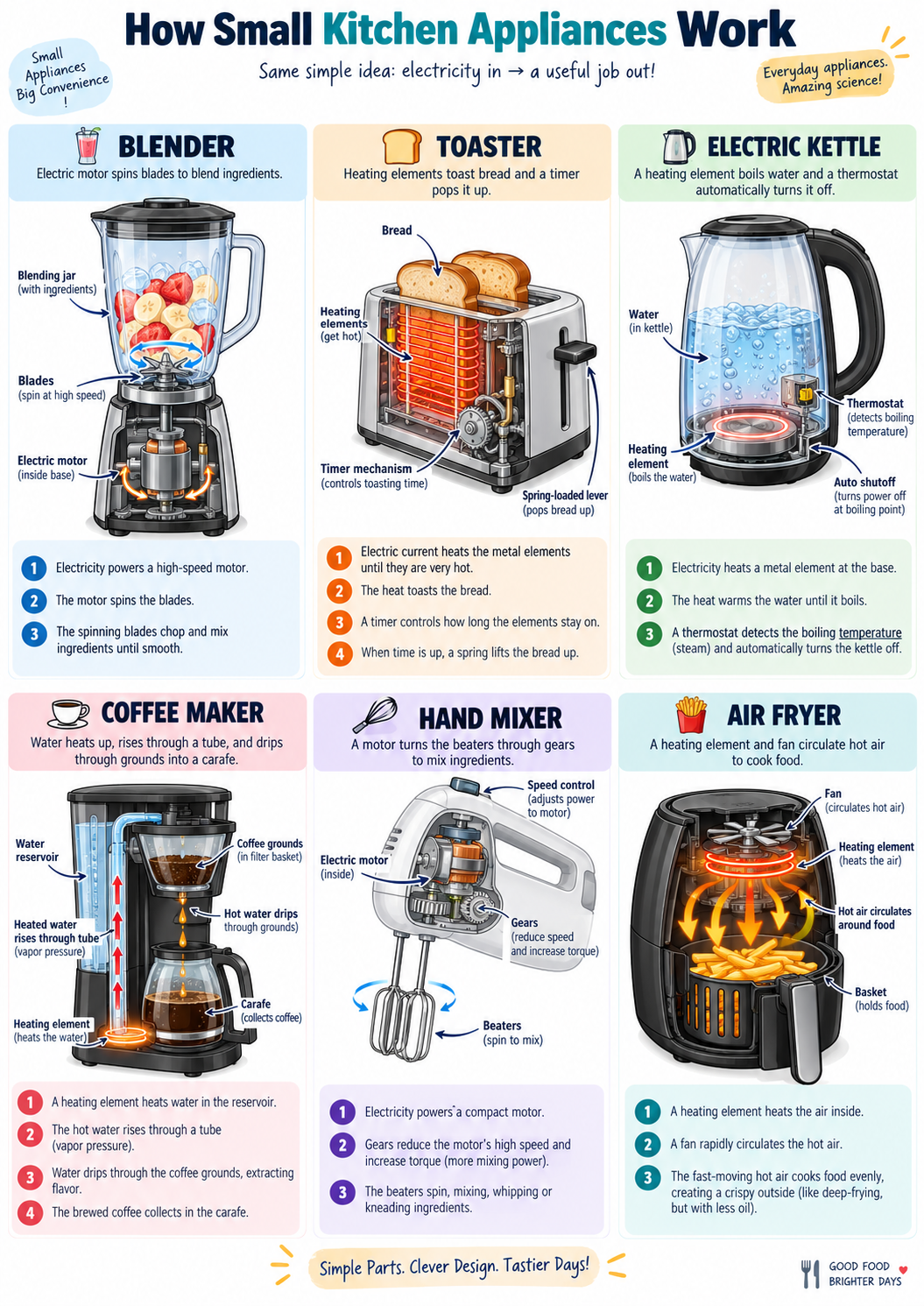
Small kitchen appliances work by converting electricity from a 120-volt outlet into either heat or mechanical motion, then limiting that conversion with a control. Heat cooks or warms food. Motion cuts, mixes, or blends it.
Three elements control the result: the power the appliance draws, measured in watts; the conversion method inside it, which is a resistance element, a magnetron, an induction coil, or an electric motor; and the control system, which is a timer, thermostat, speed switch, or thermal cutoff. The nameplate on the appliance states the values that describe the first two.
The same physics applies to a $20 toaster and a programmable pressure cooker, but the conversion method changes how fast, how evenly, and how efficiently food heats. Heating appliances sit at the top of the wattage range in a kitchen. Motor-driven appliances draw less power but run in short bursts because of motor heat limits.
This article explains what watts, volts, and amps mean, how rated wattage differs from actual draw, the four conversion systems used in countertop appliances, how controls regulate them, how to calculate energy use and cost, the electrical limits of kitchen circuits, and how to use wattage when choosing an appliance.
Small kitchen appliances draw current from a 120-volt outlet and convert it into heat or motion, with a control that sets how much energy is released and for how long.
Every countertop appliance has the same three-part structure. A power path brings current from the cord to the working component. A conversion component turns electrical energy into heat or rotation. A control component starts, limits, and stops the process.
The conversion component is what separates product categories. A toaster uses a resistance element. A microwave uses a magnetron. An induction burner uses a coil and a magnetic field. A blender uses a motor.
Understanding which component an appliance uses tells you what its wattage means in practice, because a 1,000-watt heater and a 1,000-watt motor create very different loads and very different results.
Volts measure electrical pressure, amps measure current flow, and watts measure the power the appliance uses. Watts equal volts multiplied by amps.
Standard household receptacles in the United States supply 120 volts, so voltage is fixed and the appliance varies its current draw. A 1,200-watt appliance on 120 volts draws 10 amps, because 1,200 divided by 120 equals 10. A 1,500-watt appliance draws 12.5 amps.
Energy is a separate measurement. A kilowatt-hour is 1,000 watts drawn for one hour, and it is the unit utilities bill. Power tells you the load at a single moment; energy tells you the total used over time.
This distinction matters at the outlet. The breaker responds to amps, so a high-wattage appliance can trip a breaker in seconds while barely affecting the monthly bill.
Rated wattage on a nameplate is the input power the appliance draws. A microwave’s advertised wattage is different: it states cooking output, not input draw.
Most countertop appliances list input power. Instant Brands rates the 6-quart Instant Pot Duo at 1,000 watts, 120 volts, and 60 hertz, which is the power the appliance pulls from the outlet.
Microwaves are the exception that causes errors. A microwave marketed as 1,000 watts is describing the microwave energy delivered into the cavity, and the input draw from the outlet is higher because the magnetron, transformer, fan, and turntable motor all consume power.
The practical consequence is that circuit calculations must use the nameplate input rating printed on the back or underside of the appliance, not the advertised cooking wattage on the box.
Countertop appliances use one of four conversion systems: resistance heating, microwave heating, induction heating, or an electric motor.
For practical comparison, these systems can be grouped by what the electricity becomes and where the heat or motion appears. This grouping follows the physical mechanism, not an official industry classification.
Each of the next four sections uses the same fields: what the system is, how it differs, how it works, where it is used, its relevant measurement, and its main limitation.
Resistance heating passes current through a high-resistance metal element, which converts electrical energy directly into heat at the element surface.
This is the most common system in countertop cooking appliances and the simplest. The distinguishing feature is that heat appears in the element first and then moves to the food by radiation, conduction, or moving air. Toasters radiate heat onto bread, griddles conduct it through a plate, air fryers use a fan to circulate it, and kettles conduct it into water.
The element is usually a nickel-chromium alloy. The A-grade nichrome resistance alloy specified in ASTM standards is 80 percent nickel and 20 percent chromium by mass, and it forms a stable chromium oxide surface layer that resists burning out at red heat.
The relevant measurement is input wattage, which ranges from a few hundred watts in a small kettle to 1,500 watts in an appliance such as the Instant Pot Duo Crisp with air fryer lid, rated by Instant Brands at 1,500 watts on 120 volts. The Department of Energy states that electric resistance heating is 100 percent efficient in the sense that all incoming electrical energy is converted to heat.
The main limitation is that element efficiency is not the same as cooking efficiency. Heat that warms an empty cavity, the appliance body, or the surrounding air still counts as energy used but does no cooking, which is why a small enclosure heats one portion more cheaply than a full-size oven.
A magnetron converts electricity into microwaves that pass through food and make water molecules vibrate, and the friction between molecules produces heat inside the food.
The distinguishing feature is that no element heats the food. According to the Food and Drug Administration, microwaves are reflected by metal, pass through glass, paper, and plastic, and are absorbed by food, and a magnetron inside the oven produces them.
The FDA also explains the limits of that process. Microwaves heat the outer layers of thick food directly, and the interior is cooked mainly by heat conducted inward from those hot outer layers, so a microwave does not cook from the inside out. Foods high in water content heat faster than dry foods.
The measurement used here is cooking output wattage, commonly 900 to 1,000 watts on countertop models, such as the 0.9-cubic-foot, 900-watt Toshiba EM925A5A listed by Lowe’s and the 1.1-cubic-foot, 1,000-watt Farberware Classic listed by Home Depot. On energy, the FDA notes microwave cooking can be more energy efficient than conventional cooking because food cooks faster and the energy heats the food rather than the whole oven compartment.
The main limitation is uneven heating in dense or low-moisture food, which is why manufacturers include turntables, stirring steps, and standing times. A separate safety limit also applies: Federal standard 21 CFR 1030.10 caps microwave leakage at 5 milliwatts per square centimeter at about 2 inches from the oven surface over the product’s lifetime, and a damaged door or seal is the condition that puts a unit outside that standard.
An induction coil creates a changing magnetic field that induces current in a compatible metal pan, so the pan itself becomes the heat source.
Countertop induction burners use this system. The distinguishing feature is that the appliance surface stays comparatively cool and the cookware does the heating, so heat transfer skips the element-to-surface-to-pan chain used by resistance burners.
The Department of Energy explains that an induction cooktop heats cookware directly, and reports that Consumer Reports testing found induction cooktops can boil water 20 to 40 percent faster than the gas and traditional electric cooktops tested. The Department of Energy also notes induction units do not get as hot once cookware is removed and most shut off automatically when no pan is detected.
The relevant measurement is input wattage plus cookware compatibility. Only magnetic cookware works, which is usually cast iron or magnetic stainless steel.
The main limitation is that compatibility, not power. Aluminum, copper, and most glass cookware will not heat on an induction burner regardless of its wattage rating, so the pan set decides whether this system is usable at all.
An electric motor converts electricity into rotation, and an attached blade, disc, or beater converts that rotation into cutting, blending, or mixing.
Blenders, food processors, stand mixers, hand mixers, and grinders use this system. The distinguishing feature is that the output is mechanical work rather than heat, although friction inside the motor and the food still produces some warming during long runs.
Operation is controlled by speed settings, which change the power delivered to the motor. Load changes the draw as well: thick dough or frozen fruit makes the motor work harder and pull more current than a thin liquid at the same speed setting.
The relevant measurements are motor input wattage and the maximum run time and batch size in the manual. Motor-driven appliances also draw a brief inrush current above their running wattage when they start, and the size of that spike varies by motor design.
The main limitation is heat inside the motor rather than available power. Manufacturers set maximum continuous run times and rest periods, and ignoring them triggers a thermal cutout or shortens motor life.
Controls decide how long the heat or motor runs, and a separate thermal cutoff interrupts power if the appliance exceeds a set temperature.
Normal operation is managed by timers, mechanical thermostats, or electronic controls that switch the element on and off to hold a target temperature. A pressure cooker adds pressure and temperature sensors that hold a programmed cycle.
Safety protection is a separate layer with two common designs. A resettable bimetal thermostat uses a two-layer metal strip that bends with temperature and opens the contacts, then closes again when the appliance cools. A one-shot thermal fuse uses a heat-sensitive pellet or alloy that melts above a set temperature and permanently opens the circuit; component makers such as Microtemp supply these for appliance use.
The practical consequence is diagnostic. An appliance that stops and works again after cooling is usually hitting a resettable protector, while one that never powers on again may have an open thermal fuse. Symptoms overlap with switch, cord, and control failures, so a single symptom does not confirm the cause, and the manufacturer’s service instructions apply.
Energy equals watts multiplied by hours, divided by 1,000. Multiply the result in kilowatt-hours by your electricity rate to get cost.
Worked example: a 1,000-watt appliance running 10 minutes uses 1,000 × 0.167 ÷ 1,000, which is 0.167 kilowatt-hours. At the June 2026 United States residential average of 18.34 cents per kilowatt-hour reported by the Energy Information Administration, that run costs about 3 cents. A 1,500-watt air fryer running 20 minutes uses 0.5 kilowatt-hours, or about 9 cents at the same rate.
The table below lists measured energy per use from Silicon Valley Power’s appliance energy chart, with cost calculated at the 18.34-cent national residential average.
| Appliance and task | Energy use | Cost at 18.34 cents/kWh |
|---|---|---|
| Toaster, 2 slices | 0.04 kWh per use | Less than 1 cent |
| Drip coffee maker, one brew | 0.12 kWh per brew | About 2 cents |
| Microwave, 5 minutes | 0.12 kWh per 5 minutes | About 2 cents |
| Single-serve coffee maker, one brew | 0.26 kWh per brew | About 5 cents |
| Coffee maker with warmer on | 0.4 kWh per hour | About 7 cents per hour |
| Toaster oven | 0.75 kWh per hour | About 14 cents per hour |
| Electric oven | 2.3 kWh per hour | About 42 cents per hour |
The pattern shows that run time drives cost more than wattage does: a high-wattage toaster costs less than a penny per use, while an hour of full-size oven cooking costs roughly six times an hour of toaster oven use. Electricity rates vary widely by state, so the same appliance costs more or less depending on your utility rate.
Within one product line, a larger capacity model carries a higher wattage rating, because more food and liquid need more heat to reach the same temperature.
The increase is built into the design rather than the setting. A larger pot has more mass and more surface area losing heat, so the manufacturer fits a larger element to keep heating times reasonable.
The table below shows the ratings Instant Brands publishes for one multicooker line.
| Instant Pot Duo model | Capacity | Rated wattage | Current at 120 V |
|---|---|---|---|
| Duo 3-quart | 3 quarts | 700 watts | 5.8 amps |
| Duo 6-quart | 6 quarts | 1,000 watts | 8.3 amps |
| Duo 8-quart | 8 quarts | 1,200 watts | 10 amps |
Capacity and wattage rise together, and the current column shows why size selection is also an electrical decision when several appliances share one kitchen circuit.
Higher wattage means a higher rate of energy use, not better results. Speed and cost depend on the conversion method, the heated volume, and run time.
A 1,500-watt air fryer and a 1,500-watt griddle draw the same power but cook differently, because one circulates hot air around a basket and the other conducts heat through a plate. The structural difference decides the cooking result; the wattage only sets the rate of energy consumption.
Heated volume matters as much as power. Silicon Valley Power lists a toaster oven at 0.75 kilowatt-hours per hour against an electric oven at 2.3 kilowatt-hours per hour, and the Department of Energy’s Energy Saver guidance states that a toaster or convection oven uses one-third to one-half as much energy as a full-sized oven. The countertop unit wins on small batches because it heats a smaller cavity, not because its element is more efficient.
For motors, extra wattage helps only when the load resists. A higher-wattage blender handles frozen fruit and thick dough without stalling, while for thin liquids the added power changes nothing measurable.
A 20-ampere, 120-volt kitchen circuit carries 2,400 watts. Two high-wattage countertop appliances running together can exceed that and trip the breaker.
Section 210.52(B)(1) of the National Electrical Code requires two or more 20-ampere small-appliance branch circuits to serve the receptacle outlets in the kitchen, pantry, breakfast room, and dining room of a dwelling unit. At 120 volts, each of those circuits carries 2,400 watts, and a 15-ampere circuit carries 1,800 watts.
Continuous operation has a lower ceiling. Section 210.20(A) requires the overcurrent device to be rated at not less than 125 percent of a continuous load, defined as a load running three hours or more, which works out to 1,920 watts on a 20-ampere circuit and 1,440 watts on a 15-ampere circuit. Maximum capacity and recommended continuous capacity are different numbers.
Running a 1,500-watt air fryer and a 1,200-watt multicooker at once totals 2,700 watts, or 22.5 amps, which is above the 2,400-watt limit of one 20-ampere circuit. Splitting the two appliances between the two required kitchen circuits keeps each below its rating.
Two checks are easy to miss. Receptacles on a 20-ampere circuit may be rated 15 or 20 amperes under Table 210.21(B)(3), so the outlet appearance does not confirm the circuit rating, and kitchen circuits can extend into the dining room, which hides part of the load. Circuit or outlet changes are work for a licensed electrician, and local code amendments can differ from the national text.
Read the nameplate input wattage, match it to the task and your circuit capacity, then check capacity, run-time limits, and cookware compatibility before buying.
Nameplate input wattage. Input wattage is the number that determines circuit load, and it is printed on the appliance rather than the marketing panel. A microwave’s advertised cooking wattage is output power and is lower than input draw. Using the wrong figure understates the load and produces repeated breaker trips that look like an appliance fault.
Conversion method against the task. Resistance heating suits toasting, griddling, and boiling water; microwave heating suits reheating and defrosting moisture-rich food; induction suits fast stovetop-style cooking with magnetic pans; motors suit cutting and mixing. Choosing a method that does not match the task produces poor results regardless of how many watts the appliance draws.
Capacity. Capacity and wattage scale together, shown by the Instant Pot Duo line at 700 watts for 3 quarts and 1,200 watts for 8 quarts. Size the appliance to your usual batch, since an oversized unit adds electrical load and minimum fill requirements while an undersized one forces a second cycle.
Circuit headroom. Each 20-ampere kitchen circuit carries 2,400 watts, and continuous loads are limited to 1,920 watts. Add the nameplate wattages of appliances you run at the same time and split 1,500-watt units across the two required circuits. Skipping this step is the most common cause of nuisance tripping in a kitchen.
Manual limits and compatibility. Motor appliances have maximum run times and batch sizes, pressure cookers have minimum liquid and maximum fill levels, and induction burners require magnetic cookware. These limits vary by model and manufacturer, so the manual, not a general rule, sets the correct use for a specific unit.
