
Our Location
304 North Cardinal St.
Dorchester Center, MA 02124

 ByAlan
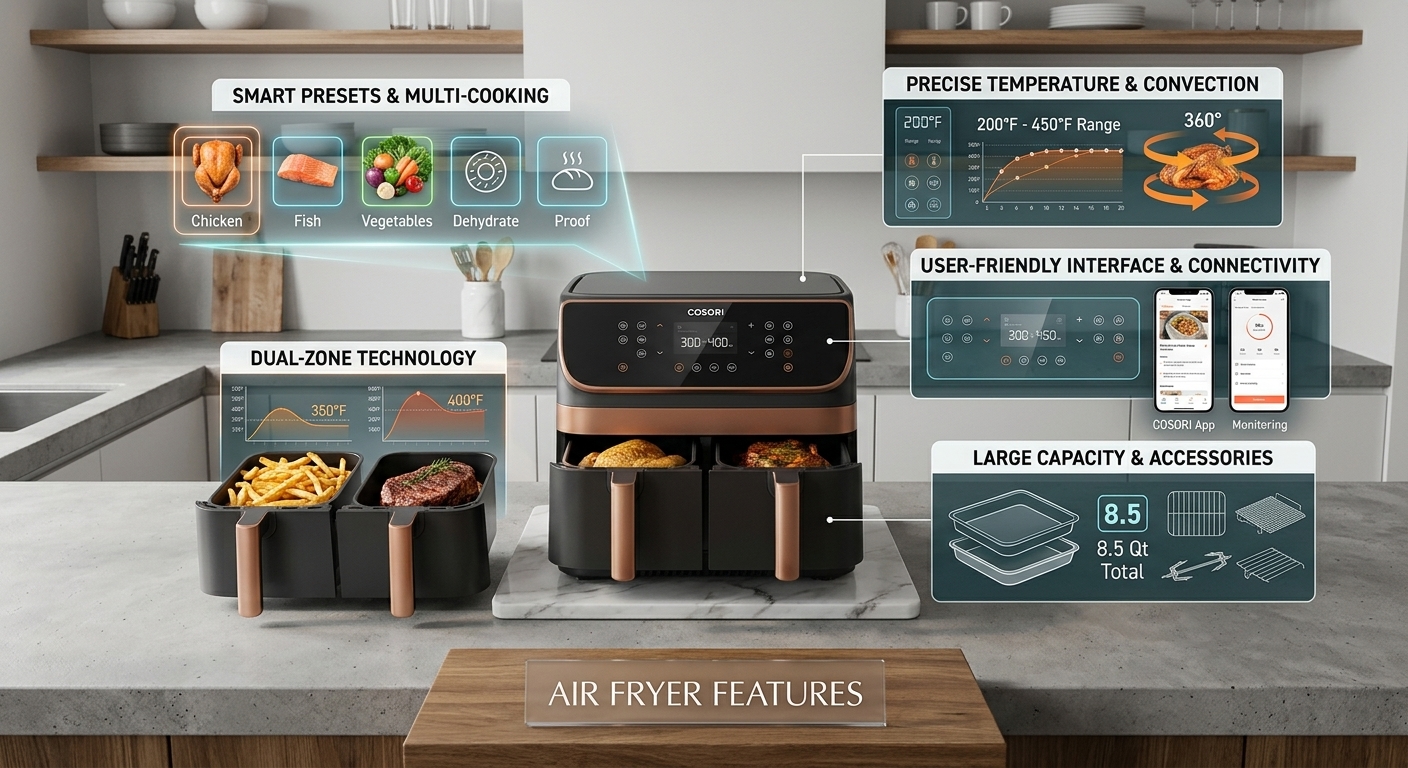
Air fryer features are the design choices that decide how much food fits, how easily you control it, which dishes it handles, and how safely it cleans up. Capacity and the control interface shape usability and versatility most, while cooking modes, dual baskets, and connectivity are add-ons that widen what the appliance can do. Every model fries, bakes, grills, roasts, and reheats by circulating hot air around food, so the real differences lie in size, settings, and convenience. Understanding what each feature does helps you pay only for what you will actually use.
Air fryers also have limits that features cannot fully remove. They suit small-batch cooking, so households of four or more may need to cook in rounds. They take up counter space, many baskets carry a nonstick coating, and lean foods can dry out if overcooked. Safety features and dishwasher-safe nonstick baskets matter for daily cleanup, because a unit that is tedious to wash tends to end up unused. Weighing these trade-offs against your habits is the most reliable way to choose well.
An air fryer works by placing a heating element above the food and using a high-speed fan to blow hot air around it, producing a browned, crisp finish. Because the cooking chamber is small, the air moves quickly and transfers heat efficiently. That is why the surface dries and crisps rather than steaming, even with very little oil. The features that drive results are the fan, the element, and the basket design, since each controls how evenly hot air reaches the food. Weak airflow or poor placement leads to pale, uneven results.
Basket design matters more than many buyers expect. Holes in the basket, or a raised crisper plate, let air reach the underside of the food so it crisps all around. Spreading food in a single layer works better than piling it up, because crowding blocks airflow and leaves soft spots. Compared with a full convection oven, an air fryer has a smaller space and a stronger fan, so it heats faster and crisps more aggressively. The texture comes close to deep-fried food but is not identical.
The capacity you need depends on how many people you cook for. A useful rule of thumb is to add about one quart of capacity for each regular eater. Size sets both the batch you can cook at once and how well the appliance fits your household. Too small means constant batches, while too large wastes counter space. A 3-5 quart model is ideal for one to three people, and a 6-quart or larger unit suits bigger households. Think about your typical meal rather than occasional gatherings.
Basket-style air fryers generally range from 2 to 6 quarts and fit individuals or couples well. They heat quickly, take modest space, and handle everyday sides, snacks, and small main dishes. Their limit is volume: food needs to sit in a loose layer, so the usable space is smaller than the quart number suggests. Anyone cooking mainly for themselves or a partner rarely needs more than this range. Compact units also tend to be easier to store between uses.
Large-capacity models, from 6 to 10 or more quarts, are built for families. They hold bigger portions, which reduces the number of rounds needed to feed several people. Even so, large families often rely on batch cooking, since an air fryer still works best with food spread out rather than stacked. Larger baskets also demand more counter and storage room, so measure your space before buying. If you regularly cook for four or more, prioritize capacity above extras like presets.
Basket-style air fryers suit small kitchens and quick everyday cooking, while oven-style units trade counter space for much larger capacity and multiple racks. Basket models need you to shake or flip food partway through for even browning. Oven-style units usually spread food across racks, which reduces handling but can lengthen cooking. Hybrid toaster-oven and multicooker models sit at the larger end of this range and combine several appliances into one. Your choice depends on whether space or volume matters more.
Real examples show the gap clearly. A 2.5-quart air fryer fits about three medium chicken thighs, so it works for one person but quickly feels cramped for a household. A hybrid oven with multiple racks can cook 10 or 12 thighs at once, though it takes longer than a basket model. Footprint matters too: a 6-quart basket model needs roughly a 12 x 15 inch patch of counter. Oven-style units, at 10-25 quarts, can handle whole chickens and larger batches.
The trade-off is speed and convenience against capacity. Basket models heat fast and feel simple, but you cook in rounds when feeding a crowd. Oven-style and hybrid units cook more at once and replace a toaster oven, yet they occupy more space and may cook more slowly. If you often roast whole birds or serve several people, the larger format makes sense. For singles and couples, a basket model is usually the more practical fit.
| Type | Quart range | Best for | Trade-offs |
|---|---|---|---|
| Basket | 2-6+ | Individuals, couples | Shaking, small batches |
| Oven-style | 10-25 | Families, whole chickens | Space, slower |
Dual-basket air fryers are worth it if you often cook two foods at once, because each basket can run at its own temperature and finish together. They fit families cooking a main dish plus a side best, since you avoid cooking in sequence while the first item cools. Independent temperature control means a protein and vegetables can each get the heat they need. That flexibility is the core reason to choose this design.
The trade-off is cost and space. Two-basket models cost more than single-basket versions and take up more counter room, which matters in smaller kitchens. If you mostly cook one item at a time or for one or two people, the extra basket may sit idle. For households that regularly serve mains with sides, however, the time saved can justify the higher price. Consider your usual dinner routine before deciding.
Digital controls are better for precision and convenience, while manual dials win on simplicity and price. Neither style changes how well the food actually cooks. Digital panels show temperature and cook time, offer presets, and often cover a wide temperature range, commonly 90°F-450°F. They cost a bit more, and a failing panel can be a risk over time. Manual dials are straightforward, cost-effective, and have fewer parts that can fail.
Control style has little effect on performance or results. The heating element and fan do the cooking, so a dial-operated model can crisp food as well as a touchscreen one. What digital controls add is repeatability: you can set an exact temperature and time, and presets save you from guessing for common foods. Manual users simply set a dial and check the food as it cooks. Either approach works once you learn your model.
The decision comes down to whether presets and precision justify the added cost. If you like exact settings or cook varied foods, digital is appealing. If you cook a few familiar items and prefer minimal fuss, manual dials deliver the same results for less. Also consider durability, since fewer electronics can mean fewer points of failure. Choose based on how you cook, not on the look of the panel.
| Criteria | Digital | Manual |
|---|---|---|
| Precision | Exact readout | Approximate |
| Presets | Yes | Rarely |
| Ease | Guided | Simple |
| Cost | Higher | Lower |
Air fryers commonly offer air fry, roast, bake, dehydrate, grill, and broil modes, and the range varies by model. Basic units focus on frying and reheating, while advanced air fryer ovens also broil, roast, bake, and toast. Multi-cooker functions turn the unit into a broader cooking appliance, which can reduce the number of devices on your counter. More modes help most if you will actually use them.
Each mode suits a different task. Roasting handles vegetables and meats, baking covers small cakes and breads, dehydrating dries fruit and jerky, and grilling adds sear. These settings mostly adjust temperature and fan behavior, so they extend what the same hardware can do beyond crisping frozen foods. Treat the list below as typical options rather than a guarantee for every model. Check which modes your chosen unit actually includes.
Multi-cooker combinations expand use beyond frying, but capacity and size still apply. A feature-rich model is only helpful if the basket or racks fit your portions. Confirm specifications for each model before assuming connected or advanced features are included, since they differ even within one brand. Paying for modes you never touch adds cost without adding value. Match functions to the dishes you cook most often.
Yes, you can bake in an air fryer, as long as the batch and pan fit the small chamber. Muffins and garlic bread are popular examples. With the right setup, a wide range of baked dishes works, though portions stay small compared with a full oven. Pan size is the main constraint, so check that your bakeware fits with room for air to move. Smaller recipes translate best.
Drier surfaces brown better than wet ones. Wet marinades can steam instead of crisp, and wet batters generally fail because high-velocity airflow blows them around before they set. Pat food dry, use thicker coatings that hold together, or choose recipes designed for air circulation. Baked goods with a firm structure, such as muffins in cups, handle the airflow well. Loose, runny mixtures do not.
Smart air fryers are worth it only if you will use remote app monitoring and recipe integration, which smart connectivity enables on supported models. The core cooking is the same as in a non-connected unit, so connectivity adds convenience rather than better crisping. For people who like checking progress from another room or following guided recipes, it can be useful. Others may never open the app.
Not every model includes these features, so confirm connectivity in the model specifications rather than assuming it. Some Philips models, for example, add smart presets or connected features. Brand names alone do not tell you what a specific unit supports, and capabilities vary across product lines. Look for the exact function you want, whether remote monitoring, app recipes, or special presets. Then confirm it is listed for that model.
Consider the practical trade-off. Connected models often cost more and add software that depends on your phone and home network. If your priorities are capacity, reliable controls, and easy cleanup, those matter more day to day than an app. Smart features make the most sense for busy cooks who value guided recipes. For simple, repeatable cooking, a standard digital or manual model is often enough.
The safety and cleaning features that matter most are a basket that stops heat when pulled out, an automatic shut-off at the end of the timer, and a dishwasher-safe basket. Automatic shut-off and overheat protection are standard on air fryers, which protects against forgotten food and excess heat. These features reduce everyday risk, especially for busy cooks. Pulling the basket out should cut the heating so you can check food safely.
Cleanup features decide whether you keep using the appliance. Dishwasher-safe nonstick baskets simplify washing, and the basket and crisper plate on many models can go in the dishwasher. Check the named coating and the manual, since materials differ between models. Nonstick coatings are also a drawback for some buyers, so consider your preference. Easy-release surfaces help most with sticky or breaded foods.
If food sticks, soak the basket and crisper plate for 10-15 minutes in hot soapy water before scrubbing gently. Soaking loosens baked-on residue without harsh abrasion that could damage the coating. Regular cleaning after each use also prevents grease buildup that can smoke or affect flavor. A removable, easy-to-wash design makes this routine far less of a chore.
The real benefits are cooking with far less oil than deep frying, fast preheating, and a crisp finish from circulating hot air. Hot air does the crisping, so food needs only a little oil. Some Philips models claim up to 90% less fat than deep-fried fries, which is a manufacturer claim. Results depend on the food and how it is prepared.
Speed is another advantage. Air fryers can reach 400°F in five minutes or less, compared with about 13 minutes for a gas oven and 17-19 minutes for an electric oven. Shorter preheating and cook times depend on the model, but the small chamber generally heats quickly. That makes them handy for quick weeknight meals and reheating leftovers without warming the whole kitchen. Capacity still limits how much you can cook at once.
Potatoes can show lower acrylamide levels than when deep fried, which is a possible advantage. Still, the health benefits are often overstated, especially when compared with oven roasting rather than deep frying. The main gain comes from replacing deep-fried food, not from the appliance itself. View it as a convenient, lower-oil cooking tool rather than a health solution.
Air fryers are limited by small-batch capacity, a single loose layer of food, and a compact size that cannot replace a full-sized oven for large volumes. The usable space is smaller than the quart rating suggests, because crowded food will not crisp evenly. Large families may need to cook in several rounds. Counter space and coated baskets are further considerations.
Some foods are harder to cook well. Steaks are tricky and tend to dry out, and lean foods can dry out if overcooked. Wet batters generally fail because the high-velocity airflow disturbs them before they set. Watching cook times and using thicker or fattier cuts helps. Knowing these limits keeps expectations realistic.
Choose air fryer features by deciding size first, then functionality and intended use. Determining the capacity you need is the first step. Household size, foods, budget, counter space, and control style should drive the choice. Smaller households that do not need a full oven often do well with a basket model. Brand lines such as Ninja, Cosori, Instant, and Philips are examples only.
Confirm specifications for each model rather than assuming features carry across a brand. Match modes, dual baskets, or connectivity to what you actually cook. If you cook for one or two people, a 3-5 quart basket model may be enough, while families should look at larger or dual-basket designs. Digital controls add precision; manual dials save money. Spend on the features you will use regularly.
| Need | Feature |
|---|---|
| 1-3 people | 3-5 quart basket |
| Larger household | 6+ quart |
| Two foods | Dual basket |
