
Our Location
304 North Cardinal St.
Dorchester Center, MA 02124

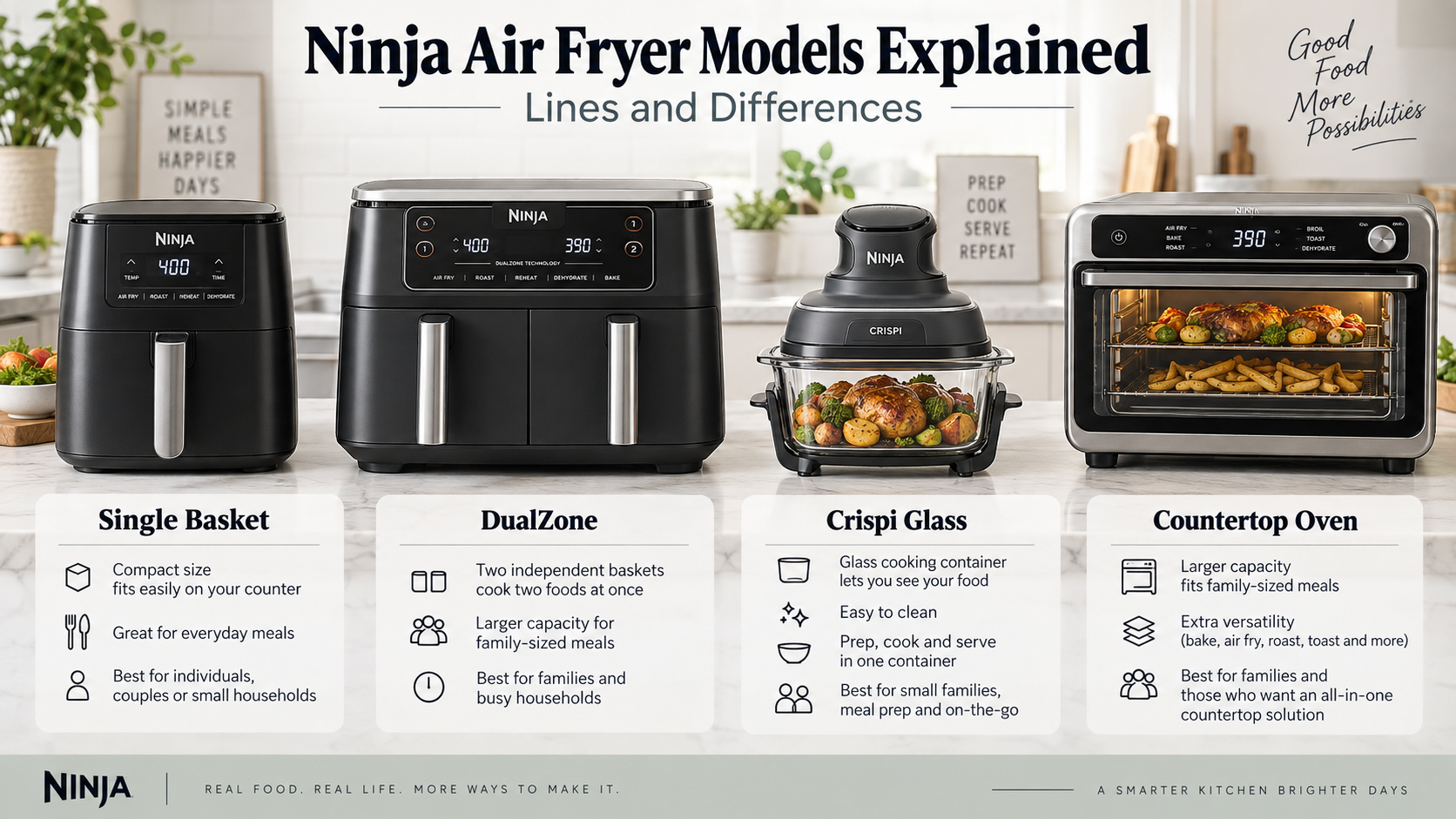
Ninja air fryer models split into five product lines and roughly twenty active model numbers, and the two-letter prefix on each number identifies the line a unit belongs to. Capacity across those lines runs from 3.8 litres in the smallest single basket up to ten quarts in a dual body, and rated wattage runs from 1,500 to 1,800 across the bodies that carry those baskets.
The AF prefix marks a single-basket air fryer, DZ marks a dual-basket DualZone body, and SL marks the stacked DoubleStack design. Newer families carry their own prefixes, and FN and AS mark the glass Crispi containers while SP marks the Flip toaster-oven bodies that fold upward against a backsplash.
Differences between the numbers sit in basket count, rated capacity, wattage, program count, and coating type rather than in the heating hardware, which stays broadly the same across the whole range. Each line also carries its own baskets, crisper plates, and racks, and those parts rarely fit another line even when the rated capacity matches exactly, and a replacement part typically has to match the line that produced it.
This article explains what the model numbers mean, how the five lines differ, what each body measures in quarts, watts, and counter width, and which model number suits a given household size, kitchen counter, and weekly cooking routine before any purchase decision.
Ninja air fryer model numbers carry a two-letter prefix and a three-digit code, and the prefix names the product line while the digits track capacity and program count. AF marks a single-basket air fryer, DZ marks a DualZone body with two drawers, SL marks the stacked DoubleStack, and FN marks a glass Crispi container.
Suffix letters mark region and colour instead of hardware, so AF100UK, AF101C, and AF140ME describe one platform sold into three separate markets at different plug and voltage ratings rather than three separate platforms. Reading the prefix before the digits prevents ordering a single-basket unit when two zones are needed, and the Foodi name marks a different appliance family altogether.
A Ninja air fryer cooks with a fan and a heater above an open basket, while a Ninja Foodi seals the same food under a pressure lid inside a pot. Foodi multi-cookers add pressure cooking, steaming, and slow cooking to the air fry cycle, and the DG551 grill pairs a 3.8-litre basket with a searing plate above it.
These Foodi bodies weigh eighteen to twenty-two pounds and stand taller than any basket model, which removes them from the compact counter-appliance category that most buyers have in mind when they compare prices. Confirming whether a recipe plan actually needs pressure cooking prevents buying the wrong family, and brand comparisons outside Ninja answer a related question about heating speed.
Ninja air fryers reach a set temperature within two or three minutes, which runs slightly faster than comparable Cosori bodies drawing the same rated wattage at the same capacity. Cosori answers with a broader preset list and app control, and the Pro LE holds five quarts at 1,500 watts while TurboBlaze holds six quarts at 1,725 watts.
Temperature stability separates the two brands more than raw speed, since Ninja bodies hold a narrower band through a long cycle and brown food more evenly at the basket edges. Weighing preheat speed against preset count prevents overpaying for software features, and the Ninja lineup itself splits into five basket arrangements that each load food differently.
Ninja air fryer lines divide by basket arrangement, and the five families cover one open drawer, two side-by-side drawers, two stacked drawers, sealed glass containers, and a folding oven cavity. Each line carries its own prefix, capacity band, and accessory set, and a basket from one line cannot seat inside another line even when it carries a matching quart rating.
These five arrangements share one heater and fan design, and the cooking result generally stays consistent while the loading pattern and the counter footprint change substantially between them, and those two factors usually decide the purchase. Choosing the arrangement before the model number narrows the list to three or four candidates, and the single-basket line holds the entry models that most kitchens meet first.
Single-basket Ninja air fryer models cover the AF line, and the AF101 holds four quarts, the AF141 Pro holds five quarts, and the AF181 Pro XL holds 6.5 quarts. Program counts rise with capacity, so the AF101 runs four programs at 1,550 watts while the AF181 adds bake and Max Crisp to those same four programs.
This line stays narrowest on the counter at about eleven inches wide and fourteen inches deep, which suits a counter run that cannot take a wider dual-basket body beside the sink. Confirming the drawer holds two pounds of fries before purchase prevents cooking in two batches, and the dual-basket line answers that batch problem with a second zone.
Two-basket Ninja air fryer models carry the DZ prefix, and the DZ201 splits eight quarts into two four-quart drawers while the DZ401 splits ten quarts into two five-quart drawers. Each zone holds its own heater, fan, and thermostat, and the DZ401 draws 1,690 watts across both drawers at roughly fifty square inches of floor area each.
The DZ550 adds a wireless thermometer probe and a smart cook mode, which holds a protein to a target internal temperature instead of running a fixed timer that ignores what the meat is doing. Measuring nineteen inches of counter before ordering prevents a fit problem, and the stacked DoubleStack line delivers the same ten quarts inside a far narrower body.
The Ninja DoubleStack stacks its two zones vertically instead of side by side, and the SL401 holds ten quarts inside roughly ten inches of counter width. Stacked zones draw 1,800 watts and carry their own trays and racks, which lets four trays of food cook at once inside one narrow tower body that occupies half the width of its side-by-side twin.
Height rises in exchange for width, so the body stands near sixteen inches and typically clears an upper cabinet by a smaller margin than a flat single-basket unit. Checking cabinet clearance above the counter prevents a height conflict, and the Crispi line replaces the coated drawer with a glass container that travels to the table.
Ninja Crispi models cook inside borosilicate glass containers because glass tolerates a refrigerator-to-oven temperature swing and lets food travel from storage to cooking without a transfer step. The FN101 holds four quarts at 1,500 watts, the AS101 Crispi Pro holds six quarts with six functions, and the DD101 pairs two four-quart containers under one lid that can heat them independently.
This powered lid clamps onto the container and carries the heater and the fan, and the glass itself takes a dishwasher cycle that typically dulls a coated aluminium basket. Confirming container count before purchase prevents washing between two courses, and the Flip line trades the sealed container for an open oven cavity with wire racks.
A Ninja Flip air fryer replaces a toaster oven in most kitchens, since the SP line toasts, bakes, broils, and air fries inside one open cavity. Cavity capacity typically reaches four to six pounds of food across 200 to 400 degrees, and the SP151 runs 1,800 watts behind a hinged glass door that can drop flat for loading.
The body folds upward against a backsplash after cooking, which returns about half the counter footprint between meals without unplugging or storing the appliance in a cabinet, and it can stay plugged in between meals. Weighing toast capability against basket depth prevents a capacity surprise, and two entry numbers inside the AF line invite a closer comparison of capacity and price.
The Ninja AF101 holds four quarts and runs four programs, while the AF141 Pro holds five quarts and adds a wider basket at the same 1,550 watts. The extra quart adds about ten square inches of floor area, which fits roughly half a pound more of hand-cut fries in one even single layer.
Panel layout differs as well, and the AF141 carries a Max Crisp setting that the AF101 reaches only through a longer cycle at the 400-degree ceiling. Paying for the AF141 pays for floor area instead of heating power, and the Pro XL sits one step above both numbers with a deeper drawer.
The Ninja Pro XL AF181 holds 6.5 quarts against five quarts in the AF141, and the deeper drawer fits a four-pound chicken that the smaller body cannot hold flat. Six programs replace four, and bake joins air fry, roast, reheat, and dehydrate inside the same 105 to 400 degree range that a single dial controls.
Footprint grows by about two inches in each direction, which matters on a counter that already carries a kettle, a toaster, and a coffee machine beside the sink, and those appliances generally hold their positions. Buying the larger drawer pays off only when regular batches exceed two pounds, and the dual-basket numbers raise the same capacity question across two separate zones.
The DZ401 holds ten quarts against eight quarts in the DZ201, and each DZ401 zone takes five quarts while each DZ201 zone takes four quarts instead. Both bodies run six programs and both carry Smart Finish and Match Cook, and the DZ401 draws 1,690 watts against 1,500 watts in the smaller unit.
Width separates the two numbers on a counter, since the DZ401 measures about nineteen inches across while the DZ201 sits closer to sixteen inches wide, which often decides the choice on a short counter run. Choosing between them rests on zone volume rather than program count, and quart ratings across the whole lineup put those two capacity numbers in context.
Ninja air fryer models measure 3.8 litres at the smallest and ten quarts at the largest, and the middle of the range clusters between four and 6.5 quarts. Rated volume counts the whole drawer, and usable area sits lower because food needs one layer over the crisper plate instead of a filled basket, and that layer rule typically costs a third of its rated volume.
| Line | Capacity | Baskets | Wattage |
|---|---|---|---|
| AF single-basket | 3.8 L to 6.5 qt | One drawer | 1,550 |
| DZ DualZone | 8 to 10 qt | Two side by side | 1,500 to 1,690 |
| SL DoubleStack | 10 qt | Two stacked | 1,800 |
| FN and AS Crispi | 4 to 6 qt | Glass containers | 1,500 |
| SP Flip | 4 to 6 lb | Two wire racks | 1,750 to 1,800 |
These quart figures cover the drawer alone, and a dual body splits its ten quarts into two separate halves instead of holding one continuous cooking space. Reading the quart column against household size prevents a two-batch weeknight routine, and serving counts translate those capacity ratings into portions at the table.
A ten-quart Ninja air fryer feeds five or six people in one cooking cycle, and each five-quart zone handles about two pounds of wings, fries, or vegetables. A four-quart single basket feeds two people, and a 6.5-quart drawer feeds three or four when the food sits in one even layer over the plate.
Portion counts fall when food arrives frozen, since surface ice adds five to eight minutes of runtime and pushes a large batch into two consecutive runs that one cycle can only partly absorb. Matching zone volume to the largest regular batch prevents weeknight double cooking, and the wattage figure explains what each of those cycles costs to run.
Ninja air fryers use 1,500 to 1,800 watts, and the AF101 draws 1,550 watts while the DZ401 draws 1,690 watts across its two heated zones together. A 1,690-watt body pulls about fourteen amps at 120 volts, which fills most of a fifteen-amp kitchen circuit during a full heating and crisping cycle.
Energy use follows runtime, so a twenty-minute cycle at 1,550 watts consumes roughly 0.5 kilowatt-hours and costs about eight cents, which can undercut a full oven cycle by half. Running one zone instead of both halves that draw on a dual body, and the temperature range sets the ceiling every program can work within.
Ninja air fryers reach 400 degrees on the basket lines, and selected bodies push to 450 degrees on Max Crisp for food taken straight from the freezer. The floor of the range sits at 105 degrees, which supports dehydrating across six to ten hours at a fan speed low enough to avoid any browning.
Grill bodies run hotter at the plate, as searing depends on conduction through hot metal instead of convection through fast-moving air above the surface of the food, and grill plates typically hold more heat in the metal itself. Confirming the ceiling before buying prevents a shortfall on frozen food, and the body footprint decides where all that heat can sit on a counter.
Ninja air fryers need eleven to twenty inches of counter width, and a single basket takes eleven inches while a dual body takes sixteen to nineteen inches across. Height runs ten to sixteen inches and depth runs eleven to fourteen, so the AF101 measures fourteen by eleven by thirteen inches at about ten pounds.
Rear clearance matters more than width, because the vents exhaust upward and backward and need four to five inches of open space behind the appliance body rather than beside it. Measuring width, depth, and rear clearance before ordering prevents a return, and the basket surface inside the drawer determines how food releases once the body fits.
Ninja air fryer baskets carry a ceramic-coated nonstick surface instead of a bare PTFE film, and the coating releases food without added oil at the 400-degree ceiling. Ceramic sol-gel layers tolerate 450 degrees, and the aluminium shell underneath carries heat across the perforated floor within the first two or three minutes of a cycle.
Crispi containers skip the coating completely, as borosilicate glass holds four quarts and takes a 300-degree swing without crazing, staining, or cracking, and it can take a dishwasher cycle without dulling. Hand washing the coating instead of machine washing extends its release life, and dishwasher ratings differ by part across every line in the lineup.
Ninja air fryer baskets and crisper plates carry a dishwasher-safe rating across the AF, DZ, and SL lines, and the powered housing never enters a dishwasher at all. Glass containers and their racks share that rating, and the powered Crispi lid takes only a damp cloth across its underside between cooking sessions.
These manuals still recommend hand washing coated parts, since detergent alkalinity near pH eleven typically dulls a ceramic surface across twenty or thirty machine cycles. Hand washing the basket and machine washing the glass keeps both surfaces intact, and the program list decides what those parts actually cook in the first place.
Max Crisp runs the fan and the heater at full output near 450 degrees, and the setting targets frozen food that a standard air fry cycle leaves soft. Surface ice clears inside the first two minutes, and browning then starts without the sogginess a lower 350-degree setting typically leaves behind on frozen fries.
This setting appears on six-program bodies instead of four-program units, so an AF101 reaches a similar result through a longer cycle at the 400-degree ceiling. Reserving the setting for frozen batches prevents drying fresh vegetables out, and Smart Finish handles a different timing problem across two separate zones.
Smart Finish staggers the start times of two zones, and an eighteen-minute batch of wings and a twelve-minute batch of fries then finish at the same minute. The panel takes a temperature and a time for each drawer, and the second zone waits until the remaining time on the longer batch matches its own setting rather than the clock.
Match Cook copies one zone onto the other instead, which doubles a single recipe across ten quarts without entering the temperature and the time a second time, and it can copy the fan speed too. Selecting Match Cook for one food and Smart Finish for two prevents a cold side dish, and liner choices affect how either zone circulates air.
Foil and parchment sit safely inside a Ninja air fryer basket when the liner stays under the food and well clear of the heating element above it. Perforated parchment rated to 425 degrees keeps airflow moving through the crisper plate, and a loose sheet lifts into the fan and blocks that circulation instead.
Foil under acidic food reacts with the metal, so a marinade carrying lemon or vinegar pits the surface and leaves grey marks on the finished food that no rinse removes. Weighting a liner with food before starting prevents it lifting into the element, and fan noise rises as soon as that circulation runs at full speed.
A Ninja air fryer runs near sixty-five decibels because a cyclonic fan moves hot air across the basket at a speed a convection oven never reaches. Noise rises with zone count, and two fans inside a dual body often add three to five decibels over a single basket at the same temperature, and that difference can be heard across a room.
This noise stays constant through the cycle, which separates it from the intermittent rattle a loose crisper plate makes against the floor of the drawer. Seating the crisper plate flat before starting removes that rattle, and airflow inside the drawer also explains uneven cooking results across a full load.
Food cooks unevenly in a Ninja air fryer when the basket carries more than one layer, because the upper layer blocks the airflow the fan depends on. Cooking time then extends by thirty to fifty percent, and the layer against the crisper plate browns while the top of the pile stays pale and soft.
Dual-zone bodies hide the fault, as a half-filled zone still cooks correctly while the overfilled zone returns uneven results inside the same twenty-minute cycle, and generally the difference shows on the plate. Loading one layer with an inch of clearance prevents the uneven result, and a worn basket coating produces a different problem inside any of these lines.
Ninja air fryer baskets and crisper plates sell as replacement parts, and a DualZone basket or an XL crisper plate costs about thirty-four dollars each. Part numbers bind each piece to one line, so a five-quart DZ basket cannot seat inside a four-quart AF drawer or a Crispi glass container.
A wireless cooking thermometer runs near one hundred dollars, and racks, loaf tins, and second baskets fill the rest of the published accessory list, and each part carries a number that binds it to one line. Ordering by part number instead of by capacity prevents a mismatch, and total cost across the lineup follows the same line-by-line pattern as the parts.
Ninja air fryer models cost between one hundred and four hundred dollars, and the entry AF101 sits at the bottom while the Crispi DualZone sits at the top. The FN101 Crispi lists near 180 dollars, the AS101 Crispi Pro near 300 dollars, and the SL401 DoubleStack near 250 dollars at full published price.
Dual-zone bodies typically carry a fifty to eighty dollar premium over a single basket of similar total volume, which pays for the second heater, fan, and thermostat rather than for extra volume. Comparing price against zone count prevents paying twice for the same capacity, and three simple checks identify the Ninja air fryer model a kitchen already holds.
Ninja air fryer identification rests on three checks: the rating plate underneath the body, the basket arrangement inside, and the program list printed around the control panel. Each check takes under a minute with the unit unplugged, and the three together separate the AF, DZ, SL, FN, AS, SP, and DG lines.
None of the three checks depends on the packaging, and a second-hand unit arriving without a box typically resolves to one published model number within two minutes. Recording that number before ordering parts prevents an incompatible basket, and the rating plate answers the question more directly than either remaining check.
To read the model number, unplug the unit, tip the body onto its side, and read the printed label on the underside of the base panel. The plate prints the model number, the wattage, the voltage, and the amperage, where AF101 appears beside 1,550 watts and 120 volts on one line.
These regional suffixes appear on the same printed line, and AF100UK carries 230 volts where the North American version carries 120 volts at the same rated capacity. Photographing the plate keeps that number available when ordering parts, and the basket arrangement confirms the line the rating plate has already named.
To count the baskets, open the appliance and count the drawers, crisper plates, and racks the body accepts in total before checking anything else on it. One drawer with one crisper plate marks the AF line, two side-by-side drawers mark the DZ line, and two stacked drawers mark the SL DoubleStack body.
A glass container under a powered lid marks the Crispi line, while a hinged door over two wire racks marks the folding SP oven body instead. Counting the drawers settles the line within seconds, and the control panel then resolves which generation inside that line a particular unit belongs to.
To check the programs, power the unit on and read the names printed or displayed around the dial and the buttons across the front control panel. Four program names indicate a base AF101 or AF141, and six names including Max Crisp and Bake indicate an AF181 or a DZ-series dual body.
Smart Finish and Match Cook labels confirm DualZone control, and a thermometer port beside the dial narrows the unit to the DZ550 generation of that line. Reading the panel after the plate confirms both line and generation, and those two facts drive the choice between the published model numbers.
One or two people suit a four-quart AF101 or a five-quart AF141, and both bodies take about eleven inches of counter width at 1,550 watts. A four-quart drawer holds two pounds of fries or two chicken breasts, which covers a two-person dinner without a second cooking run or a reheat.
A Crispi container suits the same household differently, as glass moves from refrigerator to counter to table and removes a serving dish from the evening wash that a basket model can still leave. Confirming the largest regular batch before purchase prevents buying two zones that stay unused, and larger households invert that calculation almost entirely.
A family of four or more suits a ten-quart dual body, and the DZ401 or the SL401 cooks a main dish and a side dish at once. Two zones at five quarts each handle four pounds of food in total, which covers a family meal inside a single twenty-minute cooking cycle.
Counter width decides between those two numbers, since the stacked SL401 delivers the same ten quarts across ten inches instead of the nineteen a side-by-side body needs. Confirming portion size, counter width, and dish count narrows the lineup to a single model number that fits the kitchen and prevents a second appliance purchase.
