
Our Location
304 North Cardinal St.
Dorchester Center, MA 02124

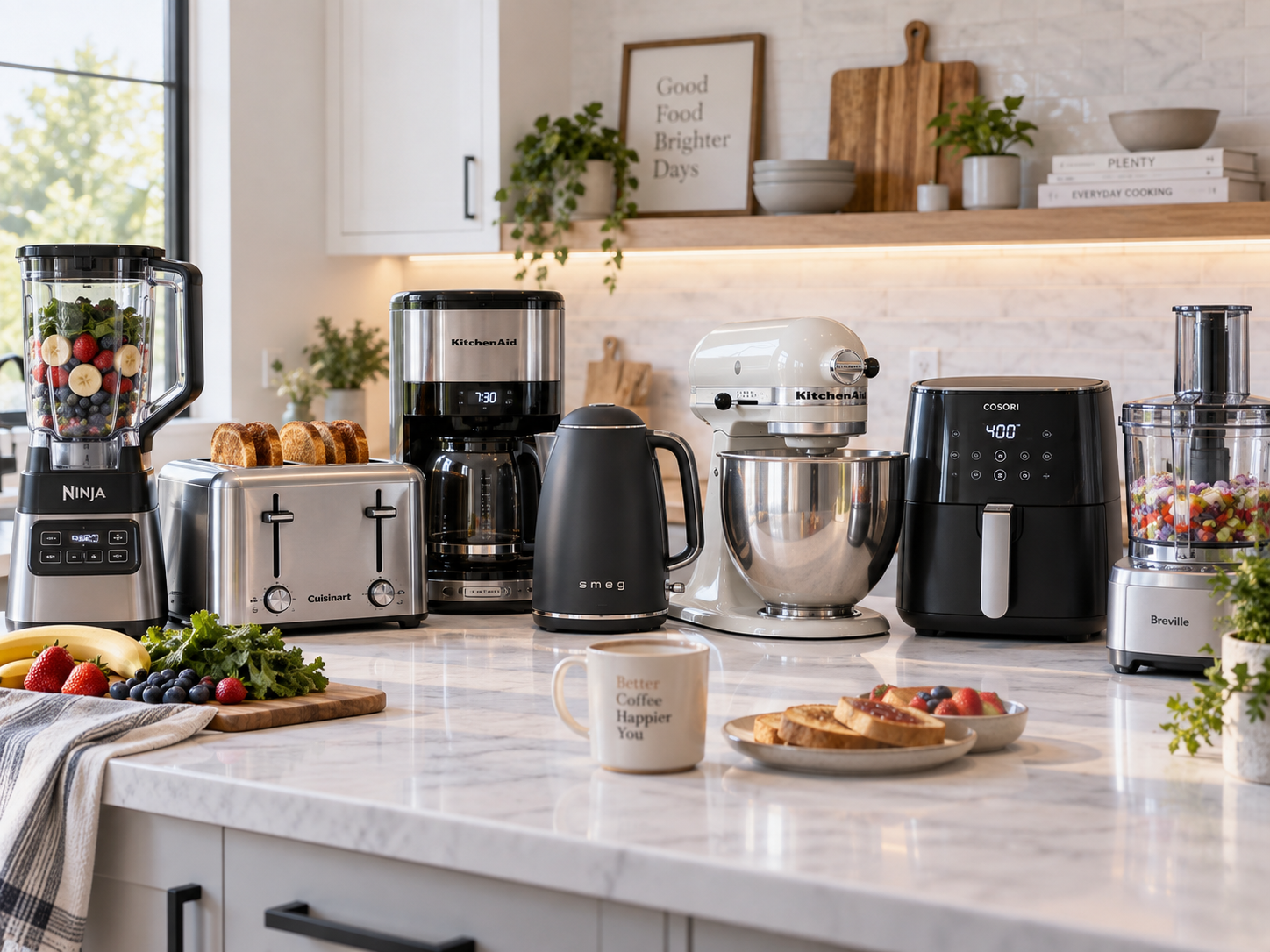
Small kitchen appliances are portable, plug-in machines used on a countertop or table to complete a single cooking, food preparation, or beverage task. They replace part of the work done by a range, oven, or hand tools.
Three things control how a small kitchen appliance performs: its power draw in watts, its capacity in quarts, cups, or cubic feet, and the mechanism inside it. Heating appliances use a resistance element or a magnetron. Food preparation appliances use an electric motor and a blade, beater, or disc. Both draw power from a standard 120-volt household outlet.
The category covers microwaves, toasters, toaster ovens, air fryers, blenders, food processors, stand mixers, coffee makers, electric kettles, rice cookers, and electric pressure cookers. The closest alternative is the major appliance group: refrigerators, ranges, wall ovens, and dishwashers, which are installed, larger, and often hardwired or on a dedicated circuit. The National Electrical Code uses the term “small appliance” for the kitchen receptacle circuits these portable units plug into.
This article defines small kitchen appliances, explains the code meaning of the term, compares them with major appliances, groups the main types, and covers sizes, operation, energy use, uses, outlet limits, labeling, and how to choose.
Small kitchen appliances are portable or semi-portable electric machines used on countertops or tables to perform one kitchen task, such as heating, mixing, blending, or brewing.
The defining features are portability and connection method. A small kitchen appliance sits on a work surface, plugs into a standard 120-volt receptacle, and can be unplugged and stored without tools or installation work. It is not fixed to cabinetry, plumbing, or a dedicated circuit.
The Association of Home Appliance Manufacturers, the North American trade group representing more than 150 appliance makers, divides home appliances into major, portable, and floor care categories. Countertop kitchen units fall under the portable group, which is why industry documents often call them portable appliances rather than small appliances.
For a homeowner, the practical test is simple: if the unit can be carried to a different outlet and used immediately, it is a small kitchen appliance.
In the National Electrical Code, “small appliance” describes the 20-ampere kitchen branch circuits that feed countertop receptacles, not the appliances themselves.
Section 210.52(B)(1) of the National Electrical Code requires that two or more 20-ampere small-appliance branch circuits serve all wall, floor, and countertop receptacle outlets in the kitchen, pantry, breakfast room, dining room, or similar area of a dwelling unit. The International Residential Code states the same requirement in Section E3703.2.
One exception matters in practice. The receptacle outlet for refrigeration equipment may be supplied from an individual branch circuit rated 15 amperes or greater.
This code language explains a common point of confusion. A countertop microwave is not officially listed as a “small appliance” by a federal agency. It is a load that a small-appliance branch circuit is designed to carry.
Small kitchen appliances are portable, plug into general kitchen receptacles, and handle one task. Major kitchen appliances are installed, often need dedicated circuits, and handle whole-meal or whole-kitchen functions.
The structural difference is installation. A range, wall oven, dishwasher, or built-in microwave is fastened in place and connected to plumbing, ventilation, or a dedicated circuit. A countertop unit is free-standing and uses a cord and plug.
The electrical difference follows from that. Countertop appliances share the two required 20-ampere small-appliance circuits with everything else on the counter. An electric range runs on a separate 240-volt circuit. The same product can change category: a portable countertop microwave is a small appliance, while an over-the-range or built-in model installed with a trim kit and its own circuit is treated as installed equipment.
The energy difference is measurable. Silicon Valley Power’s appliance energy chart lists an electric oven at 2.3 kWh per hour and a toaster oven at 0.75 kWh per hour. The Department of Energy’s Energy Saver guidance states that a toaster or convection oven uses one-third to one-half as much energy as a full-sized oven for small meals.
The practical consequence: for one or two portions, a countertop unit does the same job with less energy and no preheating of a large cavity.
Small kitchen appliances divide by mechanism into heating appliances, motor-driven preparation appliances, beverage appliances, and programmable multicookers.
For practical comparison, these options can be grouped into four sets based on what the appliance does to food: it heats, it cuts and mixes, it brews, or it combines heating with automatic control. This is a working grouping for buyers, not an official industry classification.
The sections below use the same fields for every group: definition, distinguishing feature, operating method, common application, relevant measurement, and main limitation.
Cooking and heating small appliances convert electricity into heat to cook, toast, reheat, or crisp food on the countertop.
This group includes microwaves, toasters, toaster ovens, air fryers, electric griddles, and waffle makers. The distinguishing feature is a heat source instead of a motor-driven blade. Toasters, toaster ovens, griddles, and air fryers use resistance heating elements; microwaves use a magnetron that heats water molecules in the food directly. Air fryers add a fan that moves hot air around a basket.
They are used for breakfast items, reheating, and small-batch meals. The relevant measurement is wattage, plus cubic feet for microwaves and quarts for air fryers. Home Depot lists the Farberware Classic countertop microwave at 1.1 cubic feet and 1,000 watts, and Lowe’s lists the Toshiba EM925A5A at 0.9 cubic feet and 900 watts. The Instant Pot Duo Crisp with air fryer lid is rated by Instant Brands at 1,500 watts on 120 volts.
The main limitation is power draw. This group holds the highest wattage in the category, so two heating appliances running at once on the same kitchen circuit is the most common cause of a tripped breaker.
Food preparation small appliances use an electric motor to cut, blend, mix, or grind ingredients before cooking.
This group includes blenders, food processors, stand mixers, hand mixers, coffee grinders, and juicers. The distinguishing feature is a motor driving a blade, disc, or beater rather than a heating element. The motor turns at a selected speed, and an attachment does the mechanical work: blades for blending and chopping, discs for slicing and shredding, beaters and hooks for batters and dough.
They are used for smoothies, sauces, chopped vegetables, doughs, and batters. The relevant measurements are motor wattage and bowl or jar capacity in quarts or cups, both printed on the nameplate or in the manual.
The main limitation is duty cycle rather than wattage. Motors in this group are rated for short runs, and manufacturer manuals set maximum continuous run times and maximum batch sizes. Exceeding them triggers thermal cutouts or shortens motor life.
Beverage small appliances heat water and pass it through coffee, tea, or espresso grounds, or simply boil water for drinks.
This group includes drip coffee makers, single-serve pod brewers, espresso machines, and electric kettles. The distinguishing feature is that water, not solid food, is the heated material. A heating element raises water temperature, and a pump or gravity feed moves the water through grounds or into a carafe.
They are used for daily coffee and tea and for boiling water faster than a stovetop. The relevant measurements are energy per brew and reservoir capacity. Silicon Valley Power lists a drip coffee maker at 0.12 kWh per brew, a single-serve coffee maker at 0.26 kWh per brew, and a coffee maker with the warming plate on at 0.4 kWh per hour.
The main limitation is standby heat. Keeping a warming plate on for hours costs more than the brew cycle itself, which is why the Department of Energy’s Energy Saver guidance recommends an electric kettle instead of running hot water for small amounts.
Multicookers combine a sealed pot, a heating element, and programmed controls to pressure cook, slow cook, steam, or sauté in one appliance.
This group includes electric pressure cookers, slow cookers, and rice cookers. The distinguishing feature is automatic control of time, temperature, and pressure. A heating element warms the inner pot, sensors track temperature and pressure, and the control board holds the selected program until the cycle ends.
They are used for beans, stews, rice, and batch meals. The relevant measurements are quart capacity and wattage, and they scale together. Instant Brands’ specification sheet lists the Instant Pot Duo at 700 watts for the 3-quart model, 1,000 watts for the 6-quart model, and 1,200 watts for the 8-quart model, all on 120 volts and 60 hertz.
The main limitation is sealing and venting. Pressure models depend on an intact gasket and a clear steam release, and the manufacturer specifies minimum liquid and maximum fill levels for each size.
Small kitchen appliance sizes are stated in cubic feet for microwaves, quarts for pots and air fryers, and cups or ounces for blenders and coffee makers.
Each unit uses the measurement that matches how it holds food. Microwave capacity is interior volume in cubic feet, so a 1.1-cubic-foot cavity fits a larger plate than a 0.9-cubic-foot cavity. Multicooker and air fryer capacity is the usable pot or basket volume in quarts. Blender jars and coffee carafes are rated in cups or ounces.
Exterior footprint is a separate number and is the one that decides whether the appliance fits. Home Depot lists the Frigidaire 1.1-cubic-foot countertop microwave at 20 inches wide, 14.8 inches deep, and 11.97 inches high. Standard kitchen base cabinets place wall cabinets about 18 inches above the counter, so height and depth, not volume, usually set the limit under upper cabinets.
The table below shows how capacity and rated wattage move together within one product line.
| Instant Pot Duo model | Capacity | Rated wattage | Voltage |
|---|---|---|---|
| Duo 3-quart | 3 quarts (2.8 liters) | 700 watts | 120 V, 60 Hz |
| Duo 6-quart | 6 quarts (5.7 liters) | 1,000 watts | 120 V, 60 Hz |
| Duo 8-quart | 8 quarts (7.6 liters) | 1,200 watts | 120 V, 60 Hz |
All three values come from the Instant Brands specification sheet, and they show that a larger pot requires more power to heat the same way, which raises the load on the kitchen circuit.
Every small kitchen appliance converts 120-volt household electricity into heat or motion, then uses a control to limit how much and how long.
Heating appliances pass current through a resistance element, which turns electrical energy into heat. A thermostat, timer, or thermal fuse stops the element at a set point. Microwaves work differently: a magnetron generates microwaves that agitate water molecules inside the food, so the food heats and the cavity air stays cool.
Motor-driven appliances send current to a motor that spins a shaft. Speed settings change the power delivered to the motor, and an attachment converts rotation into cutting, blending, or mixing.
One labeling detail affects expectations. A microwave advertised as 1,000 watts is stating cooking output power, while the power it draws from the outlet is higher. Nameplate input wattage, not the advertised cooking wattage, is the number to use when adding up what a circuit is carrying.
Countertop appliances draw high power for short periods, so energy per use stays low even when wattage is high.
Energy use is power multiplied by run time. A toaster draws over a kilowatt but runs for two minutes, so the total is small. An electric oven draws more and runs for an hour, so the total is large. That difference, not wattage alone, decides the cost of a task.
The table below lists measured energy per use from Silicon Valley Power’s appliance energy chart, with an electric oven included for scale.
| Appliance | Energy per use | Basis |
|---|---|---|
| Toaster (2 slices) | 0.04 kWh | Per use |
| Drip coffee maker | 0.12 kWh | Per brew |
| Microwave oven | 0.12 kWh | Per 5 minutes |
| Single-serve coffee maker | 0.26 kWh | Per brew |
| Coffee maker with warmer on | 0.4 kWh | Per hour |
| Toaster oven | 0.75 kWh | Per hour |
| Electric oven | 2.3 kWh | Per hour |
The pattern is consistent: short-cycle countertop tasks use a fraction of what an hour of full-size oven cooking uses, and the toaster oven figure of 0.75 kWh per hour is about one-third of the oven’s 2.3 kWh per hour.
Actual figures vary by model, batch size, and how long the appliance is left on, so the nameplate and the manual give the numbers for a specific unit.
Small kitchen appliances handle single tasks faster or cheaper than a range: reheating, toasting, small-batch cooking, chopping, mixing, and brewing.
The use follows the mechanism. Microwaves reheat cooked food and defrost. Toasters and toaster ovens brown bread and cook one or two portions. Air fryers crisp food with circulated hot air. Blenders and food processors cut prep time for sauces, soups, and chopped vegetables. Multicookers cook beans, rice, and stews unattended.
The Department of Energy’s Energy Saver guidance recommends using a microwave when possible and using small electric pans, toaster ovens, or convection ovens for small meals rather than a full-size stove or oven.
The practical effect is that the appliance choice changes both time and energy for the same dish. Heating one portion in a 0.75 kWh-per-hour toaster oven instead of a 2.3 kWh-per-hour electric oven reduces energy use for that task without changing the result.
Two 20-ampere kitchen circuits carry 2,400 watts each at 120 volts, so two high-wattage countertop appliances on one circuit can exceed that limit.
The math is direct. Watts equal volts times amps, so a 20-ampere, 120-volt circuit carries 2,400 watts and a 15-ampere circuit carries 1,800 watts. Running a 1,500-watt air fryer and a 1,200-watt multicooker at the same time on one 20-ampere circuit adds up to 2,700 watts, which is above the 2,400-watt limit and will trip the breaker.
Continuous loads have a lower ceiling. National Electrical Code Section 210.20(A) requires the overcurrent device to be rated at not less than 125 percent of a continuous load, which is a load running for three hours or more. That works out to 1,920 watts on a 20-ampere circuit and 1,440 watts on a 15-ampere circuit. Maximum capacity and recommended continuous capacity are different numbers.
Two more limits apply. Receptacles on a countertop circuit can be rated 15 or 20 amperes under Table 210.21(B)(3), so a standard-looking outlet does not prove the circuit rating behind it. Kitchen outlets in a house may also be shared with the dining room or pantry under Section 210.52(B)(1), so the load on a circuit is not always visible from one room.
The correct decision is to add the nameplate input wattage of appliances used at the same time, keep the total under the circuit rating, and put simultaneous high-wattage appliances on different circuits. Circuit changes and new outlets are work for a licensed electrician, and local amendments to the code can differ from the national text.
Countertop kitchen appliances carry no ENERGY STAR or EnergyGuide label, so wattage on the nameplate is the main energy figure available.
The ENERGY STAR residential appliance list covers air cleaners, clothes washers, clothes dryers, dehumidifiers, dishwashers, electric cooking products, freezers, and refrigerators. Toasters, blenders, coffee makers, and air fryers are not on it. The Federal Trade Commission’s Energy Labeling Rule in 16 CFR Part 305 requires EnergyGuide labels on products including refrigerators, freezers, room and portable air conditioners, clothes washers, dishwashers, ceiling fans, water heaters, and televisions, and countertop kitchen appliances are not covered products.
Safety certification works differently and does appear on these products. UL publishes UL 923 for microwave cooking appliances and UL 1026 for household electric cooking and food-serving appliances, and manufacturers list compliance on the nameplate. Instant Brands, for example, states that the Instant Pot Duo is UL and ULC listed at 1,000 watts and 120 volts for the 6-quart model.
The practical meaning: comparing two similar countertop appliances on efficiency is not possible from a standard label, so the useful checks are a certification mark, the nameplate wattage, and the capacity rating.
Choose by the task you repeat, then confirm capacity, exterior footprint, nameplate wattage against your kitchen circuits, and the certification mark.
Task frequency. A small appliance is worth counter space when it does a repeated task better than the range. Daily coffee, daily toast, or weekly batch cooking justifies a dedicated unit; a once-a-year task does not. The decision here is how many units stay on the counter versus stored in a cabinet.
Capacity. Capacity is rated in cubic feet for microwaves and quarts for pots and baskets. The Instant Pot Duo line runs from 3 to 8 quarts, and the 6-quart model is described by Instant Brands as suited to up to six servings. Match the rating to your usual batch size, because an oversized pot needs more power and more minimum liquid, while an undersized one forces a second batch.
Exterior footprint. Volume and footprint are separate numbers. The Frigidaire 1.1-cubic-foot microwave measures 20 inches wide, 14.8 inches deep, and 11.97 inches high, so measure counter depth and the clearance under wall cabinets before buying. Getting this wrong means the appliance does not fit even though the capacity is right.
Electrical load. Two 20-ampere kitchen circuits carry 2,400 watts each, and continuous loads over three hours are limited to 1,920 watts under Section 210.20(A). Add the nameplate input wattage of the appliances you run together, and split 1,500-watt units across circuits. Skipping this step produces repeated breaker trips, not a faulty appliance.
Certification and manual limits. Look for a recognized safety mark tied to standards such as UL 923 or UL 1026, then read the manual for maximum run time, fill levels, and required clearances. These limits vary by model and by manufacturer, and following them is what keeps the rated capacity and wattage meaningful in use.
